

Last Updated: November 16, 2026
Quick Summary
Yes, you need a waterproof duffel for fly fishing in wilderness settings, because a standard duffel soaks through at the seams and wets your dry layers. Look for a roll-top closure or airtight zipper with welded seams, then match capacity to trip length.
- Water-resistant fabric sheds light rain but soaks through under pressure or prolonged exposure.
- Roll-top closures and welded seams block water entirely, while a zippered storm flap only handles splash.
- Size a solo weeklong float trip at 70 to 90 liters and a day wade trip at 30 to 40 liters.
- A 100L bag is generally too big for solo trips and suits two people sharing basecamp gear.
- Rinse the bag with fresh water after muddy or saltwater trips and store it loose, not compressed.
Table of Contents
- Why Wet Gear Ends Wilderness Fly Fishing Trips Early
- Waterproof vs Water-Resistant: What the Ratings Actually Mean
- How to Choose the Best Waterproof Duffel Bag for River Travel
- When an Extra Large Waterproof Duffel Bag Makes Sense
- Is a Waterproof Duffel Bag 100L Too Big for Solo Trips?
- Packing a Waterproof Duffel Bag for Fishing: Waders, Fly Boxes, and Rod Storage
- Field Repair and Maintenance That Extend Bag Life
- Pick Your Capacity and Pack for the Next River Trip
- Frequently Asked Questions
Why Wet Gear Ends Wilderness Fly Fishing Trips Early
A soaked sleeping bag or waterlogged waders can end a backcountry trip faster than a cold front. This guide covers how waterproof duffel bags for wilderness fly fishing protect the gear that keeps you in the water, and where most buyers get the ratings wrong.
The problem is simple. River travel means spray, rain, and the occasional dunk. A standard duffel soaks through at the seams, and once your dry clothing is wet, you're done. Below, we'll show you exactly what separates a real waterproof duffel from a bag that only looks the part.
A waterproof duffel is a sealed gear bag built to keep contents dry through rain and splash. It differs from a water-resistant bag in one critical way: the closure and seams are designed to block water entirely, not just slow it down.
That distinction matters most for fly fishing, where waders, fly boxes, and a spare layer all need to stay dry in a wet environment.
Waterproof vs Water-Resistant: What the Ratings Actually Mean
Water-resistant means the fabric sheds light rain but will soak through under pressure or prolonged exposure. Waterproof means the bag is built with sealed seams and a closure designed to keep water out.
Most buyers never check the difference until it's too late. A bag labeled "water-resistant" is fine for a boat ride. It is not fine for a river crossing or a day of steady rain.
Roll-Top Closures, Airtight Zippers, and Welded Seams
The closure is where waterproofing lives or dies. A roll-top closure folds the fabric over itself and buckles down, creating a watertight seal with no zipper to leak. An airtight zipper uses a coated track that seals shut. Welded seams fuse the fabric together instead of stitching it, so there are no needle holes for water to find.
A common mistake is trusting a standard zipper with a storm flap. That setup handles splash, not submersion.
Fabric Choices: TPU-Coated, PVC, and Ripstop Nylon
Fabric decides durability as much as waterproofing. TPU-coated fabric stays flexible in cold weather and resists abrasion. PVC fabric is heavier and stiffer but tough. Ripstop nylon resists tearing and packs down small, though it usually needs a waterproof coating to earn the label.
For a bag headed into rock and brush, abrasion resistance should weigh as heavily as the waterproof rating. If you are also packing tackle inside the bag, the waterproof tackle box buying guide explains how seals and sizes hold up under the same conditions.
How to Choose the Best Waterproof Duffel Bag for River Travel
The best waterproof duffel bag for river travel balances three things: a real waterproof closure, a capacity that matches your trip length, and a carry system you can manage on a rough trail. Get the closure right first, then size the bag to your load.
Here is how to narrow it down:
- Closure: Roll-top or airtight zipper for anything beyond light rain
- Seams: Welded or sealed, never bare stitching
- Capacity: Match liters to trip length, not to how much gear you own
- Carry: Padded shoulder strap and grab handles for portages
- Access: A wide opening so you can reach gear without unpacking everything
If you are matching a rod to the trip, the guide to choosing the right fishing rod power helps you pair rod weight and line test with the fish you plan to chase.
When an Extra Large Waterproof Duffel Bag Makes Sense
Extra large means different things to different makers. Some brands call 90 liters extra large; others start at 120. Before you compare, check the liter rating on the maker's spec sheet, not the product name.
Here is a practical way to size it. These are starting points, not rules, check them against your own load and the maker's stated capacity:
- Day trip, wade fishing: 30 to 40 liters. Waders, boots, a rain layer, lunch, fly box.
- Weekend, truck or drift boat base: 50 to 70 liters. Adds a sleeping bag, pad, and spare clothes.
- Weeklong float or remote camp, solo: 70 to 90 liters. Adds tent, cook kit, food, and cold-weather layers.
- Two people sharing basecamp gear, or a paddling trip with bulky equipment: 90 to 120 liters.
Extra large makes sense when the bulk is real: a tent, a synthetic sleeping bag, a camp cook set, waders for two people, or cold-weather layers that do not compress. It also makes sense when the bag rides in a drift boat or on a raft and gets carried only short distances. In that case, volume matters more than carry comfort.
It does not make sense for a solo angler hiking in. A full 100L bag loaded with camp gear gets heavy fast, and a heavy duffel on a rough trail is the wrong tool.
Watch out: oversized bags invite overpacking. A 100L bag does not weigh 100L worth of gear until you fill it, and then you are carrying it. Buy for the trip you take most often, not the one you imagine.
If you are building out the small gear that rides inside the duffel, the tackle storage collection is a good place to look. For a full camp setup, the LTW Outdoor Gear Bundles collection is worth browsing.
Here are the capacity ranges the article gives as starting points for matching bag size to trip type.
| Trip type | Capacity | What it holds |
|---|---|---|
| Day trip, wade fishing | 30 to 40 liters | Waders, boots, rain layer, lunch, fly box |
| Weekend, truck or drift boat base | 50 to 70 liters | Adds sleeping bag, pad, spare clothes |
| Weeklong float or remote camp, solo | 70 to 90 liters | Adds tent, cook kit, food, cold-weather layers |
| Two people sharing basecamp gear | 90 to 120 liters | Tent, synthetic sleeping bag, cook set, waders for two |
Capacity
Is a Waterproof Duffel Bag 100L Too Big for Solo Trips?
A waterproof duffel bag 100L is generally too big for a solo fly fishing trip. That volume suits two people sharing basecamp gear or a paddling trip with bulky equipment. A solo angler usually does better in the 40 to 70 liter range.
The reason is weight and access. A full 100L bag gets heavy, and heavy bags get left in the truck. Size down and pack tighter.
For a waterproof duffel bag for fishing, the sweet spot for most solo river trips lands around 50 to 70 liters. That holds waders, boots, a rain layer, fly boxes, and a sleeping bag with room to spare.
Packing a Waterproof Duffel Bag for Fishing: Waders, Fly Boxes, and Rod Storage
Packing for a fly-fishing trip is not the same as packing for a weekend at a hotel.
Start with the wet side. Waders come off wet at the end of the day, and if they go in against your dry layers, everything gets damp by morning.
Watch out: gravel trapped in boot soles will abrade the inside of a coated duffel faster than anything else you carry. Rinse boots before they go in, or bag them.
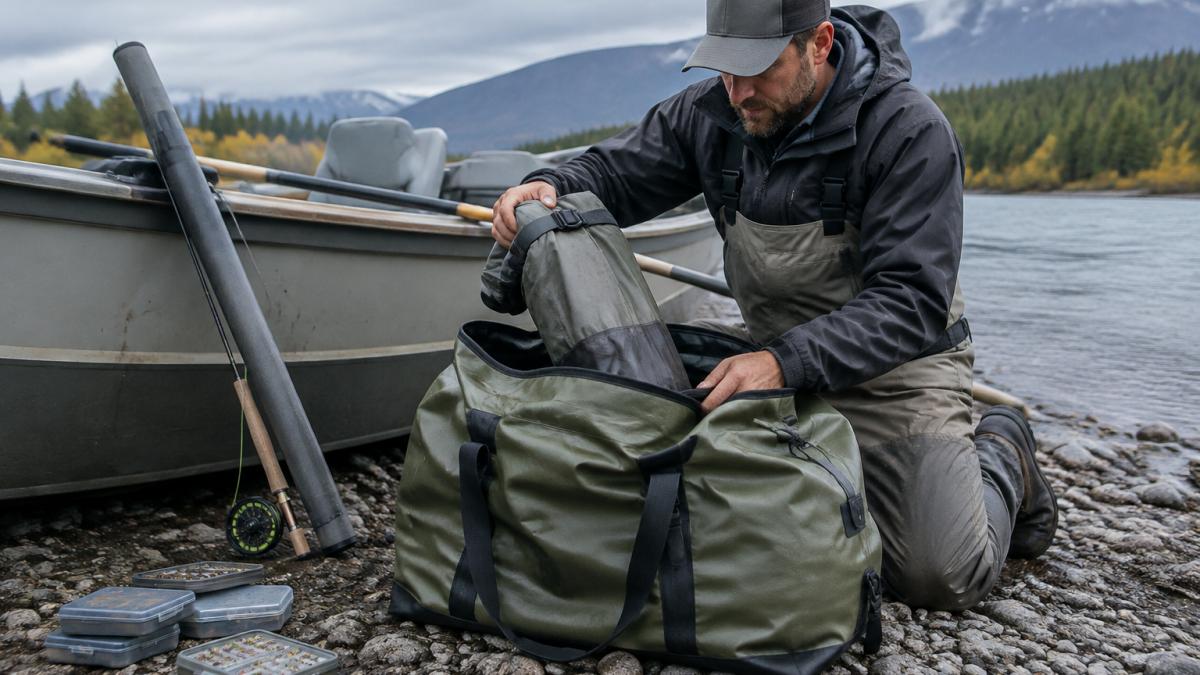
Fly boxes go in a hard case or a padded pouch near the closure, not loose at the bottom. If you carry a tackle storage pouch for tippet, nippers, and floatant, keep it in the same top layer so your fishing day kit comes out in one move.
Rod storage is the part most duffel guides skip. A 9-foot, 4-piece fly rod breaks down to a tube roughly 30 to 33 inches long, depending on the maker, check your own tube length against the bag's exterior dimensions before you buy.
A few habits that pay off on the water:
- Roll clothing instead of folding it, so you can see what you have without unpacking
- Keep a small dry bag inside for phone, keys, and license, the bag is waterproof, but a wet hand opening it in the rain is not
- Put the heaviest items at the bottom, closest to your hips when carried
- Leave the closure area for the day kit: fly box, tippet, nippers, water bottle
- Pack a spare layer at the top, not the bottom, because weather changes fast on mountain water
If you are still matching boots to waders, the guide to choosing mountain stream wading boots covers fit and sole choice. Stream anglers who want the right eye protection should read up on choosing polarized sunglasses for stream fishing.
Field Repair and Maintenance That Extend Bag Life
Rinse the bag with fresh water after saltwater or muddy trips, then dry it fully open before storage. Check the closure and seams for grit, and store the bag loose, not compressed.
Pick Your Capacity and Pack for the Next River Trip
Match capacity to trip length, confirm the closure is genuinely waterproof, and pack so the bag stays light enough to carry. That is the whole decision. Everything else is detail.
Leash the Wilderness sells fishing and camping gear, including tackle storage and bundles. Shipping runs 10 to 20 business days, and returns are accepted within 30 days. If you are planning a mountain-water trip, the list of essential trout fly patterns for mountain waters helps you fill the fly boxes before you pack. Browse the tackle storage lineup to sort out the small gear that rides inside the duffel.
The difference between a dry trip and a miserable one often comes down to one bag. Leash the Wilderness carries rugged fishing and camping gear chosen for rock, mud, salt, and weather, with bundled kits that save 20% and a 30-day return policy. Get started with Leash the Wilderness and pack for the next river trip with gear that holds up.
Frequently Asked Questions
Can a waterproof duffel protect fly-fishing gear from full submersion?
Only bags built for it. Check the maker's stated waterproof rating before relying on a bag around water. Zippered bags marketed as water-resistant are not submersible and will leak under pressure. Before any trip, check the maker's stated waterproof rating and test the bag at home with a paper towel inside. If the maker does not claim submersion protection, assume the bag handles rain and spray only.
What size waterproof duffel bag do you need for a multi-day fishing trip?
Match liters to trip length and how much bulk you carry. A weekend trip with one set of waders, boots, and a change of clothes usually fits in the 40-70L range. Trips of four days or more with camp gear, a sleeping bag, and spare layers push into 90-100L territory. Weigh your packed load before buying: a 100L bag loaded with wet waders and camp gear gets heavy fast, and you will carry it further than you expect on a wilderness fly fishing trip.
Are waterproof bags actually waterproof?
It depends on the closure and the seams. A true waterproof duffel uses welded or sealed seams and either a roll-top closure or an airtight zipper. Bags labeled water-resistant use coated fabric but standard zippers, so rain rolls off while standing water finds its way in. Read the maker's rating rather than the product name, and treat any bag without a sealed closure as weatherproof, not submersible.
How should you pack a duffel bag for a remote fly-fishing trip?
Keep wet and dry separated. Pack waders and boots in the main compartment or a separate dry bag, and put clothing, a sleeping bag, and electronics in their own waterproof sacks inside the duffel. Fly boxes go in a hard case or a padded pocket so they do not crush.
