

Table of Contents
- Why Standard Leashes Fall Short for Off-Trail Hunting
- Public Land Dog Leash Regulations You Need to Know
- Dog Leash Entanglement Risks in Dense Brush and Rugged Terrain
- Rugged Dog Harnesses for Trail Hiking and Hunting
- Hunting Dog Field Safety Gear: Beyond the Leash
- Emergency Recall Training for Off-Trail Environments
- Gear Maintenance for Off-Trail Conditions
- Conclusion
Last Updated: August 20, 2026
Why Standard Leashes Fall Short for Off-Trail Hunting
Standard leashes lack the attachment points, reinforced hardware, and snag-resistant design that rugged terrain demands. They catch on branches, fray under friction, and don't distribute force properly when your dog lunges or braces against obstacles. In wilderness settings where your dog's safety depends on reliable gear, these shortcomings matter.
Off-trail hunting presents unpredictable hazards, snags, water crossings, steep terrain, and wildlife encounters, that standard leashes were never engineered to handle. A leash designed for manicured parks becomes a liability that limits both your dog's ability to navigate safely and your ability to control them when it matters most.
Public Land Dog Leash Regulations You Need to Know
Federal and state regulations govern where dogs can run free and where they must remain leashed on public lands. The Forest Service and Bureau of Land Management (BLM) require dogs to be under control at all times. On developed recreation areas, campgrounds, and established trailheads, dogs must be leashed. In designated wilderness areas and backcountry zones, dogs are often permitted off-leash IF they're under voice control.
Voice control means your dog responds reliably to verbal commands to come, stay, and heel without hesitation. This is a legal requirement that protects wildlife, other visitors, and your dog. Many states also restrict dog access during certain seasons, turkey season often prohibits dogs entirely in some areas because they disrupt ground-nesting birds. Before you head out, check with your state fish and wildlife agency and the specific land management agency overseeing your hunting area.
Violating leash laws on public land results in citations, fines, or loss of hunting privileges. More importantly, an unleashed dog that interferes with other hunters or damages wildlife habitat creates conflict and can lead to restrictions affecting all hunters.
Dog Leash Entanglement Risks in Dense Brush and Rugged Terrain
Dense brush, fallen timber, and rocky outcrops create endless snag points. A standard leash catches on branches, wraps around dead trees, and gets wedged between rocks. When your dog pulls forward and the leash snags, panic sets in, your dog pulls harder, the leash tightens, and you have a trapped dog in terrain where you can't easily reach them.
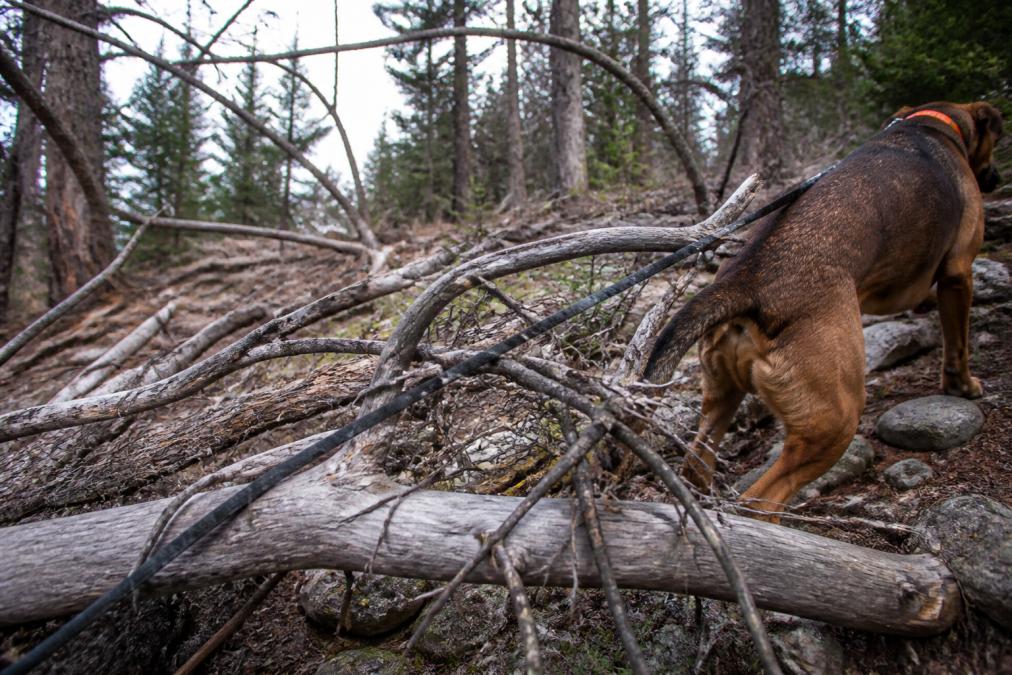
Friction damage is equally real. Standard leashes fray and weaken with constant contact against rough bark, sharp rocks, and abrasive terrain. A leash intact at mile two might be compromised by mile five. A frayed leash can snap under load, leaving your dog loose in an environment where they may not respond to voice commands under stress.
The more your dog struggles, the tighter the snag becomes. Unlike controlled environments where you can calmly work a leash free, you're managing a panicked dog, difficult terrain, and potentially poor visibility. Multi-use trails add another layer of risk, other hikers, horses, or hunters nearby create conflict and liability with a loose dog.
The solution is gear designed with snag prevention in mind: reinforced attachment points, materials that slide rather than catch, and hardware positioned to minimize snagging. Standard leashes have none of these features.
Rugged Dog Harnesses for Trail Hiking and Hunting
A rugged harness distributes force across your dog's chest and back, preventing neck strain and providing multiple control points when your dog encounters obstacles or needs guidance through difficult terrain.
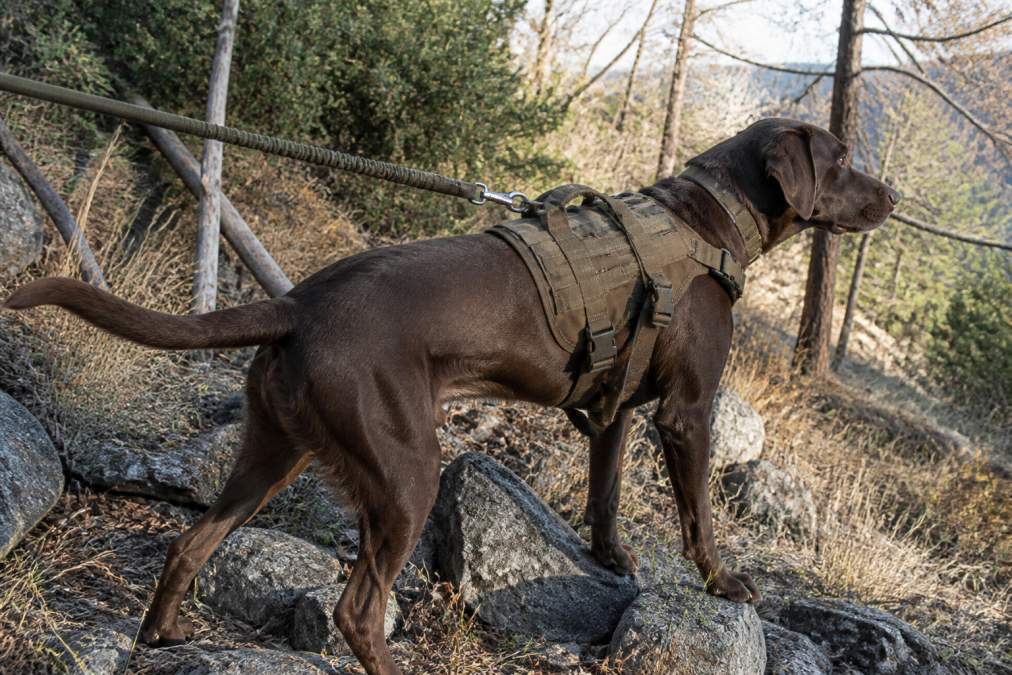
Quality harnesses designed for rugged terrain include multiple attachment points, a chest attachment for general control and a back attachment for situations where you need to guide or support your dog through difficult terrain. Reinforced stitching and heavy-duty webbing withstand constant friction and snagging. Padding in high-contact areas prevents chafing during long days in the field.
Material matters enormously. Harnesses made from ballistic nylon or similar technical fabrics resist tearing and abrasion far better than standard canvas or cotton. Hardware should be stainless steel or heavy-duty plastic that won't rust or create sharp edges that catch on brush.
Fit is critical. A harness that's too loose shifts and rotates, creating chafe points and reducing control. A harness that's too tight restricts breathing and movement. The best harnesses include adjustable straps at multiple points for a secure, comfortable fit.
For hunting environments, look for harnesses with handle attachments. A handle lets you stabilize your dog when crossing water, navigating steep terrain, or moving through dense brush. It's the difference between managing a situation and losing control in a critical moment.
Hunting Dog Field Safety Gear: Beyond the Leash
A field vest or pack protects your dog's chest and sides from brush and sharp vegetation while providing attachment points for emergency supplies, a small first aid kit, water access, or identification. Some dogs wear blaze orange vests in hunting season, improving visibility to other hunters and helping you locate your dog if separated.
Paw protection matters more than many hunters realize. Off-trail terrain is brutal on paws, sharp rocks, ice, thorns, and rough ground cut and bruise. Booties designed for rugged terrain protect against these hazards and prevent infections that can sideline your dog for weeks.
Hydration and nutrition are safety issues. A collapsible water bowl and high-calorie treats keep your dog fueled and hydrated during long days in the field. A dehydrated or depleted dog loses focus, makes poor decisions, and is more vulnerable to injury.
Emergency recall training transforms your dog from a liability into a reliable partner. In a high-stress hunting environment with wildlife nearby, unfamiliar terrain, and competing stimuli, your dog needs to respond instantly to recall commands even when instincts scream to chase or investigate.
A GPS collar or tracking device provides insurance. If your dog gets separated from you in dense terrain, a tracking device lets you locate them quickly rather than spending hours searching or losing them entirely.
Emergency Recall Training for Off-Trail Environments
Voice control on public land isn't just a regulation, it's a survival skill. Standard obedience training isn't enough. Your dog needs to respond reliably in high-distraction environments where natural instincts pull them in different directions.
Emergency recall training escalates through progressively challenging scenarios. Your dog learns to respond to recall commands with the same reliability indoors, in a park, on a busy trail, and in a wilderness setting with wildlife nearby. This requires consistent practice over months, not weeks.
The training process involves building a strong positive association with the recall command, practicing in increasingly distracting environments, using high-value rewards that matter more than competing stimuli, establishing clear boundaries that make compliance the better choice, and simulating hunting scenarios with controlled distractions.
Many hunters work with professional trainers who specialize in hunting dog preparation. A trainer can assess your dog's temperament, design a program specific to your hunting style, and identify gaps in reliability before you're miles from the truck.
Expect 6-12 months of consistent training before your dog is genuinely reliable in a high-stress wilderness environment. Dogs reliable in controlled settings often fail in the field because the stakes feel different and distractions are real, not simulated.
Gear Maintenance for Off-Trail Conditions
Rugged gear only stays reliable if you maintain it. Off-trail hunting creates harsh conditions, mud, water, sand, and constant friction against rough terrain. Gear that isn't maintained degrades quickly and becomes unreliable exactly when you need it most.
Leashes and harnesses should be inspected after every use. Check for fraying, torn stitching, cracked plastic, or corroded metal. Small damage gets worse fast in the field. A minor fray becomes a major tear under load.
After muddy or wet hunts, rinse gear with fresh water and let it dry completely before storing. Salt spray or mineral deposits can corrode metal hardware and weaken fabric. A soft brush removes caked mud. For stubborn residue, mild soap and water work fine.
Store gear in a cool, dry place. Coil leashes loosely rather than tightly, tight coiling creates weak points. Avoid storing gear in hot vehicles or direct sunlight for extended periods.
Replacement hardware is often available separately. If a buckle cracks or a D-ring breaks, you can replace just that component. Keep spare hardware on hand, especially for frequently used gear. A broken attachment point in the field is serious; a spare D-ring in your pack is a two-minute fix.
Before hunting season starts, do a complete inspection of all gear. Replace anything that's marginal. Mid-season, spot-check critical components. After season, clean everything thoroughly and store it properly.
Standard leashes for off-trail hunting create more problems than they solve. The physical demands of backcountry terrain, regulatory requirements for voice control and leash compliance, and genuine safety risks of entanglement and loss demand gear designed specifically for these conditions. A rugged harness, proper training, and field-tested equipment transform your dog from a liability into a reliable partner. Start with the right foundation, a harness that handles snags, attachment points that distribute force properly, and materials that survive rough terrain. Add emergency recall training so your dog responds reliably under pressure. Maintain your gear consistently so it performs when conditions matter most. At Leash the Wilderness, we understand that serious hunting requires serious equipment. The Dog Care Kit is built for exactly this purpose, gear that survives real-world abuse in brush, mud, and weather. Shop bundles designed for hunters and trail dogs, and get the reliability you need when the road ends and the real adventure starts.
Frequently Asked Questions
Are standard leashes safe for off-trail hunting?
Standard leashes are not ideal for off-trail hunting because they lack the durability and snag-resistant design needed for dense brush, rocky terrain, and multi-use trails. They fray, tangle easily, and can fail under stress. Specialized hunting dog harnesses with reinforced materials and secure attachment points are safer and more reliable in wilderness areas where your dog may encounter obstacles, water crossings, and unpredictable terrain.
What are the legal requirements for leashing dogs on public hunting lands?
Leash laws vary by federal land management agency and state wildlife management area. Most developed recreation areas require dogs to be on-leash at all times. Some wilderness areas permit voice control and off-leash hiking under specific conditions, but regulations differ. Check with the managing agency (Forest Service, Bureau of Land Management, state parks, or wildlife department) for your specific location. During hunting season, additional restrictions may apply to prevent conflicts with hunters and protect ground-nesting birds.
How can I prevent my dog's leash from tangling in the woods?
Use a leash made from snag-resistant, grippy-textured materials designed for rugged terrain rather than standard nylon or rope. Avoid long leashes that drag and catch on branches. Keep your dog close on multi-use trails and near portage areas. Choose a harness with a single, secure attachment point rather than multiple clips. Practice field training to improve recall reliability so your dog responds immediately to voice commands, reducing the need for constant leash tension and the risk of entanglement.
What features should a hunting dog harness have?
A quality hunting dog harness should have reinforced, durable materials that resist snagging in brush, multiple secure attachment points for different situations, and a grippy texture for wet conditions. Look for padding to distribute weight evenly and reduce joint stress during off-trail navigation. The harness should allow full range of motion for climbing and swimming while keeping your dog secure. Adjustable straps ensure a snug fit that won't slip during vigorous activity in wilderness areas.
This article was written using GrandRanker