

Table of Contents
- Top Rated Hunting Gear for 2026: Quick Comparison
- How We Selected the Best Hunting Gear
- Best Hunting Boots 2026: Foundation for Every Hunt
- Hunting Apparel Trends 2026: Layering Systems That Work
- Hunting Optics 2026: See Your Target in Any Condition
- Essential Hunting Accessories: The Gear That Saves Hunts
- Budget-Friendly Hunting Gear Without Compromise
- DIY Gear Maintenance: Extend the Life of Your Equipment
Last Updated: July 23, 2026
Top Rated Hunting Gear for 2026: Quick Comparison
Finding top rated hunting gear for 2026 means understanding which essentials survive in the field versus which ones fail when conditions turn brutal. At Leash the Wilderness, we hand-pick every item in our catalog because it's proven itself in real-world conditions: mud, cold, salt spray, and the abuse that separates gear that works from gear that breaks. This guide covers boots that keep your feet dry and warm, layering systems that don't fail when temperature swings hit, optics that cut through darkness, and accessories that turn a rough hunt into a successful one.
| Category | Top Pick | Best For | Key Feature |
|---|---|---|---|
| Hunting Boots | Waterproof Leather Military-Grade Boots | All-terrain hunting | Indestructible construction, waterproof |
| Winter Sleeping | Kamperbox Cold Temperature Down Sleeping Bag | Extended winter hunts | Premium down insulation, extreme cold rated |
| Thermal Optics | PARD Pantera 256 Thermal Scope | Nighttime hunting advantage | 256-resolution thermal imaging, WiFi enabled |
| Night Vision | 4K Night Vision Telescope | Low-light scouting | 1000ft range, 4K UHD digital |
| Camp Lighting | LED Camping Lantern | Base camp operations | Dimming control, Type-C rechargeable |
| Tackle Organization | Portable Lure Tackle Box | Gear management | Removable compartments, compact design |
| Terminal Tackle | Brass Barrel Fishing Swivels 50-Pack | Preventing line twist | Interlock snaps, multiple sizes |
How We Selected the Best Hunting Gear
The difference between field-tested gear and marketing hype comes down to one thing: does it work when you're miles from the truck with no backup plan? We evaluate what survives repeated abuse in actual hunting conditions, temperature extremes, moisture exposure, impact damage, and wear that separates premium gear from budget alternatives.
Every item in this guide has been vetted for durability, functionality, and real-world performance. The categories below cover essentials that directly impact hunt success: your foundation (boots), your insulation (layering and sleeping systems), your ability to locate targets (optics), and your operational efficiency (accessories).
Best Hunting Boots 2026: Foundation for Every Hunt
Your feet determine how far you can go and how effectively you can hunt. A day in wet, cold boots destroys your ability to move quietly, stay warm, and make good decisions when the moment comes.
The Waterproof Leather Military-Grade Boots combine waterproof protection with construction that doesn't fail. Military-grade leather resists puncture and abrasion from brush and rocks. The waterproof treatment keeps moisture out during stream crossings and wet brush work, maintaining insulation when it matters most.
What separates these boots from casual footwear: the sole holds up under rocky terrain without separating, the heel counter resists collapse on steep descents, and the leather doesn't crack from temperature swings. Hunters report these boots lasting multiple seasons of hard use.
Setup requires minimal break-in. Most hunters report full comfort after 2-3 days of wearing them during regular activities. The ankle support prevents rolling that causes injuries on uneven ground.
Hunting Apparel Trends 2026: Layering Systems That Work
The core principle of hunting clothing is moisture management and insulation. A proper system starts with a base layer that wicks moisture away from your skin, a middle layer for insulation (fleece or synthetic), and an outer shell that blocks wind and precipitation.
The mistake most hunters make is treating each layer as independent. They work together, a premium base layer that fails to dry quickly will undermine even the best insulation layer above it. Hunting apparel trends for 2026 emphasize packability. You should compress your insulation layer small enough to fit in a day pack without interfering with rifle handling or binocular access.
Synthetic insulation has closed the gap with down in cold-weather performance while maintaining better moisture resistance, a critical advantage when moving through snow or wet brush. Your layering system should allow adjustment without removing your outer shell.
Winter Sleeping Systems for Extended Hunts
Extended hunts in cold conditions require a sleeping system that doesn't compromise. The [Kamperbox Cold Temperature Winter Sleeping Bag Down Sleeping Bag](https://leashthewilderness.com/products/kamperbox-cold-temperature-winter-sleeping-bag-down-sleeping-bag-winter-camping-equipment) is built specifically for freezing temperatures where margin for error is zero.
Premium down insulation compresses better than synthetic alternatives, allowing you to pack a cold-rated bag without sacrificing pack space. The key metric is temperature rating, this bag maintains insulation well below freezing, providing the comfort buffer that lets you sleep and recover.
Down's primary weakness is moisture sensitivity. When wet, it loses insulation value dramatically. This matters less in winter hunting because humidity is typically low and your tent protects from moisture. However, you still need to manage condensation from your breath and ventilate appropriately.
Box-stitch or baffle-box construction prevents down from shifting and creating cold spots. A sleeping pad is non-negotiable with this bag, as insulation underneath you compresses under body weight. A quality cold-rated pad provides the barrier that prevents ground cold from draining body heat.
Hunting Optics 2026: See Your Target in Any Condition
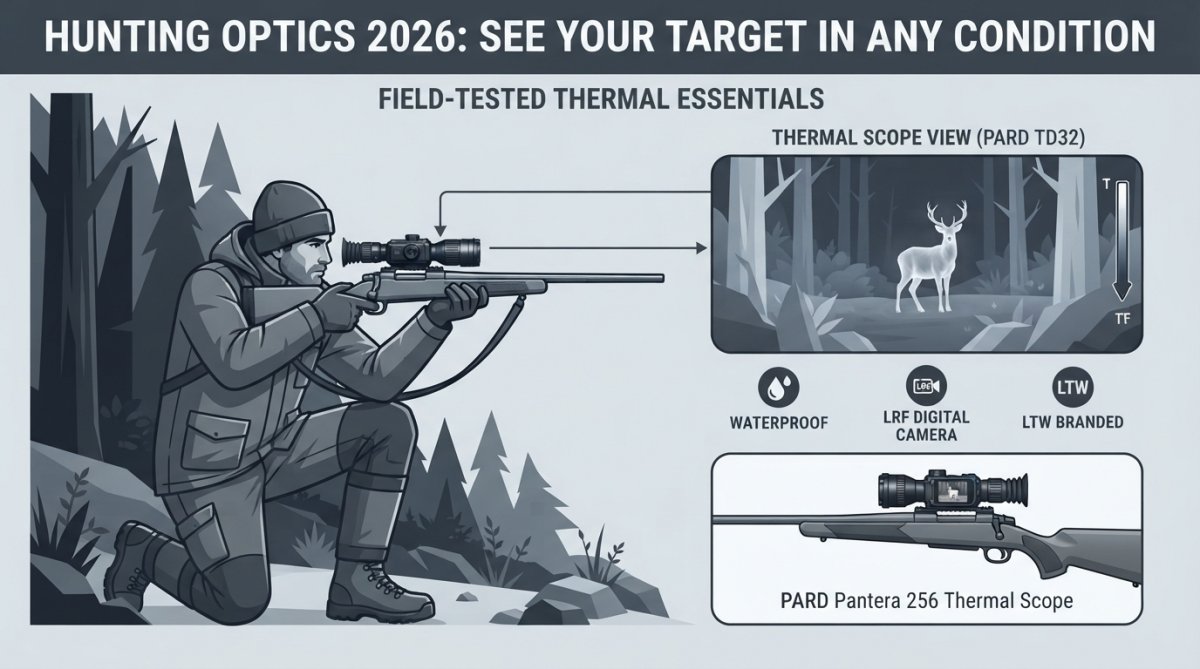
Optics determine whether you can locate, identify, and engage your target effectively. The evolution of hunting optics in 2026 has shifted toward thermal imaging and night vision as practical tools rather than premium additions.
Traditional binoculars and spotting scopes remain essential for daylight glassing. Quality optics provide brightness and clarity in low-light conditions during dawn and dusk when most hunting happens. However, thermal and night vision optics have become practical enough that serious hunters integrate them into their standard loadout.
Thermal Imaging for Nighttime Advantage
The [PARD Pantera 256 Thermal Scope](https://leashthewilderness.com/products/pard-pantera-256-q-thermal-lmaging-scope-sensor-256-wifi-for-hunting-camera) delivers practical thermal imaging advantage without extreme cost. Thermal imaging detects heat signatures, allowing you to locate warm-blooded game in complete darkness or through light obscuration like fog or smoke.
The 256-resolution sensor provides enough detail to identify game species and estimate distance to target. WiFi connectivity allows you to stream the image to a phone for scouting or to verify targets before committing to a shot. Thermal imaging's primary advantage is that it works in any light condition, total darkness, bright moonlight, or daylight. It's not affected by ambient light the way night vision is. The tradeoff is higher cost and battery management. Most thermal units run 4-8 hours on a charge, adequate for a hunt but requiring planning.
Night Vision for Low-Light Scouting
The 4K Night Vision Telescope delivers 1000-foot range with 4K resolution for low-light scouting. Night vision amplifies available light, moonlight, starlight, or distant light sources, and displays it in a visible spectrum.
Night vision's advantage is that it preserves detail and color information. You can see terrain features, identify vegetation, and distinguish game species more clearly than with thermal. The disadvantage is that night vision requires some ambient light to function. On moonless nights or in deep forest, effectiveness decreases.
The 1000-foot range lets you scout from a distance without disturbing game or leaving human scent. The rechargeable battery system eliminates constant battery replacement, though you must manage charging before hunts. Digital night vision has advantages over traditional image-intensifier tubes: no burn-in risk from bright light exposure, better low-light performance, and the ability to record what you're viewing.
Essential Hunting Accessories: The Gear That Saves Hunts
Accessories directly impact your ability to manage gear, maintain visibility in camp, and keep equipment functional.
Tackle Organization and Camp Lighting
The [Portable Lure Tackle Box](https://leashthewilderness.com/products/portable-lure-tackle-box-removable-plastic-fishing-tackle-box) solves the problem of managing small items in the field. Removable compartments allow you to organize by category, terminal tackle in one section, repair items in another, small tools in a third. The compact design fits in a day pack without creating bulk. The plastic construction resists damage from moisture and impact.
The LED Camping Lantern provides reliable light when the sun goes down. Dimming control lets you adjust brightness based on task, full brightness for setting up camp, lower brightness for evening activities that shouldn't broadcast your location. Type-C charging means you can power it from the same battery pack that charges other devices. Camp lighting prevents mistakes that happen in darkness and serves as a backup if your primary headlamp fails.
Terminal Tackle and Fishing Integration
The Brass Barrel Fishing Swivels with Interlock Snaps 50-Pack prevents line twist that occurs when retrieving lures or fighting fish. Line twist creates weak points that fail under load. The interlock snap design allows you to change lures quickly without retying. The brass construction resists corrosion better than steel alternatives, extending the swivel's lifespan. A 50-pack provides backups and supply for an entire season.
Budget-Friendly Hunting Gear Without Compromise
Building a complete hunting setup doesn't require extreme spending on each category. Invest in items that directly impact hunt success: boots (your feet determine how far you can go), optics (you can't take what you can't see), and insulation and weatherproofing (failed gear in cold conditions creates safety risk).
Items that don't require premium pricing include basic camp lighting, tackle organization, and many accessories. A functional lantern costs a fraction of premium alternatives and provides the same core benefit. A practical tackle box solves the organization problem without luxury features.
Leash the Wilderness offers bundled kits that combine essential items at a discount compared to buying individually. Most hunters find that starting with a bundle then adding specialized items based on their specific game and conditions is more efficient than building piecemeal.
DIY Gear Maintenance: Extend the Life of Your Equipment
Gear maintenance determines whether your investment lasts one season or multiple seasons. Basic maintenance tasks take minimal time and prevent failures that force mid-hunt replacements.
Boots require conditioning every 3-4 months during active use. Leather conditioner replenishes oils that weathering removes, preventing cracking. Wet boots should dry at room temperature, never near direct heat.
Optics require lens cleaning after each use. Use a soft brush to remove dust and debris before wiping with a lens cloth. Never wipe dry optics with a cloth, you'll scratch the lens coating. A few drops of lens cleaning solution on the cloth, then gentle circular wiping, removes moisture and residue without damage.
Sleeping bags should be stored uncompressed during off-season. Compression degrades insulation over time. Hang your bag in a closet or store it loosely in a large storage bag. Spot-clean stains rather than full washing when possible. When full washing is necessary, use cold water and down-specific detergent.
Tackle boxes benefit from occasional drying. After wet trips, open all compartments and allow them to air dry completely before closing. This prevents mold growth and corrosion of metal components.
Lanterns and rechargeable devices should be stored with batteries at 50% charge during off-season to extend battery lifespan.
The challenge with hunting gear selection isn't finding options, it's identifying which ones actually perform when conditions turn brutal. Leash the Wilderness specializes in gear that survives real-world abuse: waterproof boots that don't fail, insulation systems that maintain warmth in extreme cold, optics that cut through darkness, and accessories that keep your camp running efficiently. Every item in our catalog is hand-picked because it's proven itself in the field. Shop all bundles and build a complete system with savings compared to buying individually.
Frequently Asked Questions
What hunting gear is essential for beginners in 2026?
Start with the fundamentals: reliable hunting boots, a quality layered apparel system, and optics suited to your game type. Waterproof leather boots provide durability and comfort. A winter sleeping bag rated for your climate ensures safety during extended hunts. Add a basic optic like the PARD Pantera 256 thermal scope for versatility across seasons. Build from there based on your specific hunting style, waterfowl, upland, or big game each have slightly different accessory priorities.
How do I choose the right hunting gear for different seasons and terrains?
Match your gear to three variables: temperature range, terrain type, and hunting duration. For cold-weather hunts, invest in insulated layers and a premium down sleeping bag like the Kamperbox model. Waterproof boots handle muddy or wet terrain year-round. Optics selection depends on light conditions, thermal imaging excels in darkness, while standard scopes work in daylight. Accessories like portable tackle boxes organize gear efficiently. The key is layering systems that let you adjust without switching entire outfits.
What are the best budget-friendly hunting gear options for 2026?
Prioritize core gear with the highest impact-to-cost ratio. Quality boots ($119.99) prevent foot failure, the most common hunt-ending problem. LED camping lanterns ($41.99) deliver reliable light without battery drain. Fishing reels and rods ($55.99-$61.99) handle multi-purpose hunting and fishing trips. Swivels and tackle boxes ($16.99-$39.99) organize terminal tackle efficiently. Bundle these essentials rather than buying premium versions of every category. Leash the Wilderness bundles save 20%, making field-tested gear more accessible.
Why should I upgrade my hunting gear if I already own working equipment?
Field-tested gear differs from standard retail equipment, it's built to survive real-world abuse in rock, mud, salt, and brutal weather, not just marketing claims. Older optics lack modern thermal or night-vision capabilities that give genuine hunting advantages. Boots that worked five years ago may lack waterproof technology or support innovations. Apparel layering systems have evolved to balance breathability, insulation, and weight better. Upgrading specific categories, starting with optics or boots, compounds your success rate without replacing your entire setup.
How fast can I get hunting gear if I have an upcoming trip?
Leash the Wilderness ships from the US with fast domestic turnaround, so you can plan around your hunt schedule. A 30-day return policy means if gear doesn't perform as expected, you have time to swap it. Build your kit 2-3 weeks before departure to allow for delivery and any adjustments. Bundled kits arrive pre-assembled, saving setup time. For last-minute needs, contact support, field-tested gear designed for real conditions means less troubleshooting once you're in the field.
This article was written using GrandRanker