

Table of Contents
- Spinning vs Baitcasting Reels for Beginners: The Core Difference
- Quick Comparison: Spinning vs Baitcasting at a Glance
- Why Spinning Reels Are the Standard for New Anglers
- What Baitcasting Reels Do Better (and Where They Struggle)
- How to Cast a Baitcaster for Beginners: Taming the Backlash
- Spinning Reel Maintenance Tips to Avoid Costly Repairs
- Matching the Reel to Your Target Species and Budget
- Common Beginner Mistakes and How to Avoid Them
- Frequently Asked Questions
Last Updated: September 4, 2026
Spinning vs Baitcasting Reels for Beginners: The Core Difference
The choice between spinning vs baitcasting reels is mechanical, not a matter of skill or brand loyalty. A spinning reel hangs below the rod with an open face and fixed spool, letting line peel off naturally. A baitcaster sits on top with a rotating spool that must spin faster than the lure falls, or the line tangles into a backlash.
For beginners, this design distinction changes how you cast, what lures you can throw, and how much time you spend untangling line.
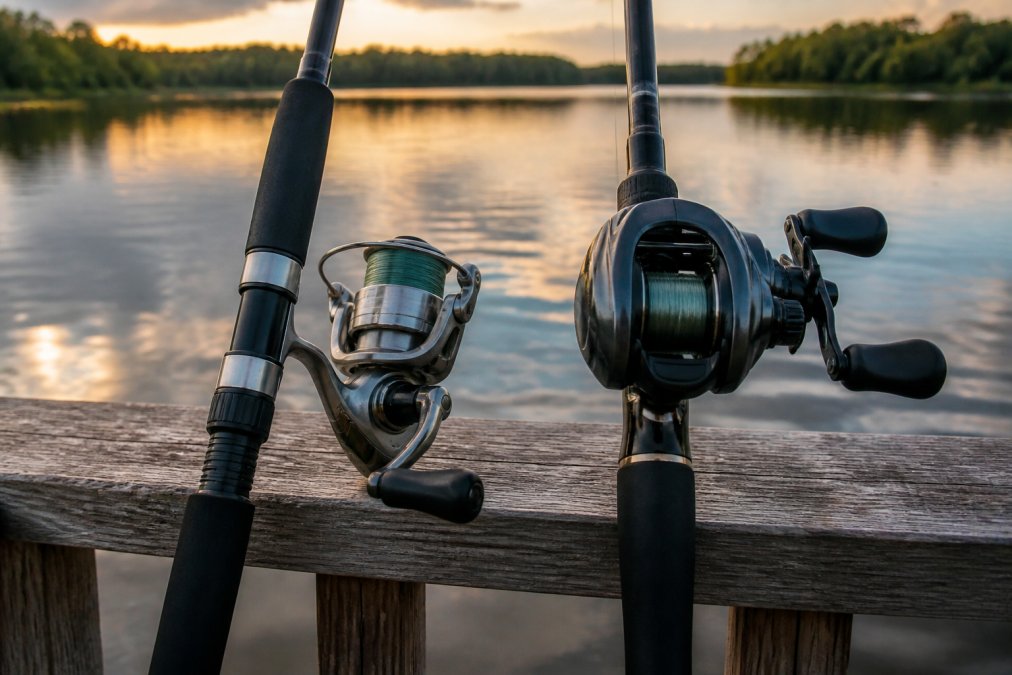
Quick Comparison: Spinning vs Baitcasting at a Glance
Spinning reels are easier to learn, handle light lures better, and rarely backlash. Baitcasters offer more accuracy and power with heavier lines and lures, but they demand practice and constant thumb control.
| Feature | Spinning Reel | Baitcasting Reel |
|---|---|---|
| Learning curve | Gentle, forgiving | Steep, frustrating at first |
| Backlash risk | Low | High without brake tuning |
| Best lure weight | Light to medium (1/16 to 3/8 oz) | Medium to heavy (1/4 oz and up) |
| Casting accuracy | Good | Excellent once mastered |
| Line management | Line twist possible | Backlash is the main enemy |
| Typical gear ratio | 5.2:1 | 6.3:1 to 7.2:1 |
| Best for beginners | Yes, start here | Only with patience and practice |
Gear ratio matters: a 5.2:1 spinning reel gives solid cranking power for steady retrieves, while a 7.2:1 baitcaster retrieves line faster for topwater lures or fast fish.

Why Spinning Reels Are the Standard for New Anglers
Spinning reels dominate the beginner market because they work. You open the bail arm, hold the line with your finger, and cast. The line flows off the fixed spool without needing to outrun the lure, so backlash barely exists.
A spinning setup also handles light lures and finesse fishing far better. When throwing small jigs, drop shots, or trout spinners under 1/4 ounce, the fixed spool lets those offerings fly naturally. Baitcasters struggle with light lures because the spool needs momentum to keep up.
For a durable first reel, the OKUMA AC Series Spinning Reel brings a metal body and CNC-machined spool that resists line twist and tangles. With 12kg of max drag, it handles bass, pike, catfish, and inshore saltwater species. Available in six sizes from 2000 to 7000, you can match it to nearly any rod and target species.

Shop the OKUMA AC Series Spinning Reel ->
What Baitcasting Reels Do Better (and Where They Struggle)
Baitcasters earn their keep when you need power and precision. The rotating spool sits in line with the rod guides, so line feeds straight through with less friction, translating to longer casts, better accuracy, and enough torque to turn big fish away from heavy cover.
The struggle is real, though. Every cast requires your thumb to control spool speed, and the reel needs tuning through spool tension and brake systems. Cast into the wind or forget to thumb the spool, and you will pick out a bird's nest.
Most beginners who buy a baitcaster first end up frustrated. The learning curve is steep, and mistakes punish you with lost fishing time. That said, if you are committed to power fishing with heavy jigs, frogs, or swimbaits, a baitcaster is the right tool.
The SAMOLLA Baitcasting Reel offers a 7.2:1 gear ratio for fast retrieval and the control experienced anglers want when flipping jigs or working crankbaits. Pair it with the Sougayilang Baitcasting Rod & Reel Combo, which comes pre-spooled with 10 magnetic brakes and 7KG of drag, so you can start practicing the day it arrives.

Shop the SAMOLLA Baitcasting Reel ->
Shop the Sougayilang Baitcasting Rod & Reel Combo ->
How to Cast a Baitcaster for Beginners: Taming the Backlash
Learning how to cast a baitcaster for beginners starts with accepting that you will backlash. Every angler who uses these reels has picked out a nest. The goal is to minimize how often it happens and fix it fast when it does.
Setting the Brakes and Spool Tension
Before your first cast, dial in the reel. Start with the magnetic or centrifugal brake system set high, around 75 to 80 percent of maximum. Tighten the spool tension knob until a lure barely falls under its own weight when you release the spool with the rod tip pointed up.
The Mechanics of a Backlash-Free Cast
A backlash happens when the spool spins faster than the line can exit the rod guides, creating slack line that the spool wraps over itself. To prevent it, match spool speed to lure speed. Here is the sequence most instructors teach:
- Start with the rod tip at 10 o'clock. This gives the lure a natural pendulum path.
- Begin the cast with a smooth acceleration, not a violent snap. Jerky motions cause the spool to overrun.
- Keep your thumb on the spool for the first 2 feet of the cast. This is the moment when the spool is most likely to overrun, as the lure is accelerating.
- As the lure reaches peak velocity, ease off the thumb pressure. You want the spool to spin freely but not wobble.
- Just before the lure hits the water, press your thumb down firmly. This stops the spool and prevents the line from going slack.
The 5-Minute Bird's Nest Rescue Drill
Even with perfect technique, you will eventually get a backlash. The worst thing you can do is start yanking on the line. Here is the step-by-step rescue most experienced anglers use:
- Disengage the spool and walk backward to take all slack out of the line.
- Look for the loop that is buried deepest in the spool. This is the "core" of the nest.
- Use a toothpick or a specialized line picker to gently lift that core loop. Do not use a knife or scissors.
- Pull that single loop free. Often, this releases the tension on the entire nest.
- Once the core loop is out, gently pull line off the spool in 5-yard increments until you find the end of the tangle.
- If the line is deeply embedded, do not force it. Cut the line above the spool, strip off the tangled section, and re-tie your lure. It is faster than fighting a 15-minute nest.
Why Line Twist Is a Baitcaster Problem Too
Beginners often think line twist is only a spinning reel issue. On a baitcaster, a common mistake is reeling against the drag. When a fish runs, the spool is stationary, but the handle is turning. If you keep cranking, you are twisting the line. Always pause your retrieve when a fish is pulling line against the drag.
When to Upgrade Your Practice
Once you can cast 30 feet without a backlash 9 out of 10 times, start introducing variables. Cast into a light wind, then try a heavier lure, then a lighter one. Each change forces you to adjust your thumb. This progression turns a frustrated beginner into a competent baitcaster angler in about three practice sessions.
Shop the SAMOLLA Baitcasting Reel ->
Shop the Sougayilang Baitcasting Rod & Reel Combo ->
Spinning Reel Maintenance Tips to Avoid Costly Repairs
Spinning reels are workhorses, but they still need care. The most common failure point is the drag system seizing up after a season in the salt or a dunk in the mud. Rinse your reel with fresh water after every trip, especially in saltwater, then dry it with a soft cloth.
A few routine steps keep your reel spinning smooth:
- Remove the spool and wipe down the rotor and bail arm after each outing
- Apply a light coat of reel oil to the bail arm hinge and roller
- Grease the main gear once per season or after heavy use
- Check the anti-reverse switch and drag knob for smooth operation before each trip
Many anglers skip these steps and pay for it later. A well-maintained spinning reel lasts for years, while a neglected one develops grinding gears and a sticky drag right when you hook a big fish. Even rugged gear needs basic care to perform at its best.
Matching the Reel to Your Target Species and Budget
Your target species should drive the spinning vs baitcasting decision more than any other factor. Beginners often buy a reel in isolation, only to discover they need a different rod, heavier line, or a new lure assortment to make it work.
Species-Specific Setup Guide
| Target Species | Reel Type | Size Range | Best Line | Rod Power & Action |
|---|---|---|---|---|
| Panfish, trout | Spinning | 1000-2500 | 4-8 lb monofilament | Light power, fast action (6 ft) |
| Bass (finesse) | Spinning | 2500-3000 | 8-12 lb fluorocarbon | Medium-light to medium power, fast action (6'6"-7 ft) |
| Bass (power fishing) | Baitcasting | 150-200 size | 12-20 lb fluorocarbon | Medium-heavy power, fast action (7 ft) |
| Catfish, pike | Baitcasting or large spinning | 4000-7000 | 20-30 lb braided line | Medium-heavy to heavy power, moderate-fast action (7'6"+) |
| Inshore saltwater | Spinning | 4000-6000 | 20-40 lb braided line | Medium-heavy power, fast action (7'6"-8 ft) |
The Real Cost of a First Setup
Most guides compare reels in isolation, but you cannot fish with just a reel. Here is what a complete spinning setup versus a baitcasting setup typically includes.
A complete spinning setup for panfish or bass finesse fishing:
- A 2500-size spinning reel
- A 6'6" medium-light power rod
- 150 yards of 8 lb monofilament or fluorocarbon line
- A small assortment of jig heads and soft plastics (1/16 to 1/8 oz)
A complete baitcasting setup for bass power fishing:
- A 150-size baitcasting reel
- A 7' medium-heavy power rod
- 150 yards of 15 lb fluorocarbon line
- A few 3/8 oz spinnerbaits or crankbaits
What You Actually Need for Each Species
Panfish and Trout (Bluegill, Crappie, Rainbow Trout): A 1000 to 2500 size spinning reel spooled with 4 to 6 lb test is the standard. You are casting tiny 1/32 to 1/16 oz jigs and small spinners. A baitcaster simply cannot cast these light lures effectively.
Largemouth Bass (Finesse vs. Power): If you are throwing a drop shot, a wacky rig, or a Ned rig, a 2500-size spinning reel with 8 to 10 lb fluorocarbon is the right tool. If you are flipping a 1/2 oz jig into heavy cover or burning a lipless crankbait, a 150-size baitcaster with 15 to 20 lb line gives you the torque to turn a fish's head. Many bass anglers carry both setups on deck.
Catfish and Pike: These fish are not lure-shy about weight. A 4000 to 7000 size spinning reel or a large baitcaster both work. The key is line capacity and drag. For catfish on the bottom, a spinning reel with 20 lb braid is simple and effective. For pike in weedy bays, a baitcaster with 30 lb braid lets you cast heavy spoons and retrieve them fast.
Inshore Saltwater (Redfish, Speckled Trout, Flounder): Saltwater demands corrosion resistance (noaa.gov). A 4000 to 6000 size spinning reel with a sealed drag is the most beginner-friendly option. Baitcasters in saltwater require more maintenance because braking systems and bearings are exposed to sand and salt. Start with a spinning reel for inshore work.
Budget-Conscious Starter Kits
If you are just starting out, you do not need the most expensive gear. A quality spinning reel paired with a light power rod covers 80 percent of freshwater species. To keep your first investment low, consider a pre-assembled kit. The 187pc Ultimate Fishing Kit gives you a wide assortment of terminal tackle and lures to experiment with, so you can figure out what species you enjoy before spending more on specialized gear.
Shop the 187pc Ultimate Fishing Kit ->
For anglers targeting catfish specifically, the Catfish Angler Starter Kit pairs a rod and reel combo with a DIY rig kit and a 40L tackle backpack. It is built for bank fishing, boat fishing, and lakes.
Shop the Catfish Angler Starter Kit ->
The Bottom Line on Budget
Do not spend your whole budget on the reel. A balanced setup, rod, reel, and line that match, will cast better and last longer than an expensive reel paired with a flimsy rod. For a first setup, prioritize the spinning reel for its versatility and forgiveness. Once you have mastered casting, then invest in a baitcaster for power fishing.
Common Beginner Mistakes and How to Avoid Them
Every new angler makes the same errors. Knowing them in advance saves you frustration on the water.
Buying a baitcaster first. The appeal of accuracy and power pulls beginners in, but backlash frustration sends many home early. Start with a spinning reel, build your casting confidence, then add a baitcaster once you understand line dynamics and lure weight.
Using the wrong line. Heavy braided line on a light spinning reel kills casting distance and spooks finicky fish. Match your line test to your rod and reel rating, and remember that fluorocarbon sinks while monofilament floats, which matters for topwater presentations.
Ignoring the drag system. Set your drag before you cast, not after you hook a fish. A drag set too tight breaks light line; too loose and you cannot control a strong run. Test the drag by pulling line off the spool with your hand, it should release smoothly without jerking.
Forgetting to close the bail by hand. Flipping the bail arm closed with the handle twists your line and creates weak spots. Close it manually every time to avoid line twist and premature break-offs.
Physical ergonomics matter too. Anglers with smaller hands often struggle with larger baitcaster frames, while a compact spinning reel feels more natural. Hold both types in a store before buying.
Choosing between spinning vs baitcasting reels for beginners does not need to be complicated. Start with a spinning reel to learn casting fundamentals without the frustration of backlash, then graduate to a baitcaster when you want more accuracy and power for heavier lures. At Leash the Wilderness, every reel we carry is field-tested in rock, mud, salt, and weather. Shop our rods and reels collection or save 20% with LTW bundles, and get started with gear that will not quit when the fish gets big.
Frequently Asked Questions
Which reel is easier for a beginner, a spinning reel or a baitcaster?
A spinning reel is almost always the easier choice for a new angler. The fixed spool design lets you cast light lures without the spool spinning, which eliminates the risk of a backlash or bird's nest. You can focus on learning to feel bites and setting the hook instead of fighting your equipment. Baitcasters require thumb control and brake adjustment to avoid tangles, which adds a frustrating learning curve for someone just starting out.
Why would I ever choose a baitcaster over a spinning reel?
Baitcasters offer two key advantages: accuracy and power. The reel sits on top of the rod, so you can place a lure precisely under overhanging branches or tight against structure. The low-profile design also gives you more leverage to turn big fish away from heavy cover. Baitcasters handle heavier lines and lures better than spinning reels, making them the standard for bass fishing around thick weeds, docks, and laydowns.
How do I prevent backlashes on a baitcasting reel?
Preventing a backlash starts with proper setup. Turn the magnetic brake or centrifugal brake up to 70-80 percent of its maximum for your first few outings. Tighten the spool tension knob until the lure falls slowly when you press the release bar. Begin by casting with a smooth, controlled motion, stopping the spool with your thumb just before the lure hits the water. As you get comfortable, gradually reduce the brake and tension settings to increase distance.
What is the best budget for a beginner's first reel?
You can get a quality, dependable first reel for between $25 and $65. At the lower end, look for a spinning reel with a metal body and at least 10 kg of drag. A solid choice is the NX fishing reel at $30.99, which offers a metal reel cup and 10 kg of max drag. The OKUMA AC series at $62.99 provides a CNC-machined spool and 12 kg of drag, giving you room to grow into larger species without breaking the bank.
This article was written using GrandRanker