

Table of Contents
- Monofilament vs. Fluorocarbon vs. Braided Line for Spinning Reels
- How to Spool a Spinning Reel Without Line Twist and Backlash
- Choosing the Right Pound Test for Your Spinning Setup
- Fluorocarbon Leader for Spinning Reels: When and Why
- Line Visibility, Abrasion Resistance, and Water Clarity
- Cold Weather Performance and Line Maintenance
- Conclusion
Last Updated: August 12, 2026
Monofilament vs. Fluorocarbon vs. Braided Line for Spinning Reels
Choosing the right best fishing line for spinning reels starts with understanding how the three main line types behave in the water and on your reel. Each has distinct advantages and trade-offs that directly affect casting distance, sensitivity, visibility, and tangles.
Monofilament: Versatility and Affordability
Monofilament remains the workhorse of spinning reels. A single strand of polymer delivers moderate stretch, which acts as a shock absorber when fighting a fish or setting the hook with force.
That elasticity means you can use heavier pound test without risking a snapped line on a hard hook set. But the same stretch reduces sensitivity, you won't feel subtle bottom contact or light bites as clearly as with braided or fluorocarbon line. Monofilament also develops line memory, causing wind knots and casting tangles after sitting on your reel for weeks.
Monofilament is visible to fish in clear water, making it less ideal for pressured situations. However, in stained or murky water, visibility becomes irrelevant. The line is also buoyant, useful for topwater presentations but a liability if you want your lure to sink quickly.
Fluorocarbon: Invisibility and Sensitivity
Fluorocarbon line is denser than monofilament and sinks, making it the choice when you need a line that disappears in the water column. Its refractive index is closer to water's refractive index, so fish see it less readily, especially in clear conditions.
With virtually no stretch, every vibration travels up the rod to your hand. You feel the tick of a lure touching bottom, the hesitation of a tentative bite, the drag of weeds. That zero-stretch characteristic also means faster, more direct hook sets, the rod loads immediately without the delay that monofilament's elasticity introduces.
Fluorocarbon is harder and more abrasion-resistant than monofilament, resisting cuts from sharp rocks, shell, and rough structure better than either alternative.
The trade-off is cost and handling. Fluorocarbon is stiffer than monofilament, which can increase wind knots if your casting technique isn't clean. It also has less forgiving stretch, so a hard hook set or sudden head shake from a large fish increases the risk of a break. Many anglers use fluorocarbon as a leader material rather than a mainline for this reason.
Braided Line: Strength and Zero Stretch
Braided line is woven from multiple strands of synthetic fiber, typically polyethylene. The result is a line with essentially zero stretch, extreme sensitivity, and a diameter much thinner than monofilament or fluorocarbon at the same pound test rating. A 20-pound braided line might have the diameter of 8-pound monofilament, allowing you to spool more line onto your reel and cast farther with less effort.
The zero-stretch characteristic gives you direct communication with your lure. Every movement, every snag, every subtle bottom change registers immediately. This sensitivity is unmatched and makes braided line the choice for techniques where feel matters: flipping jigs in heavy cover, working soft plastics along structure, or fishing in deep water where you need to detect strikes at distance.
Braided line is also the strongest for its diameter. You can tie a 30-pound braided line that's thinner than 10-pound monofilament, which opens up casting distance and reduces water resistance on the cast.

The downside is visibility and handling. Braided line is highly visible to fish in clear water, which is why many anglers use it as a mainline and attach a fluorocarbon or monofilament leader. Braided line is also prone to wind knots if your casting technique is sloppy or if your reel isn't spooled with proper tension.
According to fishing line research from the American Sportfishing Association, braided line maintains consistent tensile strength across temperature ranges better than monofilament, which can lose up to 15% of its strength in cold water conditions.
| Line Type | Stretch | Sensitivity | Visibility | Abrasion Resistance | Best For |
|---|---|---|---|---|---|
| Monofilament | High | Low | Moderate | Moderate | All-around freshwater, beginners |
| Fluorocarbon | Very Low | High | Low | High | Clear water, structure, finesse |
| Braided | None | Very High | High | High | Heavy cover, distance, saltwater |
How to Spool a Spinning Reel Without Line Twist and Backlash
The most common mistake anglers make when spooling a spinning reel is applying too little tension or allowing the line to feed unevenly onto the spool. This creates slack coils, which immediately translate into wind knots and casting tangles.
Proper spooling requires three things: consistent tension on the incoming line, a backing layer to prevent slippage, and attention to how the line sits on the spool as it fills.
Start by attaching a backing layer. For braided line, use electrical tape or a layer of monofilament wound tightly around the spool. For monofilament or fluorocarbon, backing is optional but recommended if your spool is small or if you're using light pound test.

Tie your mainline to the backing using an improved clinch knot or arbor knot. Now spool the line onto the reel while maintaining firm, consistent tension. Use your thumb and forefinger to pinch the line between your rod and the reel, applying steady pressure as the line winds onto the spool. This tension keeps the line tight and prevents slack coils from forming.
As you spool, watch how the line lays on the spool. It should wind in neat, parallel wraps from one side of the spool to the other. If the line starts piling up on one side or creating loose loops, stop and adjust your tension.
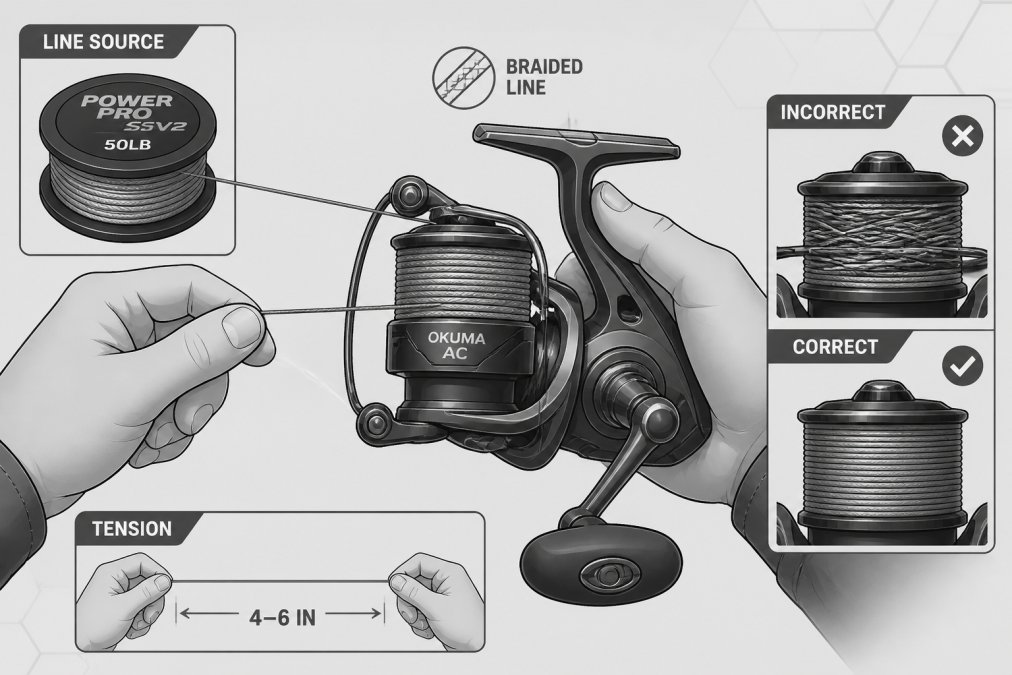
Fill the spool until the line reaches about one-eighth of an inch from the lip of the spool. Too much line and you'll get wind knots; too little and you'll sacrifice casting distance.
Preventing Wind Knots and Tangling
Wind knots form when loose line coils slip during the cast, and the line twists back on itself before it can exit the spool. The primary cause is inconsistent tension during spooling, but casting technique plays a role too.
To prevent wind knots, maintain a tight spool from the start. If you notice your reel is already creating backlash, empty it and respool with better tension control. Smooth, controlled casts allow the line to exit cleanly. If you're using braided line on a spinning reel, feather the line with your index finger as it comes off the spool for finer control.
Line twist develops when your reel's drag is too tight or when you're retrieving against resistance. Loosen your drag slightly so it slips under moderate thumb pressure. This allows the spool to turn freely during retrieve and prevents twist buildup.
Matching Line Capacity to Your Reel
Every spinning reel has a specified line capacity, usually printed on the spool or in the manual. This number tells you how many yards of a specific pound test can fit on that reel. Respecting this capacity is critical for casting distance and reel performance.
If you underfill a reel, you lose casting distance. If you overfill, line spills off the spool during the cast, creating backlash and tangles.
For braided line, you can often use a lighter pound test than you would with monofilament because braided line is thinner. A 2500-size spinning reel might hold 150 yards of 20-pound braided line but only 100 yards of 20-pound monofilament. Check your reel's capacity chart; most manufacturers now list capacity for multiple line types.
Choosing the Right Pound Test for Your Spinning Setup
Pound test refers to the amount of weight a line can theoretically support before breaking. In practice, knots reduce this strength by 10-30%, and factors like age, UV exposure, and water temperature affect the line's actual breaking strength.
Choosing the right pound test depends on three factors: the size of fish you're targeting, the structure you're fishing around, and your rod's rated line weight.
Your rod is rated for a specific range of line weights, typically printed near the handle. Using line heavier than the rod's maximum rating can damage the rod or prevent it from loading properly. Using line lighter than the minimum rating wastes the rod's potential.
Match your line weight to your target species. Panfish and small bass in open water can be handled on 6-8 pound monofilament. Medium bass and pike in moderate cover need 10-15 pound line. Large catfish, pike, and saltwater species demand 20-30 pound or heavier.
Structure changes the equation. If you're fishing around heavy cover, fallen trees, thick weeds, or rocky outcrops, use heavier line than you would in open water. In open water with minimal structure, lighter line is fine and offers better casting distance and lure action.
Fluorocarbon Leader for Spinning Reels: When and Why
A fluorocarbon leader is a section of fluorocarbon line tied to the end of your braided or monofilament mainline. The leader is typically 12-36 inches long and 2-4 pounds heavier than your mainline. This setup gives you the best of both worlds: the casting distance and sensitivity of braided mainline with the invisibility and abrasion resistance of fluorocarbon where the fish can see it.
Use a fluorocarbon leader in clear water where fish are line-shy. The invisibility advantage is significant enough to justify the extra knot. In stained water or heavy cover, a leader is optional but still recommended for finesse presentations or when targeting educated fish.
To spool a spinning reel with a leader system, spool your mainline onto the reel normally. Tie your fluorocarbon leader to the mainline using a uni-knot or improved clinch knot. Trim the tag ends and you're ready to fish. The knot will pass through your guides smoothly and won't cause issues during casting or retrieval.
The leader should be heavy enough to resist abrasion but not so heavy that it creates a weak link in your system. A 15-pound mainline with a 17-20 pound fluorocarbon leader is a solid starting point. Test your knot strength before fishing by pulling both lines hard.
According to knot strength testing by the International Game Fish Association, a properly tied uni-knot in fluorocarbon retains 90-95% of the line's rated strength, making it one of the most reliable knots for leader connections.
Line Visibility, Abrasion Resistance, and Water Clarity
Line visibility and water clarity are directly related. In clear water, fish can see your line from surprising distances. In stained or murky water, visibility becomes irrelevant.
Monofilament comes in various colors, from bright yellow to clear to dark green. Bright colors are easier for you to see but more visible to fish. Clear monofilament is harder to see but still visible in clear water due to refraction. Fluorocarbon is the most invisible because its refractive index is closer to water.
Braided line is highly visible in clear water because it's opaque and doesn't refract light like monofilament or fluorocarbon. This is why most anglers use braided line as a mainline with a fluorocarbon leader.
Abrasion resistance is how well a line withstands contact with rough surfaces. Fluorocarbon is the most abrasion-resistant, followed by braided line, then monofilament. If you're fishing around rocks, shells, or rough structure, fluorocarbon or braided line will last longer than monofilament.
Match your line choice to your specific water conditions and target species. There's no universal best line for every situation; context determines the right choice.
Cold Weather Performance and Line Maintenance
Cold water and freezing temperatures affect line performance in ways many anglers overlook. Monofilament becomes stiffer and loses elasticity in cold water, reducing its shock-absorbing ability. Fluorocarbon becomes even stiffer. Braided line is relatively unaffected by temperature, which is one reason it's popular in cold-water applications.
If you're fishing in cold weather, check your line for brittleness. Bend it gently; if it cracks or feels unnaturally stiff, replace it. Cold-stiffened line is more prone to breaking on the cast or during hook sets.
Line maintenance extends the life of your line and prevents unexpected failures. After each fishing trip, rinse your reel and line with fresh water to remove salt, sand, and debris. Store your reel in a cool, dry place away from direct sunlight. UV exposure breaks down the polymer structure of all line types. Replace line annually if you fish regularly, or every two years if you fish casually.
Inspect your line regularly for fraying, discoloration, or stiffness. These are signs that the line is degrading and should be replaced.
Selecting the best fishing line for spinning reels comes down to matching the line type to your water conditions, target species, and fishing technique. Whether you're building a complete spinning setup or upgrading your existing reel, the right line makes the difference between consistent success and frustrating failures. Start with the fundamentals: understand how monofilament, fluorocarbon, and braided line behave, spool your reel with proper tension to prevent backlash, and match your pound test to your rod and target. From there, adjust based on water clarity and structure. Your next trip will tell you whether you made the right choice.
Frequently Asked Questions
Is monofilament or fluorocarbon better for spinning reels?
Monofilament is more forgiving for beginners and general freshwater fishing due to its stretch and affordability. Fluorocarbon excels when line visibility matters, in clear water or when targeting pressured fish. For spinning reels, monofilament is easier to cast and spool without issues, while fluorocarbon offers superior sensitivity and invisibility underwater. Your choice depends on water clarity and target species.
Is it okay to put braided line on a spinning reel?
Yes, but braided line requires proper technique. Zero-stretch braided line like Power Pro SSV2 delivers maximum sensitivity and strength for big catfish and saltwater applications. The challenge: braided line is thinner than monofilament at the same pound test, which can cause wind knots if your drag isn't set correctly. Spool it with slightly higher tension and use a monofilament backing to prevent slipping. Many anglers pair braided mainline with a fluorocarbon leader for the best of both worlds.
What is the best pound test for a standard spinning reel?
Most spinning reels perform best with 6-12 lb monofilament or fluorocarbon for freshwater, and 15-30 lb braided for saltwater or catfish. Check your reel's spool capacity and line recommendations. Lighter pound test casts farther and feels more natural; heavier test handles abrasion in rocky or weedy areas. Match pound test to your target species' average size and your reel's drag range for balanced performance.
How often should you replace the line on your spinning reel?
Replace monofilament and fluorocarbon annually or after 50-100 hours of active use. Braided line lasts 2-3 years if maintained properly. Signs you need fresh line: visible abrasion, reduced knot strength, line memory, or color fading. Cold weather degrades monofilament faster, so if you fish winter months, check your line every 6 months. Inspect your line regularly for nicks or weak spots before each outing.
This article was written using GrandRanker