

Table of Contents
- What Bore Sighting Actually Does (And What It Doesn't)
- Bore Sighting vs. Scope Calibration: The Real Difference
- Tools You Need Before You Start
- How to Zero a Rifle Scope: Step-by-Step
- Rifle Scope Adjustment Basics: Windage, Elevation, and Parallax
- Common Bore Sighting Mistakes and How to Fix Them
- Environmental Factors That Throw Off Your Zero
- Frequently Asked Questions
Last Updated: September 16, 2026
What Bore Sighting Actually Does (And What It Doesn't)
Bore sighting gets your rifle scope on paper. That's it. It does not zero your rifle, and treating it as a finished job is the fastest way to waste a box of ammo and a morning.
Here's the distinction that matters. Bore sighting aligns your scope's optical center with the bore axis so your first live-fire shot lands somewhere on a paper target instead of in the dirt berm. Scope calibration vs bore sighting explained in one line: bore sighting is a starting point, calibration is the process of actually dialing your point of impact to your point of aim.
At Leash the Wilderness, we offer optics for rifles that get carried through brush, rained on, and bounced around in truck beds. The alignment still needs to be done right.
SAAMI glossary of firearm and ammunition terminology
Mechanical Alignment vs. Ballistic Trajectory
Mechanical alignment is geometry. Your bore axis and your scope's optical center need to point at roughly the same place. You can verify this without firing a shot, using a collimator, a laser, or your own eye down the barrel.
Ballistic trajectory is physics. Even a perfectly aligned scope sends a bullet on a curved path affected by gravity, wind, and the ballistic coefficient of your load. A rifle sighted dead-on at 25 yards will shoot high at 100 and drop below the line of sight past 200.
Bore sighting corrects the first problem. Only live fire corrects the second.
Bore Sighting vs. Scope Calibration: The Real Difference
Bore sighting and scope calibration are two stages of the same job, and confusing them costs you time at the range.
Bore sighting is a pre-zero alignment step. You're matching the bore axis to the scope's optical center so the rifle prints on paper. It takes five minutes at the kitchen table and requires no ammunition.
Scope calibration, sometimes called zeroing, is the live-fire process of adjusting windage and elevation turrets until your point of impact matches your point of aim at a chosen distance. It requires ammo, a stable rest, and patience.
The comparison below lays out how the two stages differ in practice.
| Stage | What It Aligns | Ammo Needed | Time | Result |
|---|---|---|---|---|
| Bore sighting | Bore axis to optical center | No | 5-10 min | On paper at 25-50 yards |
| Scope calibration | Point of impact to point of aim | Yes | 20-40 min | True zero at chosen distance |
Think of it this way: bore sighting is the rough cut, calibration is the finish pass. Skipping the rough cut means your first shots may not even hit the paper, which makes turret adjustment guesswork.
Tools You Need Before You Start
You can bore sight with nothing but a steady rest and your own eyes, but a few tools make the job faster and more repeatable.
- A stable rest: sandbags, a bipod, or a proper shooting rest. A wobbly setup throws off every adjustment you make.
- A cleaning rod or arbor: for the manual method, a rod that fits your bore diameter without wobbling.
- A laser bore sighter: a chambered or muzzle-mounted unit that projects a dot onto a target.
- A collimator: a magnetic or arbor-mounted optical tool that shows reticle alignment without a downrange target.
- A paper target and a safe backstop: for confirming your work with live fire.
- The right tools for your mounting rings and base: a torque driver matters here. Over-tightened rings crush a tube; under-tightened rings let the scope shift under recoil.
If you're setting up a new scope from scratch, start with the mounting rings and base alignment before you touch a turret. A scope that isn't sitting level in its rings will fight you through the entire calibration process.
If you're building a hunting setup from zero, our Rods & Reels and optics collections cover the rest of the kit. For an optics bundle, the Hunters Optics Kit pairs a scope, rangefinder, and binoculars in one order.
How to Zero a Rifle Scope: Step-by-Step
Zeroing a rifle scope means adjusting your turrets until point of impact matches point of aim at your chosen distance. The process below works for any centerfire rifle and any scope with exposed or capped turrets.
6-24x50 AO Rifle Scope Hunting →
Total Time: 30-45 minutes Difficulty: Beginner to intermediate
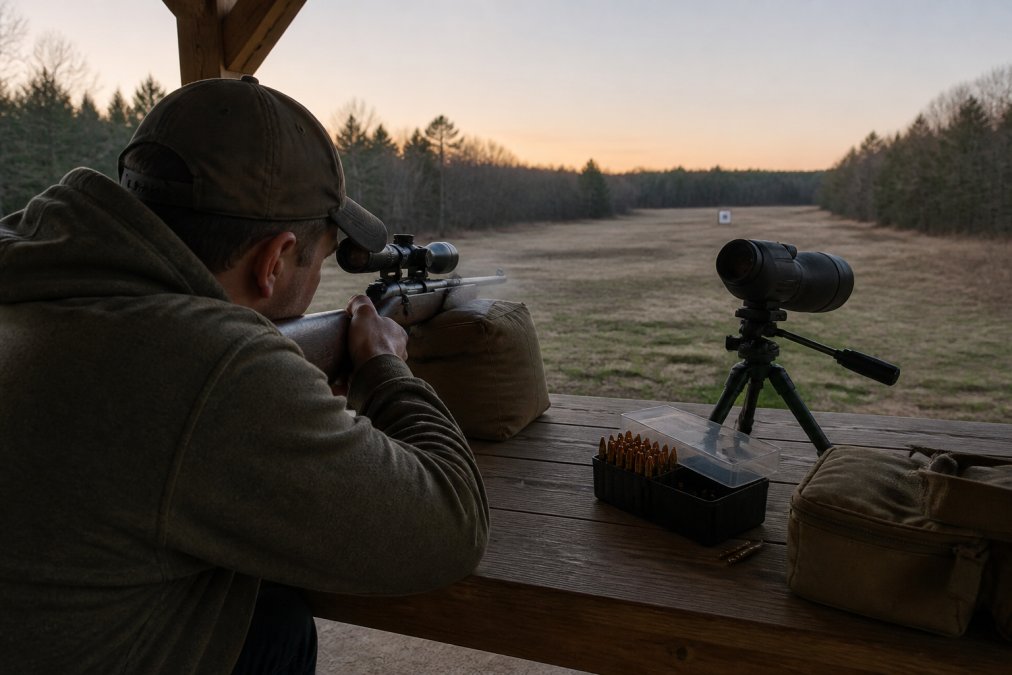
- Bore sight first. Complete either the manual or laser method below before firing a shot.
- Set up at 25 yards. A close target catches your first shots even if alignment is rough.
- Fire a three-shot group. Use the same hold and breathing for each shot.
- Measure the offset. Find the center of your group relative to your point of aim.
- Adjust windage and elevation. Match your turret clicks to the offset, using your scope's click value.
- Fire another group. Confirm the adjustment moved the group the way you expected.
- Move to 100 yards. Repeat the process at your true zero distance.
- Confirm with a final group. Three shots inside your acceptable group size means you're done.
Expected Result: A three-shot group centered on your point of aim at 100 yards.
Bore Sighting the Manual Way
The manual method uses the rifle itself as the alignment tool, and it costs nothing.
Remove the bolt on a bolt-action rifle, or open the action on a semi-auto so you can see through the bore. Rest the rifle so it won't move. Look through the bore at a target 25 to 50 yards away and center the target in the bore. Without moving the rifle, look through the scope and note where the reticle sits relative to that same target. Adjust your windage and elevation turrets until the reticle centers on the target.
The trick is keeping the rifle absolutely still between the two views. Sandbags help. A second set of hands helps more.
Bore Sighting with a Laser
A laser bore sighter is faster and easier to read, especially in low light.
Chamber the laser unit or attach the muzzle-mounted version, following the manufacturer's instructions. Point the rifle at a target 25 to 50 yards away. Turn on the laser and note where the dot lands. Look through the scope and adjust your turrets until the reticle sits on the laser dot.
Two things to watch for.
Rifle Scope Adjustment Basics: Windage, Elevation, and Parallax
Three adjustments do all the work on a rifle scope, and knowing which one fixes which problem saves you from chasing your group around the paper.
Common Bore Sighting Mistakes and How to Fix Them
| Mistake | What Happens | Fix |
|---|---|---|
| Loose mounting rings | Scope shifts under recoil, zero drifts | Torque rings to spec with a driver |
| Rushing the bore-to-scope view | Reticle alignment is off before you fire | Use sandbags, take your time |
| Trusting a cheap laser unit | First group lands far off target | Verify the unit or switch to manual |
| Skipping live-fire confirmation | Rifle prints off zero at distance | Always confirm with real shots |
| Ignoring parallax setting | Group scatters at longer ranges | Set AO dial to target distance |
| Wrong click value assumption | Turret adjustments overshoot or undershoot | Check your scope's MOA per click |
Environmental Factors That Throw Off Your Zero
If you're setting up a dedicated cold-weather rifle, our Cold Weather Hunting collection covers the layers and gear that keep you in the field when the temperature drops.
🛒 Shop the 6-24x50 AO Rifle Scope →

Frequently Asked Questions
Does bore sighting actually work?
Yes, but only as a starting point. Bore sighting aligns the scope's optical center with the bore axis so your first shot lands on paper at 25 to 50 yards instead of missing the target entirely. It does not account for bullet drop, wind, or barrel harmonics. Expect to be within a few inches at close range, then finish with live fire at 100 yards to set a true zero.
Can you hunt with just a bore-sighted rifle?
No. A bore-sighted rifle is mechanically aligned, not zeroed. At 100 yards your point of impact could be several inches off, and at 200 yards that error grows fast. Before hunting, confirm your zero with live fire at the distance you expect to shoot. If you skip that step, a clean shot at 150 yards can turn into a miss or a wounded animal.
What are the most common bore sighting mistakes?
Three mistakes show up constantly. First, bore sighting at 100 yards when 25 or 50 yards is easier to correct. Second, leaving the laser sighter in the muzzle while firing, which damages the barrel and the tool. Third, skipping the turret check: confirm each click moves point of impact the stated amount (usually 1/4 MOA) before you trust the dial. Fix these and zeroing takes minutes, not boxes of ammo.
How do I know if my scope is properly calibrated after bore sighting?
Fire a three-shot group at 100 yards from a stable rest. Measure the distance from the group's center to your point of aim. Adjust windage and elevation turrets in the direction the group needs to move, then fire another group to confirm. If the group is tight and centered, the scope is calibrated. If it wanders between groups, check your mounting rings and base torque before blaming the optic.