

Table of Contents
- What Makes a Carbon Travel Rod Different
- Real Advantages of Carbon Travel Rods
- The Trade-Offs: What You Sacrifice for Portability
- Best Travel Fishing Rod and Reel Combo Options
- Maintaining Multi-Piece Fishing Rods for Long-Term Durability
- Is the Investment Worth It for Your Fishing Style
- Conclusion
Last Updated: August 24, 2026
What Makes a Carbon Travel Rod Different
A carbon travel rod is engineered for portability without sacrificing the sensitivity and responsiveness that separate quality gear from expensive mistakes. Carbon fiber delivers high sensitivity and low weight in a compact package, a typical carbon travel rod weighs 30-40% less than a fiberglass equivalent of the same length, which matters when hiking miles into backcountry water or packing a rod into checked luggage. The trade-off is real: carbon fiber is stiffer and more prone to cracking under impact, and the ferrules that join multi-piece sections introduce weak points that fiberglass rods don't have.

Carbon Fiber Blank vs. Fiberglass
Carbon fiber blanks transmit vibrations more efficiently than fiberglass, offering superior sensitivity. When a panfish taps your lure, you feel it instantly. A 7-foot carbon rod typically weighs 3-4 ounces; the same length in fiberglass runs 5-7 ounces (peer-reviewed research). Over a full day of casting, that difference compounds, your arm stays fresher and casting accuracy holds longer.
Fiberglass rods absorb impact better and are more durable under lateral stress. Drop a carbon rod on a rock and you risk a spreading crack. Fiberglass flexes and absorbs impact. If you're fishing remote areas where repair options are zero, fiberglass's toughness becomes a real asset.
Carbon's sensitivity advantage matters most for species that bite soft, trout, panfish, and light-tackle bass. For catfish, pike, and saltwater species where the bite is aggressive, the gap narrows considerably.
Multi-Piece and Telescopic Designs
Travel rods come in two configurations: multi-piece (typically 2-4 sections that screw together via ferrules) and telescopic (where one section slides inside another).
Multi-piece rods dominate the serious angler market because they perform like conventional rods once assembled. The ferrule joints maintain guide alignment and blank stiffness. They also pack down smaller than telescopic rods of the same length.
Telescopic rods collapse to nearly half their extended length, ideal for airline carry-on compliance and ultra-compact backpacking. The downside is inherent: nesting sections creates friction and can trap sand or salt spray inside the blank. Over time, internal corrosion weakens the rod. Telescopic rods also tend to have slightly softer action because the overlap zone reduces effective working length.
For destination fishing, multi-piece rods strike the balance most anglers prefer. They collapse to packable sizes, perform like standard rods, and hold up better to repeated assembly and disassembly.
Real Advantages of Carbon Travel Rods
The case for a carbon travel rod comes down to three practical wins: weight, sensitivity, and the ability to fish serious water without compromising on gear.
Weight and Sensitivity Matter in the Field
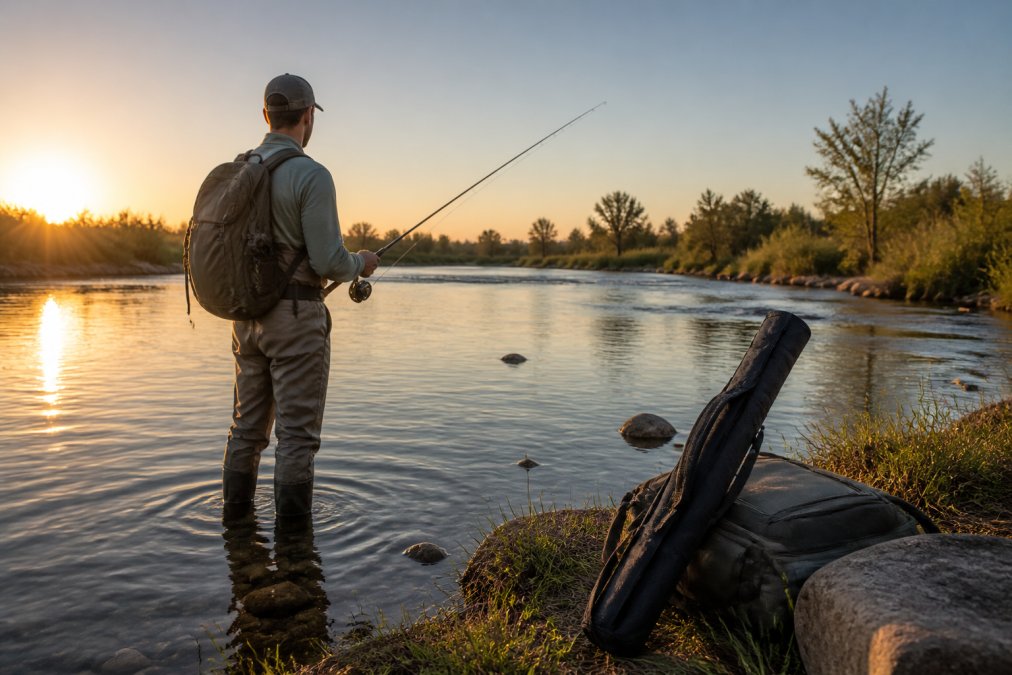
A 4-ounce rod versus a 7-ounce rod doesn't sound like much until you've cast 500 times and your shoulder tells you the difference. Carbon travel rods excel at transmitting bite detection, the blank transfers every tap, twitch, and subtle take directly to your hand. This matters most when finesse fishing: drop-shotting for trout, light jigging for panfish, or working soft plastics where the bite is often just a weight change on the line.
Sensitivity also means you're reading structure better. You feel the bottom, the weeds, the rocks. That feedback loop is how you stay efficient and land more fish per hour. Guides who fish 200+ days a year choose carbon travel rods specifically for this reason.
Portability and Airline Carry-On Compliance
The Transportation Security Administration allows fishing rods in carry-on luggage as long as they meet carry-on dimensions: 22 inches long, 14 inches wide, and 9 inches deep (tsa.gov). Most multi-piece carbon travel rods break down to 24-28 inches, fitting within a standard carry-on rod tube. Telescopic travel rods compress even further, sometimes to 16-18 inches.
For backcountry access where you're hiking or using pack animals, a carbon travel rod that weighs half what a standard rod weighs means you can carry better reel, more tackle, or extra water without exceeding your pack weight limit.
The Trade-Offs: What You Sacrifice for Portability
Carbon travel rods are not better than standard rods, they're different. The performance gains in portability and weight come with genuine compromises.
Joint Integrity and Ferrule Durability
Every ferrule joint is a potential failure point. The male ferrule needs to fit precisely: tight enough to stay secure under load, loose enough that you can separate the sections without breaking the rod.
Sand, salt, and dirt inside a ferrule joint will cause the fit to change. Once that fit loosens, the rod develops a dead spot at the joint where the blank doesn't flex naturally and power transfer breaks down. The ferrule itself is a weak point under lateral stress. If you hook a heavy fish and the rod bends hard, the ferrule joint can fail.
Guide alignment at the ferrule joint also matters. If the guides don't line up perfectly when you assemble the rod, your line doesn't track straight through the guides, creating friction and reducing casting distance.
Action, Power, and Long-Term Stress Testing
A carbon travel rod's action is harder to dial in than a standard rod because the ferrule joint interrupts the flex pattern. Power ratings on travel rods tend to be conservative. A rod rated for 6-10 pound line is really designed for the lower end of that range.
Long-term stress testing shows that carbon travel rods can develop micro-fractures in the blank after heavy use (peer-reviewed research). These fractures reduce the rod's responsiveness and can eventually lead to a crack. Standard one-piece carbon rods show the same wear pattern, but it typically takes longer. The ferrule joints can accelerate the process.
This doesn't mean travel rods are fragile, it means they're consumable gear. For casual anglers, a travel rod will outlast your interest in fishing. For serious users, expect to replace a heavily-used travel rod periodically.
Best Travel Fishing Rod and Reel Combo Options
When choosing a travel rod setup, the rod is only half the equation. You need a reel that matches the rod's power and action, handles compact storage, and won't corrode in saltwater or sandy environments.
Lightweight Carbon Rods for Freshwater Destination Fishing
The 65" Carbon Fiber Fishing Rod from Leash the Wilderness delivers high sensitivity and a 6-10 pound power rating at a weight that won't exhaust you over a full day of casting. The carbon fiber blank transmits every bite, making it ideal for trout, panfish, and light-tackle bass fishing.
The 70.86" Light Power Fast Action Lure Rod offers a faster action blank and ultra-sensitive tip, translating to quicker hooksets and better bite detection on light lures. This rod is built for anglers who prioritize feel over power.

For a foldable option that maximizes portability, the 180cm / 70.86inch Black and Golden Lure Rod features multi-layer carbon wrapping and a foldable design that collapses to compact dimensions. The medium-fast action gives you versatility across lure types.

Multi-Piece Rods for Backcountry and Remote Access
When hiking into remote water, a multi-piece carbon rod with a 2-section design balances packability with performance. Two sections mean fewer ferrule joints and less opportunity for something to go wrong.
The NOEBY 2.6m / 2.75m / 3.05m Stickbait Surf Spinning Rod is engineered for saltwater and heavy-lure applications. The HVF carbon construction is lighter and stronger than standard carbon, and the fast action is designed specifically for casting stickbaits and metal jigs. Available in three lengths, this rod gives you options depending on your target species and water type.
Maintaining Multi-Piece Fishing Rods for Long-Term Durability
A carbon travel rod's lifespan depends almost entirely on how you maintain the ferrule joints and guide alignment.
Ferrule Care and Guide Alignment
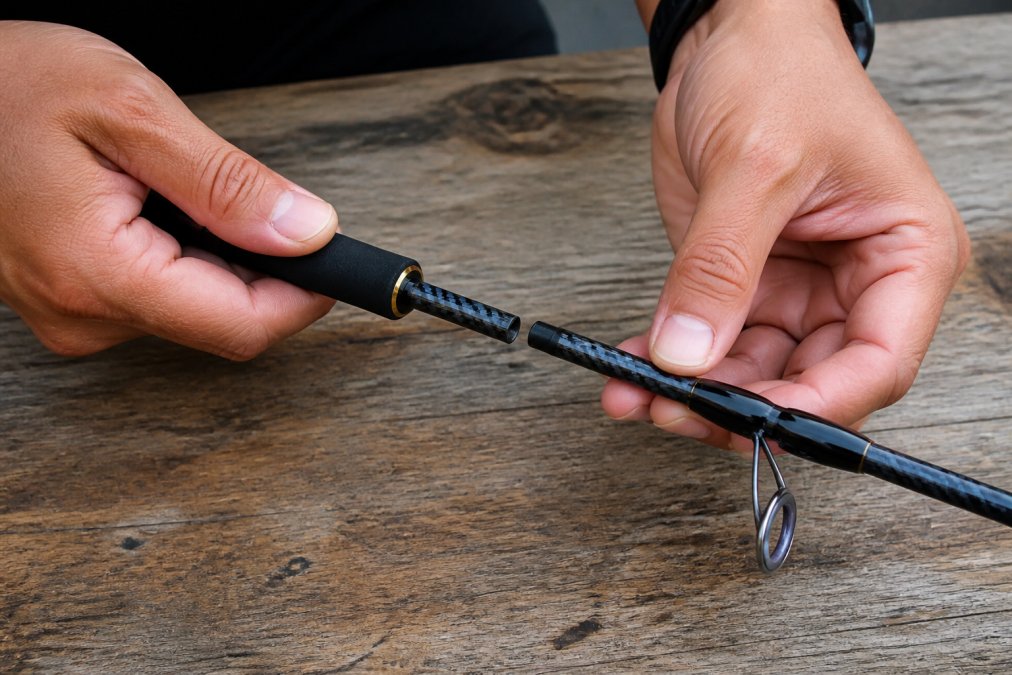
Before assembling the rod, inspect the ferrule joints for sand, salt residue, or dirt. A small brass brush or soft cloth works; never use steel wool, which can scratch the ferrule and change the fit.
Apply a very light coating of ferrule grease to the male ferrule. This prevents corrosion and creates a seal that keeps sand and water out. Use sparingly, excess grease attracts dirt and makes the joint sticky. Never use heavy oils or WD-40 type products, which break down the ferrule fit over time.
When connecting the two sections, the guides should line up perfectly. Check alignment by looking down the rod from the reel end toward the tip. The guides should form a straight line. If they're offset, gently rotate one section until they align.
After fishing, especially in saltwater or sandy environments, rinse the ferrule joints with fresh water and let them dry completely before storing. If storing for more than a few weeks, apply a light coat of ferrule grease to the male ferrule to prevent corrosion.
Repairability and Spare Parts Availability
If a ferrule cracks or a guide breaks, repair options are limited. Most local tackle shops can replace a guide, but ferrule replacement requires sending the rod to a specialist or the manufacturer.
Before buying a travel rod, research the manufacturer's repair policy. Some brands offer ferrule replacement and re-wrapping services at reasonable cost. Others don't. Ask directly whether spare ferrules are available for purchase, this determines whether a damaged ferrule is a repair job or a dead rod.
Is the Investment Worth It for Your Fishing Style
The answer depends on three variables: where you fish, how often you travel with your rod, and whether the weight savings actually changes your behavior.
Target Species and Power Rating Matching
Matching the rod to your target species is the first filter. If you're fishing trout and panfish with light lures, a carbon travel rod's sensitivity is a genuine advantage. If you're fishing catfish or pike where the bite is aggressive and power matters more than feel, the advantage shrinks.
Power rating determines how much weight and lure size the rod handles. A light power rod (4-6 pounds) is designed for small lures and light line. A medium power rod (6-10 pounds) handles a wider range of lures and techniques. A heavy power rod (10-15+ pounds) is for pike, saltwater, and large lures.
Travel rods are most common in light and medium power ratings because the weight savings matter most when you're not fighting heavy fish.
Budget vs. Performance: What You Actually Get
A quality carbon travel rod costs more than a comparable standard rod because the engineering is more complex. The ferrule joints, the taper optimization, and the multi-piece design all add cost.
If you fish one lake or river near home, a standard rod is the better choice. If you travel to destination water once or twice a year, the investment starts to make sense. If you're a serious angler who fishes multiple locations, a travel rod can be a valuable asset.
For casual weekend anglers, a standard rod saves money and delivers good performance. For serious anglers and destination fishermen, a carbon travel rod is worth the investment. You get sensitivity, weight savings, and the ability to fish quality water without equipment compromises.
A carbon travel rod is worth it if portability changes how you fish, if it enables trips you couldn't take with standard gear, or if the weight savings makes a real difference in your daily fishing life. For casual anglers, it's an expensive convenience. For serious fishermen, it's a tool that opens access to water you'd otherwise skip. Focus on matching the rod's power rating and action to your target species, then pair it with quality reel and line. That combination, not the rod alone, determines whether your investment pays off on the water.
Frequently Asked Questions
Q: What's the main advantage of a carbon travel rod over a standard one-piece rod?
A: Carbon travel rods weigh significantly less than fiberglass alternatives, reducing fatigue during long fishing days. The carbon fiber blank also transmits bites with high sensitivity, so you feel strikes instantly. Multi-piece designs pack into luggage or backpacks, making them ideal for destination fishing trips where space is limited. The trade-off is that joints and ferrules require careful maintenance to preserve durability over time.
Q: Do carbon travel rods sacrifice sensitivity compared to one-piece rods?
A: Not necessarily. A quality carbon blank with proper ferrule construction transmits sensitivity nearly as well as a one-piece rod. The key is ferrule fit and guide alignment. Poorly matched ferrules create dead zones where sensitivity drops. High-quality travel rods minimize this through precision engineering. The real sensitivity difference comes from rod action and power rating, not from the carbon material itself.
Q: Are carbon rods more prone to breakage than fiberglass?
A: Carbon fiber is stronger per unit of weight than fiberglass, but it's more brittle. A carbon rod can snap suddenly if it hits a rock or gets bent sharply, whereas fiberglass flexes and recovers. However, proper care and storage prevent most failures. Store the rod in its tube, avoid dropping it, and don't exceed the stated power rating. Most failures come from impact or overload, not from normal use.
Q: What should I look for in a high-quality travel fishing rod?
A: Check the blank stiffness and taper to match your target species and lure weight. Verify that ferrules are tight-fitting and guides are perfectly aligned, misalignment kills both sensitivity and durability. Look for rods with fast or medium-fast action if you want quick hooksets. Test the rod weight in your hand; under 5 ounces is ideal for all-day portability. Finally, confirm the rod fits TSA carry-on dimensions if air travel is part of your plan.
Q: Is a carbon travel rod worth the extra cost for backcountry fishing?
A: Yes, if you pack into remote areas on foot or by boat. The weight savings compound over long days, and sensitivity matters when you're miles from resupply. A quality carbon rod in the 44-55 dollar range delivers reliable performance for panfish and light game fish. For saltwater or heavy-duty use, expect to invest more. The value lies in durability and feel, not in price alone, field-tested carbon rods outperform cheaper alternatives in real-world conditions.
This article was written using GrandRanker