

Table of Contents
- Why Proper Storage Matters for Your Fishing Rods
- How to Clean Fishing Rods After Saltwater Use
- Vertical vs. Horizontal Storage: Which Method Works Best
- Best Way to Store Fishing Reels
- Long-Term Fishing Gear Storage Tips
- Storage Solutions for Different Rod Types and Spaces
- Preventing Rod Warp, Bending, and Corrosion
- Frequently Asked Questions
Last Updated: September 1, 2026
Why Proper Storage Matters for Your Fishing Rods
Fishing rods are among the most abused pieces of equipment in any angler's arsenal. They get bent, warped, corroded, and tangled, often not because of what happens on the water, but because of what happens in storage.
Poor storage costs real money. A rod investment can be lost to preventable damage: corroded guides, permanent curves, or separated reel seats. The difference between a rod that lasts five years and one that lasts fifteen comes down to three things: how you clean it, where you store it, and what conditions you store it in. Humidity causes corrosion. Heat causes warping. Poor support causes permanent bending.
This guide covers the exact methods that keep rods in tournament-ready condition for years. We'll walk through cleaning protocols, storage orientation, environmental controls, and solutions for every space, from a garage to a studio apartment.
How to Clean Fishing Rods After Saltwater Use
Saltwater is the enemy of fishing equipment. Salt crystals embed themselves in guides and corrode metal components. Cleanup can't wait, rinse your rods within hours of fishing saltwater.
Start with fresh water and a soft cloth or sponge, never abrasive scrubbers. Work from the rod handle toward the tip, paying special attention to guides and the reel seat where salt accumulates. For the reel, rinse the exterior thoroughly but avoid spraying water directly into internal mechanisms. A damp cloth works better than a hose.
Wipe the rod blank gently with a soft, damp cloth. Don't scrub. Once rinsed, dry completely with a microfiber cloth. Any moisture left behind will corrode guides and metal fittings over weeks in storage.
After drying, store the rod in a cool, dry place for at least 24 hours before long-term storage to ensure trapped moisture evaporates.
Vertical vs. Horizontal Storage: Which Method Works Best
The orientation of your rod in storage determines whether it stays straight or develops a permanent curve.
Vertical storage, rods standing upright with tips pointing up, is the superior method for long-term storage. Gravity pulls the blank straight, and the rod's own weight keeps it aligned naturally. Vertical storage also saves space.
Horizontal storage creates a problem: the weight of the reel and handle concentrates stress at support points. Over months, this pressure causes the blank to develop a curve exactly where it's being supported. The rod will cast slightly off-axis, and that curve never fully straightens. The exception is very short rods under 5 feet, which can be stored horizontally without risk.
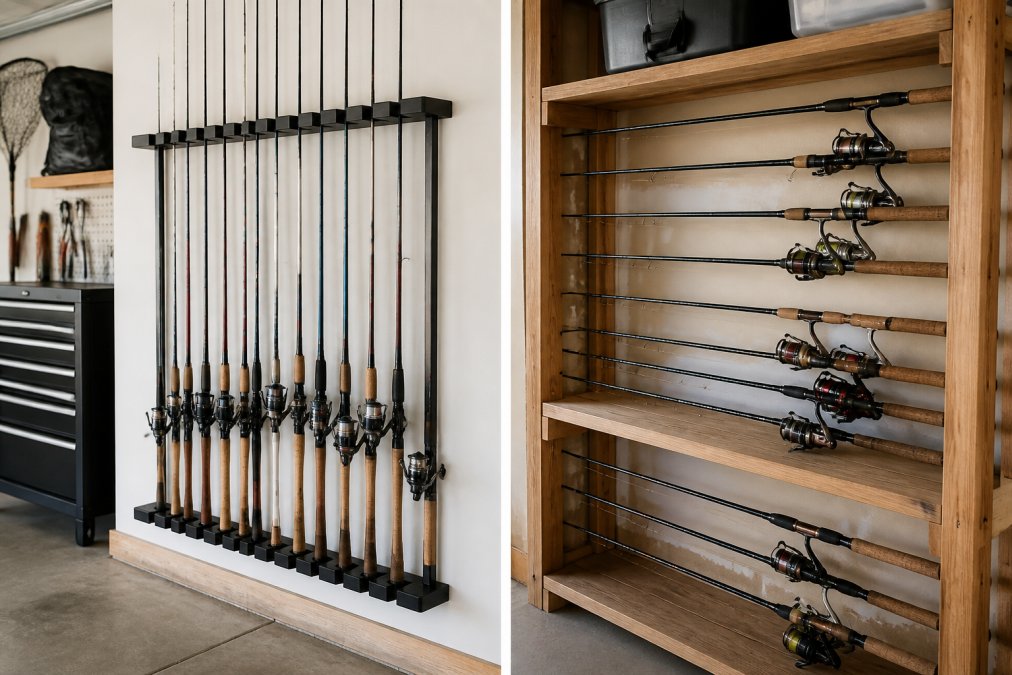
Wall-Mounted Rod Racks
Wall-mounted racks are the gold standard for serious anglers. They hold rods vertically, keep them visible and accessible, and use vertical wall space efficiently.
A good rod rack holds the blank near the handle and midpoint, creating two support points that distribute weight evenly and prevent sagging. When mounting, position the rack at eye level or slightly higher to make grabbing a rod intuitive and keep tips away from foot traffic. Space rods 4-6 inches apart to prevent tangling.
Ceiling-Mounted Storage Solutions
Ceiling racks work well when wall space is limited. A rod hangs from above, gravity keeps it straight, and the rod is completely out of the way.
The downside is accessibility. Grabbing a rod from a ceiling rack requires a step stool every time. Ceiling racks are best for seasonal rods or backup equipment you access infrequently.
Use heavy-duty hooks rated for the weight. A full rack of five rods weighs 10-15 pounds (osha.gov). Space hooks at least 3 feet apart to keep rods separated. Ensure at least 12 inches of clearance below the lowest rod tip.
Best Way to Store Fishing Reels
Store reels in a dry environment with moderate humidity (below 60%). If you store rods with reels attached, the reel is protected by the rod storage conditions. If you remove reels for off-season storage, place them in a sealed container with silica gel packets to absorb moisture.
Before storing a reel, back off the drag slightly. A fully engaged drag left in place for months can cause the drag material to stick or harden. Don't store reels in direct sunlight, UV exposure degrades housing material and can make plastic components brittle.
For saltwater reels, apply a light coat of reel-specific oil on external metal parts to provide corrosion protection during storage. Use sparingly; excess oil attracts dust and debris.
Long-Term Fishing Gear Storage Tips
Long-term storage requires environmental control. Extended storage introduces humidity, temperature fluctuation, and pest risks that destroy equipment if left unchecked.
Humidity and Temperature Control
Humidity is the silent killer of fishing gear. Above 60% relative humidity, corrosion accelerates on metal components (peer-reviewed research). Guides rust. Reel seats corrode. Below 30% humidity, wood components dry out and crack. The ideal range is 40-55% relative humidity.
Temperature swings also damage rods. A garage that's 85 degrees in summer and 40 degrees in winter creates expansion and contraction cycles that stress the rod blank and loosen guides. Consistent temperature, ideally between 50 and 70 degrees, keeps the rod stable (nist.gov).
A small 30-pint dehumidifier in a garage or storage closet maintains humidity in the safe zone. Run it continuously during humid months and periodically during drier months. Temperature control is harder unless you have climate control in your storage space. If your rods are in an unheated garage or shed, focus on humidity control, a dehumidifier will still protect against corrosion even if temperature fluctuates.
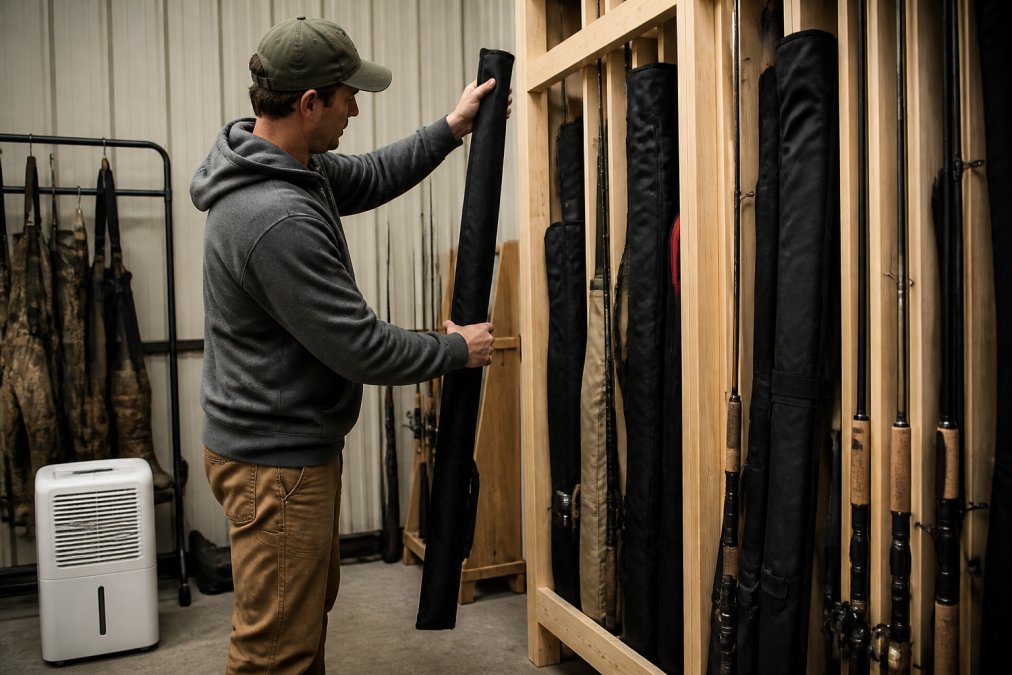
Pest and Rodent Prevention
Mice and insects are attracted to organic materials in rod handles and cork grips. They'll nest in a stored rod, chewing through handle material and leaving droppings inside the blank.
Prevent pests by storing rods in sealed containers or protective sleeves. Soft rod socks provide basic protection. For serious long-term storage, hard rod tubes offer complete protection from rodents and insects.
Store rods off the ground. Mice travel along baseboards. A wall-mounted rack keeps rods 4-5 feet off the floor, out of typical rodent travel zones. Check stored rods monthly, especially during fall and winter when pests seek shelter.
Storage Solutions for Different Rod Types and Spaces
Storage solutions need to fit your actual space, whether that's a sprawling garage or a small apartment.
Garage and Shed Storage
A garage offers the most flexibility. Wall space, ceiling space, and climate control options are usually available. Multiple racks can be installed on the same wall, spaced vertically to maximize capacity.
If your garage is unheated, a dehumidifier becomes essential. An unheated garage in a humid climate can reach 80-90% humidity in summer, accelerating corrosion dramatically. A single dehumidifier running during warm months will protect your entire rod collection.
Organize rods by type or frequency of use. Frequently used rods should be at eye level on wall racks. Seasonal rods or backups can go higher on the wall or on ceiling racks.
A shed works similarly to a garage, but with less climate control. If your shed isn't insulated, temperature swings will be more extreme. Prioritize humidity control and protective sleeves for rods stored in an uninsulated shed.

Apartment and Small-Space Solutions
Apartment anglers face real constraints. Wall space is limited, and drilling into walls may violate lease agreements.
A closet rod can hold multiple rods vertically if you use a tension rod or adjustable shelf system. Rods stand upright in the corner of a closet, taking up minimal floor space. A small dehumidifier in the closet maintains humidity control.
Under-bed storage is another option. Soft rod socks protect rods from dust, and the space under a bed stays relatively stable in temperature. A compact rod case or storage tube holds one or two rods and can slide behind a door, under a couch, or in a corner.
The key constraint in small spaces is humidity control. A single small dehumidifier, even a compact 20-pint unit, will protect rods stored in a closet or small room.
Preventing Rod Warp, Bending, and Corrosion
Rod warp is permanent and irreversible. Once a blank develops a curve, no amount of heat will fix it. Prevention is the only strategy.
Warp happens through three mechanisms: improper horizontal storage (weight concentrating at support points), exposure to direct heat (car trunks, hot garages), and stress from heavy reels on unsupported blanks. Vertical storage eliminates the first risk. Keeping rods out of hot environments eliminates the second. Proper support eliminates the third.
Bending is different from warp. A bent rod can sometimes be straightened if caught early, but repeated bending in the same spot leads to micro-fractures. Eventually, the rod breaks. Store rods where they won't be leaned against, stepped on, or crushed.
Corrosion is the most visible damage. Rust on guides and the reel seat is obvious, but internal corrosion is harder to detect. By the time you see surface corrosion, internal damage has already begun. This is why humidity control matters: it prevents corrosion before it starts.
Salt residue accelerates all three problems. A rod rinsed after saltwater use but not thoroughly dried will corrode faster than a freshwater rod in the same storage conditions. Proper post-use care prevents storage problems later.
Storing fishing rods properly extends their lifespan from years to decades. The investment in a wall-mounted rack, a dehumidifier, and protective sleeves pays for itself the first time you avoid replacing a corroded or warped rod. Start with vertical storage, add humidity control, and your rods will be ready whenever you are.
Frequently Asked Questions
Is it better to store fishing rods vertically or horizontally?
Vertical storage is generally better for most fishing rods because it prevents the blank from warping under its own weight over time. Horizontal storage works if you support the rod evenly along its length, but vertical mounting on a wall rack or in a rod holder keeps the blank straight and minimizes stress on the guides. For long-term storage, vertical is the safer choice.
How do I prepare my fishing gear for long-term storage?
Start by cleaning your rods and reels thoroughly, especially after saltwater use. Dry everything completely, then apply a light coat of reel oil to moving parts. Store rods vertically or horizontally with even support, use protective sleeves or rod socks to prevent dust and damage, and keep gear in a climate-controlled space away from direct sunlight. Check on your gear every few months to catch any corrosion or pest activity early.
Can I store fishing rods in my garage?
Yes, garages work for fishing rod storage if you control humidity and temperature swings. Avoid storing rods near heat sources, direct sunlight, or areas prone to moisture buildup. Use a dehumidifier if your garage gets damp, and keep rods off concrete floors to prevent corrosion from ground moisture. Wall-mounted racks or ceiling storage keeps rods organized and protected from accidental damage.
Does sunlight damage fishing rods during storage?
Yes, prolonged sunlight exposure can fade rod finish, weaken fiberglass and carbon fiber blanks, and degrade reel components. UV rays break down protective coatings and can make guides brittle over time. Store rods in a shaded area, use protective rod sleeves or cases, or cover wall-mounted racks with a tarp if they're near windows. This is especially important for long-term storage.
This article was written using GrandRanker