

Table of Contents
- How to Select Fishing Reels: The Core Framework
- Types of Fishing Reels Explained: Spinning vs. Baitcasting
- Fishing Reel Sizes Explained: Understanding the 1000-5000 Series
- Fishing Reel Gear Ratio Explained: What It Means for Your Retrieve
- Fishing Reel Drag System Explained: The Foundation of Smooth Fighting
- Matching Your Reel to Rod, Species, and Environment
- 2026 Innovations: What's New in Reel Technology and Materials
- Reel Maintenance and Troubleshooting: Keep Your Gear Field-Ready
Last Updated: July 22, 2026
How to Select Fishing Reels: The Core Framework
Selecting a fishing reel isn't a single choice, it's a series of connected decisions. You're matching mechanical capability to your target fish, water type, and skill level. Get that framework right, and everything else falls into place.
Below, we cover the types that dominate the market, the technical specs that actually matter, and how to avoid common mistakes when rushing the selection process.
Why Reel Selection Matters More Than You Think
A reel is the mechanical interface between your rod, line, and fish. A smooth drag prevents line breakage on hard runs. Poor bearings slow your retrieve at critical moments. These aren't minor inconveniences, they're the difference between landing and losing fish.
Reel quality compounds over time. A cheap reel works fine on calm days with small fish, but add saltwater corrosion, heavy cover, or a 20-pound fish on the line, and flaws surface immediately. Field-tested gear survives these conditions because every component is chosen for durability under real-world abuse.
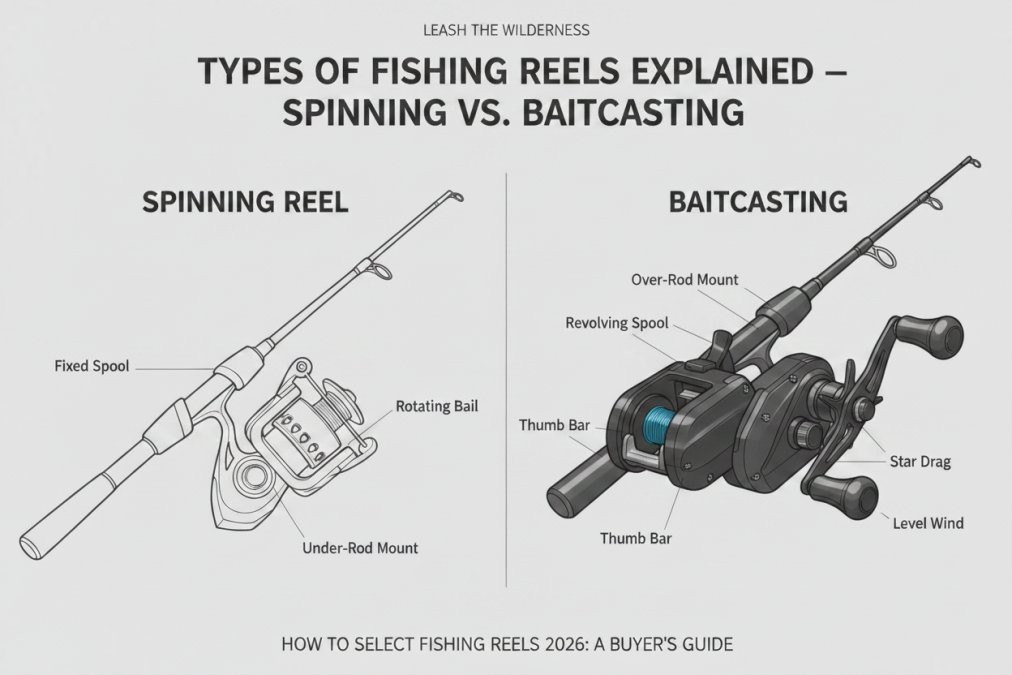
Types of Fishing Reels Explained: Spinning vs. Baitcasting
The reel type you choose determines your entire casting experience.
Spinning Reels: Versatility and Ease
A spinning reel hangs below the rod and uses a bail mechanism to release and control line. You cast by holding the line against the rod handle with your index finger, then flipping the bail open. On retrieve, the bail closes automatically and the rotor winds line back onto the spool.
Close-up of a spinning reel mounted on a fishing rod showing the bail mechanism, rotor, and handle in bright outdoor lighting
Spinning reels excel at ease of use and versatility. They handle light lures (under 1/8 ounce) better than baitcasters, making them ideal for finesse fishing. The learning curve is shallow, most beginners cast accurately within their first session.
The trade-off is power and precision at distance. The bail mechanism inherently twists line as it closes, and the open spool design is less forgiving of casting errors in windy conditions.
Baitcasting Reels: Precision and Power
A baitcasting reel sits on top of the rod. The spool rotates horizontally, and you control line release with your thumb. The spool stops rotating the instant you stop applying thumb pressure, giving you precise casting control.
Baitcasters excel when you need power, accuracy, or heavy lures. A 7.0:1 ratio baitcaster paired with a medium-heavy rod will move a fish out of thick cover faster than any spinning setup. The direct spool-to-line connection means zero line twist and maximum sensitivity.
The learning curve is steep. Backlashes, tangles caused by the spool spinning faster than line is being cast, are common for new users. Mastering a baitcaster takes practice, but the payoff is control that spinning reels can't match.
For saltwater applications, baitcasters dominate because sealed designs resist corrosion better and power transfer is superior for fighting large fish.
Fishing Reel Sizes Explained: Understanding the 1000-5000 Series
Reel size refers to spool capacity and overall frame size. The numbering system (1000, 2000, 3000, etc.) indicates line capacity in yards.
Light, Medium, and Heavy Reel Sizes
A 1000-2000 series reel is built for light work: panfish, small trout, or ultralight lure presentations. These hold 150-250 yards of 4-8 lb test line. They're sensitive and perfect for finesse fishing where feel matters.
A 2500-3500 series is the workhorse category. These handle 200-300 yards of 8-12 lb test and work across freshwater applications, largemouth and smallmouth bass, pike, walleye, and light saltwater species like redfish. Most anglers own at least one reel in this size range.
A 4000-5000 series reel moves into heavy-duty territory. These hold 300-400+ yards of 12-20 lb test and are built for saltwater, pike, musky, or any scenario where you need power and line capacity. The larger spool diameter means faster line retrieval.
Fishing Reel Gear Ratio Explained: What It Means for Your Retrieve
Gear ratio is the number of times the rotor completes one full rotation for each turn of the handle. A 5.1:1 ratio means the rotor spins 5.1 times per handle turn.
How Gear Ratio Affects Retrieve Speed and Power
Higher gear ratios (6.5:1 and above) retrieve line faster but with less mechanical advantage. A 7.0:1 baitcaster retrieves roughly 28 inches of line per handle turn, ideal for covering water quickly or keeping tension on a fish running toward you.
Lower gear ratios (5.1:1 to 5.8:1) retrieve slower but with more power. These excel when working heavy cover or fighting large fish that need steady pressure. The slower retrieve gives finer control over lure action.
Most anglers benefit from owning both ratios. A medium-speed reel (5.8:1) works across more scenarios, but specialists catch more fish in their specific situations.
Gear Ratio |
Retrieve Speed |
Best For |
Power Level |
|---|---|---|---|
5.0-5.3:1 |
Slow |
Heavy cover, large fish |
High |
5.4-5.8:1 |
Medium |
Mixed conditions |
Medium-High |
5.9-6.4:1 |
Fast |
Shallow water, reaction baits |
Medium |
6.5:1+ |
Very Fast |
Open water, speed fishing |
Lower |
Fishing Reel Drag System Explained: The Foundation of Smooth Fighting
The drag system is the single most important component of any reel. It allows line to slip under pressure, preventing line breakage when a fish runs hard.
Drag Quality and Consistency Under Load
A quality drag uses multiple friction discs (usually 4-6) made from stainless steel, felt, or composite materials. As you tighten the drag knob, you increase pressure on these discs, creating more friction.
The critical measure is consistency. A drag that maintains the same resistance regardless of how much line is on the spool, water temperature, or how hard the fish is running is reliable. Test a reel's drag before buying if possible. Set it to about 25% of your line's breaking strength, then pull line steadily. It should slip smoothly without hesitation.
Saltwater reels require sealed drag systems because exposure to salt and sand degrades traditional drag materials.
Matching Your Reel to Rod, Species, and Environment
The reel doesn't work in isolation. It's part of a system that includes your rod, line, and target fish. A mismatch anywhere creates problems.
Freshwater vs. Saltwater Applications
Freshwater reels prioritize smoothness and finesse. The water isn't corrosive, so manufacturers can focus on drag quality and bearing count. A spinning reel with 5-7 ball bearings works fine for largemouth bass.
Saltwater reels must resist corrosion. Quality saltwater reels use sealed drag systems, stainless steel components, and corrosion-resistant coatings. They cost more because the environment demands it.
If you fish both freshwater and saltwater, own separate reels. Salt corrosion accelerates exponentially, and a reel that works fine after one saltwater trip will show problems within months.
Target Species and Heavy Cover Demands
Bass fishing often happens around heavy cover and timber. You need a reel with enough power to move a fish away from snags quickly. A 5.4:1 baitcaster or a 3000-series spinning reel with a 6.2:1 ratio works well.
Pike and musky demand even more power. These fish are larger and require heavier line (15-20 lb test). A 4000-5000 series reel with a lower gear ratio (5.1:1 to 5.6:1) gives you the mechanical advantage to fight these fish effectively.
Match reel power to fish size and environment difficulty. Oversizing gives unnecessary weight and cost. Undersizing puts you at risk of losing fish and damaging gear.
2026 Innovations: What's New in Reel Technology and Materials
The reel market in 2026 has shifted toward durability and reliability. Manufacturers are investing in materials science and sealed designs that extend reel life in harsh conditions.
Sustainability and Eco-Friendly Reel Materials
Several major manufacturers have introduced reels using recycled aluminum and composite materials that reduce environmental impact without sacrificing performance. Recycled aluminum performs identically to virgin aluminum, and modern composites are as durable as traditional materials.
The practical benefit is weight reduction. A reel made from composite frame components weighs slightly less without losing rigidity, reducing fatigue during all-day casting.
Smart Reel Integration and Digital Features
Modern sealed ball bearings reduce friction and increase smoothness compared to reels from 3-4 years ago. A 2026 mid-range reel often feels as smooth as a 2023 premium reel, which means better value across the board.
New spool designs reduce line memory and prevent bunching that plagued earlier spinning reels.
Reel Maintenance and Troubleshooting: Keep Your Gear Field-Ready
A well-maintained reel outlasts a neglected one by years. Consistency matters more than intensity.
Common Issues and Quick Fixes
Rough or grinding drag: Salt, sand, or debris has contaminated the drag system. Disassemble the reel, clean the drag stack with fresh water, and reassemble. If the problem persists, the drag discs may be worn and need replacement.
Backlashes on baitcasters: Reduce your casting force slightly and apply consistent thumb pressure throughout the cast. If backlashes persist with proper technique, check the spool bearing, a worn bearing can cause the spool to spin too freely.
Line twist on spinning reels: Check that the bail closes smoothly and fully. If it doesn't, the bail arm or roller may be bent and need replacement.
Slow or stiff retrieve: Rinse the reel thoroughly with fresh water and let it dry completely. If stiffness persists, the bearing may need replacement or professional cleaning.
Drag creep (line slipping when stationary): Tighten the drag knob slightly. If the problem returns immediately, the drag system needs servicing.
Most issues are preventable with basic maintenance. After each saltwater trip, rinse your reel with fresh water and let it air dry. Store reels in a cool, dry place. Oil the handle bearing annually with light reel oil.
Problem |
Cause |
Fix |
Prevention |
|---|---|---|---|
Rough drag |
Debris in drag system |
Clean or replace drag discs |
Rinse after saltwater trips |
Backlashes |
Spool spinning too freely |
Adjust casting technique, check bearing |
Use proper thumb pressure |
Line twist |
Bail or rotor issues |
Check bail closure, replace rotor bearing |
Maintain consistent retrieve speed |
Stiff retrieve |
Bearing contamination |
Rinse with fresh water, replace bearing |
Rinse after each trip |
Drag creep |
Worn drag or loose adjustment |
Tighten drag, service drag system |
Check drag regularly |
Selecting the right reel comes down to matching capability to your actual fishing situation, not chasing the newest model or the most expensive option. The best reel for you is one that handles your target species reliably and survives the conditions you fish. Whether you're building your first setup or upgrading gear you've outgrown, match a reel to your rod, species, and environment for field-tested gear that actually works when conditions turn brutal.
Frequently Asked Questions
What's the difference between spinning and baitcasting reels, and which should I choose?
Spinning reels are easier to learn, better for lighter lures, and forgiving with casting. Baitcasting reels offer greater accuracy, better control with heavier lures, and more power for heavy cover fishing. Choose spinning if you're a beginner or fish finesse presentations; choose baitcasting if you need precision and power for flipping into dense cover or deep drop fishing for swordfish and other heavy-target species.
How do I understand fishing reel sizes and what do the numbers mean?
Reel sizes—typically numbered 1000 to 5000 in spinning reels—indicate line capacity and spool diameter. Smaller sizes (1000-2000) hold less line and suit light finesse fishing. Medium sizes (2500-3500) balance versatility for freshwater and light saltwater. Larger sizes (4000-5000) handle heavy cover, deeper drops, and saltwater applications with greater line capacity and durability.
What does gear ratio mean, and why does it matter when I select fishing reels?
Gear ratio (expressed as 5.1:1, for example) tells you how many times the spool rotates per handle turn. Higher ratios (6.0:1+) mean faster retrieve speed, ideal for covering water quickly or working topwater lures. Lower ratios (4.5:1 or less) provide more power per turn, better for heavy lures and deep cover. Match your gear ratio to your fishing style: fast for reaction fishing, slower for power and control.
How important is the drag system, and what should I look for?
The drag system is critical—it prevents line breakage by slipping under pressure when a fish runs hard. Look for smooth, consistent drag that doesn't stick or surge. Quality drag systems use multiple ball bearings and advanced materials for reliability in both freshwater and saltwater. Test the drag before buying; it should feel progressively smoother as you increase tension, not jerky or inconsistent.
The right reel gets you on the water with confidence — but the right lure seals the deal. Round out your setup with the Shop the Pro Fishing Lure Kit and hit every species on your list.
This article was written using GrandRanker