

Table of Contents
- Essential Clothing and Layering System for Wilderness Fishing
- Fishing Gear and Tackle Essentials: What Actually Goes in Your Pack
- Safety, First Aid, and Emergency Signaling in Dead Zones
- Sun Protection, Skincare, and Bug Defense Essentials
- Navigation, Communication, and Offline Maps
- Food, Hydration, and Water Filtration Strategy
- Footwear, Waders, and Non-Marking Shoes for Different Waters
- How to Pack for Wilderness Fishing Trips: Weight Management and Organization
Last Updated: July 19, 2026
Essential Clothing and Layering System for Wilderness Fishing
Proper clothing determines whether you stay comfortable during long hours on the water or suffer through hypothermia and exhaustion. A three-layer system works best: a moisture-wicking base layer against your skin, an insulating mid-layer for warmth, and a waterproof outer shell for protection. Base layers pull sweat away from your body, preventing rapid heat loss. Merino wool outperforms synthetics because it regulates temperature naturally and resists odor even after days without washing.
Mid-layers should be fleece or lightweight down, depending on expected temperatures. Down compresses smaller and weighs less, but fails completely when wet. Fleece stays functional even when damp, making it the safer choice for wilderness fishing where water exposure is inevitable. Your outer shell must breathe to prevent interior condensation while blocking wind and rain.
Pack at least two complete base layer sets and one mid-layer. You'll rotate them as you fish, allowing damp layers to dry while wearing clean ones. Include a lightweight hat and gloves, even on warm-weather trips. Head and hands lose heat fastest, and temperature drops dramatically once the sun sets.
Fishing Gear and Tackle Essentials: What Actually Goes in Your Pack
Wilderness fishing requires ruthless selectivity, you'll carry this gear miles from the truck. For fly fishing, your pack needs a fly rod (9-10 feet is standard), reel, backing, fly line, leader material, and a selection of flies. Limit yourself to 30-50 flies maximum, organized by type in small waterproof boxes. Include split shot, strike indicators, and a small spool of tippet material.
Fly Fishing vs. Conventional Tackle Setup
Fly fishing requires less total weight than conventional spinning setups. A quality fly rod weighs 3-4 ounces, and your entire fly-fishing system fits into a pack roughly the size of a hardcover book. Spinning rods, reels, and tackle boxes are heavier and bulkier, making them less practical for multi-day backpacking trips where every pound matters.
However, conventional tackle works better in murky water and for larger species. If you're targeting pike, musky, or catfish in low-visibility conditions, the extra weight is justified. The choice depends on your target species and water conditions, not on what you're most comfortable with at home.
Pack a compact multi-tool with scissors, pliers, and a file for line maintenance. Include a net with a collapsible frame that attaches to your pack. A small headlamp lets you fish early morning and evening when fish are most active. Polarized sunglasses reduce glare and let you see fish underwater, improving your catch rate significantly.
Safety, First Aid, and Emergency Signaling in Dead Zones
Wilderness fishing means you're often beyond cell service and far from medical help. Your first aid kit must address injuries unique to angling: fish hook wounds, deep cuts from sharp tackle, and waterborne infections. Include tweezers for removing fish hooks, antibiotic ointment, pain relievers, and anti-diarrheal medication. Blister treatment matters more than most guides acknowledge, untreated blisters will force you off the trail before day two.
Emergency signaling becomes critical when you're injured and can't hike out. A whistle carries sound farther than shouting and requires less energy. A signal mirror reflects sunlight for miles, visible to rescue aircraft. Include a personal locator beacon (PLB) if you're fishing remote areas without cell coverage. These devices transmit your GPS coordinates to rescue services and cost roughly $300-400.
Pack a lightweight emergency shelter, a space blanket or bivy sack weighs ounces and could save your life if you're stranded overnight. Include waterproof matches and a fire starter. A small trauma kit with a tourniquet, hemostatic gauze, and pressure bandages addresses serious bleeding that standard first aid can't handle.
File a detailed trip plan with someone who knows your route and expected return date. If you don't check in by a specific time, they should contact authorities.
Sun Protection, Skincare, and Bug Defense Essentials
Wilderness fishing exposes you to intense sun reflection off the water, accelerating skin damage and increasing melanoma risk. High-SPF sunscreen rated for water activities is non-negotiable. Reapply every two hours and after swimming or heavy sweating. Lip balm with SPF prevents painful sun damage to your lips.
A wide-brimmed hat protects your face, ears, and neck. Light-colored hats reflect more heat than dark ones, keeping you cooler during midday fishing. Long sleeves and pants made from lightweight, breathable fabric offer UV protection without overheating.
Insect repellent containing DEET or picaridin prevents mosquito-borne illness. Mosquitoes are most active at dawn and dusk, exactly when fish feed. Apply repellent to exposed skin and reapply after swimming. Pack anti-itch cream for inevitable bug bites. Scratching bites opens them to infection, a real problem when you're days from medical care. Include a small mirror to check for ticks, which transmit Lyme disease in many regions.
Bring extra socks and foot powder. Wet feet develop blisters and fungal infections quickly. Change socks if they get damp, even if you're not swimming. Dry feet are the difference between comfortable hiking and painful limping.
Navigation, Communication, and Offline Maps
Cell service disappears in wilderness fishing areas. You need navigation tools that don't depend on cellular networks. Offline maps stored on your phone, combined with a physical map and compass, create redundancy that keeps you safe if technology fails.
Download maps covering your fishing area before leaving cell service. Apps like AllTrails, Gaia GPS, and OnX Maps let you download topographic maps for offline use. These apps track your GPS location without cell service, letting you see exactly where you are on the map. A basic GPS unit (Garmin eTrex series) weighs less than 200 grams and provides backup navigation if your phone dies.
Carry a physical map and compass as your ultimate backup. Learn to navigate by map and compass before your trip. A compass costs $15 and weighs almost nothing.
Consider a satellite communicator like the Garmin inReach Mini for truly remote areas. These devices send and receive text messages via satellite, letting you stay in contact with people outside the wilderness. They're expensive ($350+) but invaluable for multi-day trips in truly remote areas.
A portable battery pack keeps your phone charged for navigation and emergencies. Bring at least 10,000 mAh capacity. Waterproof phone cases protect your device from water damage and keep it accessible for photos and navigation.
Food, Hydration, and Water Filtration Strategy
Caloric demands increase dramatically during wilderness fishing because you're hiking, wading, and fighting fish in cold water. Pack calorie-dense foods: nuts, dried fruit, energy bars, and jerky. Aim for 4,000-5,000 calories per day depending on activity level and temperature.
Breakfast should be substantial, oatmeal with nuts and dried fruit provides sustained energy for morning fishing. Lunch can be lightweight: trail mix, energy bars, and jerky eaten while fishing. Dinner should be hot and filling, using lightweight backpacking meals (freeze-dried or dehydrated options).
Water filtration is essential because wilderness water sources often contain giardia and cryptosporidium parasites. A lightweight water filter (Sawyer Squeeze or LifeStraw) weighs ounces and purifies liters of water. Carry at least two liters of water capacity in collapsible bottles. Fill from streams and lakes, filter into your drinking bottle, and drink throughout the day. Dehydration impairs judgment and increases cold-related injuries.
Electrolyte powder (Liquid IV, Nuun) replaces minerals lost through sweat and helps your body retain water. Pack a lightweight camp stove and fuel for hot meals and water purification. A canister stove (JetBoil or MSR) boils water in minutes using minimal fuel.
| Food Type | Weight | Calories | Best For |
|---|---|---|---|
| Trail mix | 0.5 oz/serving | 180 cal | Quick energy, hiking |
| Jerky | 1 oz/serving | 100 cal | Protein, snacking |
| Energy bars | 1.5 oz | 200-300 cal | Breakfast, lunch |
| Freeze-dried meals | 3 oz | 500-800 cal | Dinner, hot food |
| Nuts | 1 oz/serving | 160-200 cal | Sustained energy |
Footwear, Waders, and Non-Marking Shoes for Different Waters
Your feet determine whether you can fish effectively or spend the trip limping. Hiking boots should be broken in before your trip. Choose boots with good ankle support and waterproof membranes. Merrell, Salomon, and Danner make excellent backcountry boots.
Waders let you wade into deeper water and stay dry. Chest waders provide maximum coverage for cold-water fishing, while hip waders work for warmer streams. Neoprene waders insulate in cold water but are heavy and warm in summer. Breathable waders work year-round by letting moisture escape while blocking water entry.
Wading boots have felt or rubber soles for traction on slippery rocks. Felt soles grip better but are heavier and can transport invasive species between water bodies. Rubber soles are lighter and more environmentally responsible. Many wilderness areas now prohibit felt soles to prevent spreading aquatic invasive species.
Non-marking shoes prevent damage to delicate wilderness environments and are often required in protected areas. Pack lightweight camp shoes (Crocs, sandals) to wear around camp. These let your feet air out and reduce blister risk. Bring extra socks, at least four pairs. Merino wool socks dry faster than cotton and resist odor.
How to Pack for Wilderness Fishing Trips: Weight Management and Organization
The difference between a successful wilderness fishing trip and a miserable one often comes down to pack weight and organization. A good rule: your pack should weigh no more than 20-25% of your body weight.
Start by listing every item you think you need. Then cut it in half. You'll be surprised how little you actually miss. Organize your pack by frequency of use. Items you need multiple times per day (sunscreen, bug spray, snacks) go in the top pocket or side pockets. Items you need only at camp (sleeping bag, cooking gear) go at the bottom. Fishing gear goes in the middle, accessible but not taking up prime real estate.
Use compression sacks to minimize volume. Your sleeping bag, clothing, and tent compress significantly when vacuum-sealed. Waterproof dry bags protect sensitive items (electronics, matches, first aid supplies) from water damage.
Distribute weight evenly. Heavy items should sit in the middle of your pack, close to your back. Avoid loading one side heavier than the other, which creates imbalance and increases injury risk.
Test your pack weight on day hikes before your trip. Carry your fully loaded pack for 5-10 miles on varied terrain. If your shoulders, hips, or knees hurt, something is wrong with your weight distribution or pack fit.
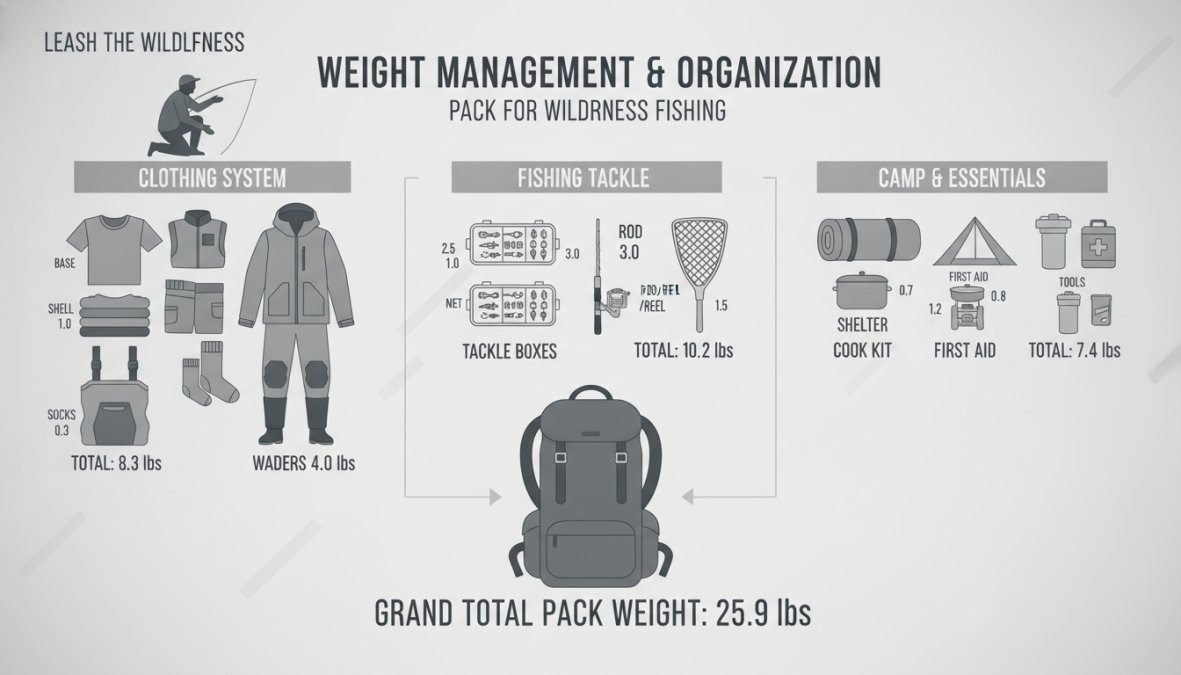
Cubic Inches and Backpack Sizing for Fly-In and Backpacking Trips
Pack size matters enormously. Too small and you'll overstuff everything, creating an uncomfortable pack. Too large and you'll pack unnecessary items just to fill space. Most wilderness fishing packs range from 40-65 liters.
Cubic inches convert to liters by dividing by 61. A 2,500 cubic-inch pack equals roughly 41 liters, appropriate for 3-4 day trips. A 3,500 cubic-inch pack (57 liters) handles 5-7 day expeditions. Fly-in fishing trips where you're flown directly to a remote lake can use smaller packs. Backpacking trips where you hike to your fishing destination require larger packs to carry food and camping gear.
Most quality packs cost $200-400 and last 10+ years with proper care. Osprey, Gregory, and Arc'teryx make packs specifically designed for wilderness fishing and backpacking. Pack fit matters more than brand. Visit an outdoor retailer and try on multiple packs with weight inside. Your pack should sit snugly on your hips, with the shoulder straps angled slightly back.
Wilderness fishing demands careful planning, but the payoff is solitude and fishing opportunities unavailable to casual anglers. The right gear, selected thoughtfully and organized strategically, transforms a potentially miserable experience into an unforgettable adventure. Proper gear choices directly reduce environmental impact while improving your trip safety and comfort. Start with a quality backpack, add a proven layering system, and pack strategically. Your feet, shoulders, and mind will thank you when you're standing in a remote stream catching fish that few people ever experience.
Frequently Asked Questions
What's the difference between packing for a fly-in fishing trip versus backpacking into wilderness?
Fly-in trips allow heavier gear since weight limits are less restrictive than backpacking. For backpacking wilderness fishing, prioritize ultralight tackle and consolidated gear measured in cubic inches. Fly-in trips benefit from redundant safety items and comfort gear; backpacking requires ruthless weight management. Both demand waterproof organization and field-tested reliability, but backpacking demands gear that earns its space through multiple functions.
How do I keep my pack weight manageable when packing for wilderness fishing trips?
Start with a base weight budget, typically 15-20 pounds for a week-long trip. Invest in ultralight fishing gear: titanium cookware, lightweight waders, and compact tackle boxes. Use ziploc bags instead of bulky storage. Consolidate items: one multi-tool replaces several tools. Choose layering pieces that work across conditions. Every item must justify its weight by serving multiple purposes or being essential for safety and fishing success.
What should I include in a first aid kit for remote wilderness fishing?
Beyond standard bandages and pain relief, include blister treatment (critical for hiking to fishing spots), tweezers for hook removal, antibiotic ointment, elastic wrap for sprains, and high-dose ibuprofen. Add sanitary wipes for field hygiene and wound cleaning. Include a small emergency shelter (space blanket) and a whistle for signaling in dead zones where GPS and communication fail. Field-tested kits prioritize injuries specific to angling: cuts from tackle, sunburn, and dehydration.
How do I practice leave-no-trace principles while packing for and processing fish in wilderness?
Pack out all waste in ziploc bags, no exceptions. For post-catch processing, pack a small fillet knife and use biodegradable soap to clean fish away from water sources. Bury fish scraps 200+ feet from water, or pack them out. Use established campsites to concentrate impact. Never discard fishing line or tackle. Bring a waste bag system and plan your meal strategy before the trip to avoid excess packaging. Leave No Trace starts with packing intentionally.
This article was written using GrandRanker