

Table of Contents
- Why High Visibility Matters for Small Dogs in the Field
- Understanding Blaze Orange vs. Reflective Trim for Hunting Season
- Dog Safety Vest Sizing Guide: Measuring Your Small Breed
- Key Features to Look for in a Safety Vest
- Rugged Dog Gear for Outdoor Adventures: Comfort and Range of Motion
- Integration with Existing Gear and Harness Compatibility
- Day-Time vs. Night-Time Visibility: What Your Small Dog Actually Needs
- Conclusion
Last Updated: August 25, 2026
Why High Visibility Matters for Small Dogs in the Field
Small dogs face a specific visibility problem that larger breeds don't. When a dog stands waist-high in brush or tall grass during hunting season, a hunter scanning the field sees obstacles and movement, not necessarily a dog. Blaze orange changes that equation. A high-visibility vest makes your small dog unmistakable, even at distance, even in poor light.
A small dog in camouflage colors blends into the environment in ways that larger dogs don't. Their lower profile means they disappear into shadow, tall grass, and terrain features faster. Add hunting season into the mix, and the risk multiplies. Hunters are focused on game, scanning quickly, and making split-second decisions. A blaze orange vest eliminates ambiguity.
Understanding Blaze Orange vs. Reflective Trim for Hunting Season
Blaze orange and reflective trim serve different purposes. Blaze orange is a fluorescent color that's highly visible to the human eye in daylight. It doesn't glow; it reflects ambient light in a way that makes it stand out against natural backgrounds. Blaze orange is mandated for hunters in most states during hunting season because it's visible at distance in daylight conditions.
Reflective trim only works when light hits it directly and bounces back toward the source. In daylight, reflective trim is nearly invisible. At night, it's highly effective. For small dogs in the field during hunting season, blaze orange is the primary requirement. Reflective trim is a bonus, useful for early morning hunts, late evening returns, or if your dog ventures near roads.
Many small dog owners buy vests that are mostly reflective with minimal blaze orange coverage. In reality, reflective trim is nearly useless in daylight, the exact time when hunting season visibility matters most. A proper safety vest for small dogs prioritizes blaze orange coverage, then adds reflective trim as a secondary layer.
Dog Safety Vest Sizing Guide: Measuring Your Small Breed
Sizing a blaze orange vest for a small dog is where most purchases fail. Too loose, and the vest shifts during movement, leaving gaps where your dog's body shows through. Too tight, and you restrict breathing and range of motion.
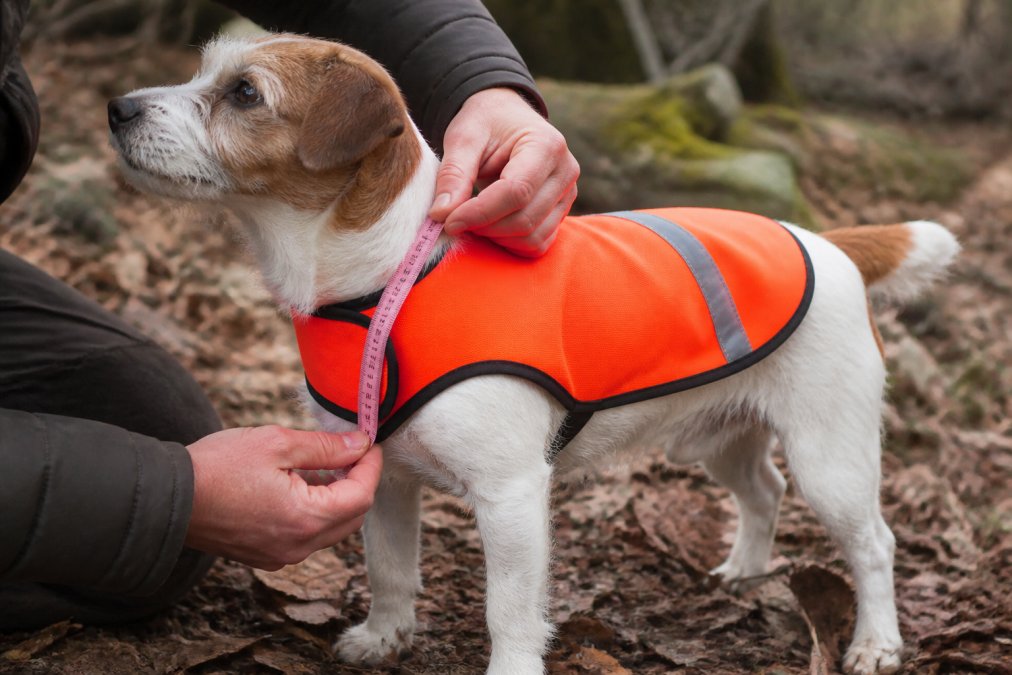
Taking Chest and Neck Measurements
Start with chest measurement. Wrap a soft measuring tape around the widest part of your dog's chest, just behind the front legs. Keep the tape snug but not compressing. For small dogs, chest measurement typically ranges from 12 to 20 inches.
Neck circumference is your second measurement. Measure around the base of your dog's neck, where a collar sits. For small dogs, neck circumference usually ranges from 8 to 14 inches. The gap between chest and neck measurement matters. A vest designed for that ratio will fit properly.
Take both measurements while your dog is standing naturally on all four legs. A comfortable fit on the measuring tape translates to a comfortable fit in the vest.
Weight-to-Vest Ratio for Small Dogs
A blaze orange vest adds weight. For a 12-pound dog, a 1-pound vest represents 8% of body weight. That's material.
Small dogs under 15 pounds should wear vests under 12 ounces (aaha.org). Small dogs between 15 and 25 pounds can handle vests up to 1.5 pounds. Anything heavier creates fatigue and discourages movement. Check the vest weight before purchasing. If weight isn't specified, contact the seller.
A properly fitted, lightweight vest should feel like part of the dog's gear, not a burden. Your small dog should move normally, turn sharply, and climb without hesitation.
Key Features to Look for in a Safety Vest
Not all high-visibility vests are built the same. Small dogs need specific features that larger-dog vests often skip.
Material Durability and Weather Resistance
Field work means mud, brush, water, and weather. Look for denier nylon as the primary material. For small dog vests, 600D to 1000D nylon provides good durability without excessive weight (peer-reviewed research). Below 400D, the fabric tears easily. Above 1200D, the weight becomes problematic for small dogs.
Water resistance is separate from waterproofing. A water-resistant vest sheds light rain and morning dew. For hunting season, water-resistant is usually sufficient.
Check the stitching. Durable stitching uses reinforced seams, usually visible as double or triple lines of thread. Single-line stitching fails under stress. For small dogs that move unpredictably through brush, reinforced seams matter.
Adjustability and Strap Systems
Small dogs come in different shapes. Adjustability is what makes a vest work across body types. Look for multiple adjustment points: chest straps, side straps, and neck closures. Each adjustment point should use quick-release buckles or velcro, not knots.
Velcro closures are fast but wear out after repeated use. Quick-release buckles are more durable but take slightly longer to adjust. A mix of both is ideal.
Test the strap system before purchasing. Can you adjust it one-handed? Can you tighten it without cutting off circulation? For field work, speed and reliability matter more than perfection.
Rugged Dog Gear for Outdoor Adventures: Comfort and Range of Motion
A vest that restricts your small dog's movement defeats the purpose. Your dog needs to run, turn, climb, and navigate terrain without fighting the gear.
Proper fit is the foundation. The vest should sit centered on the dog's back, covering the spine and sides without extending too far forward or backward. Armholes should be large enough that your dog's legs move freely. Many small dog vests have undersized armholes that pinch during movement.
The vest should not ride up during movement. A properly fitted vest stays in place during active movement, running, jumping, and sharp turns.
Breathability matters for small dogs more than large ones. Small dogs have higher metabolic rates and smaller surface area for heat dissipation. Look for mesh panels or ventilation gaps that allow air circulation.
Consider the terrain your dog will navigate. Rocky terrain, dense brush, and water crossings all demand different things from a vest. Match the vest design to your hunting environment.
Integration with Existing Gear and Harness Compatibility
Most small dogs already wear collars and harnesses. A new vest needs to work with what's already in place.
Check harness compatibility before purchasing a vest. Some vests are designed to go over harnesses; others require the harness to be removed. If your dog is used to a specific harness for field work, you want a vest that accommodates it.
The vest should not interfere with collar attachment points. Your dog's ID tags and leash need to stay accessible. If you use a working harness for your small dog, the vest should sit above or below it without overlap.
Day-Time vs. Night-Time Visibility: What Your Small Dog Actually Needs
The visibility equation changes depending on when you hunt. During daylight hours, the primary hunting season window, blaze orange is the only visibility tool that matters. The human eye sees blaze orange at 100+ yards in good conditions, at 50 yards in overcast conditions, and at 30 yards in heavy brush (the CDC).
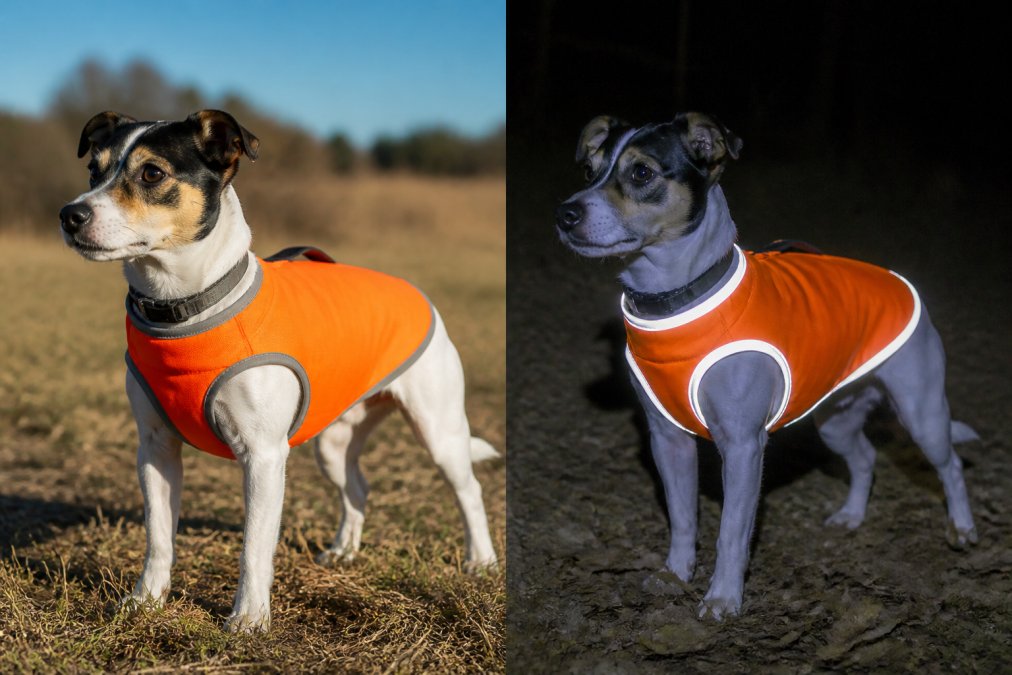
At night or in very low light, blaze orange becomes nearly invisible. Reflective trim, activated by a flashlight or headlamp, becomes your visibility tool. Most small dogs hunting during daylight don't need reflective trim. They need blaze orange coverage and nothing else.
The exception: if you hunt near roads or if your small dog ever ventures near vehicle traffic, reflective trim becomes important. Vehicle headlights activate reflective material at distance. For safety near roads, reflective trim is the tool that works.
A practical approach for small dogs is to prioritize blaze orange coverage during hunting season, then add reflective trim if your hunting environment includes road proximity or low-light conditions. Don't sacrifice blaze orange coverage to add reflective trim. The order of priorities is: blaze orange first, reflective trim second.
Choosing a blaze orange vest for your small dog comes down to three decisions: fit, durability, and visibility coverage. Measure twice, test the fit with your dog moving naturally, and verify that the blaze orange coverage is substantial enough to be visible at distance. A vest that's too loose, too heavy, or inadequately colored fails in the field. A vest that fits properly, uses durable materials, and prioritizes blaze orange coverage keeps your small dog visible and safe during hunting season.
At Leash the Wilderness, we understand that small dogs need gear designed for their specific biomechanics. Our curated selection of field-tested equipment includes vests and safety gear engineered for dogs under 25 pounds, with attention to weight-to-body-ratio and harness compatibility. When you're equipping a small dog for serious field work, gear that's been tested in real conditions is what separates a safe outing from a close call. Shop our collection of small-dog safety gear and find the vest that matches your hunting environment and your dog's build.
Frequently Asked Questions
Q: Why is blaze orange essential for small dogs in the field?
A: Blaze orange (also called hunter orange or fluorescent orange) is legally required wear for hunters during hunting season in most states. Small dogs are harder to spot than larger animals, especially in brush or low-light conditions. A high-visibility blaze orange vest makes your dog instantly recognizable to other hunters, reducing the risk of accidental shooting. This precautionary gear is a critical safety measure that can help keep your dog safe when other hunters are in the area.
Q: How do I measure my small dog for a proper vest fit?
A: Start by measuring your dog's chest girth (the widest part around the ribcage, just behind the front legs) with a soft measuring tape. Write down the measurement in inches. Next, measure the neck circumference where a collar would sit. Most small-breed vests size by chest measurement. A snug fit is important, you should be able to fit one finger between the vest and your dog's body. The vest should not restrict range of motion or cause chafing. If your dog is between sizes, choosing the smaller size can help prevent the vest from sliding or riding up during activity.
Q: What's the difference between blaze orange fabric and reflective trim?
A: Blaze orange (fluorescent fabric) is visible during daylight and low-light conditions because of its bright color. Retro-reflective trim bounces light back to its source, making it visible at night when a flashlight or headlights hit it. The best small-dog vests combine both: solid blaze orange panels for day visibility and reflective trim accents for night safety. Blaze orange alone will not be visible in complete darkness, so if your dog hunts during dawn or dusk, reflective elements can be a useful backup.
Q: Will a safety vest restrict my small dog's movement?
A: A properly fitted vest should not restrict range of motion. Lightweight denier nylon and breathable fabrics allow your dog to move naturally while hunting or hiking. The key is correct sizing and adjustable straps that don't bind the shoulders or hindquarters. Poor fit causes chafing and discomfort; proper fit means your dog won't even notice it's wearing the vest. Test the vest during short walks before heading to the field to ensure your dog moves freely and comfortably.
This article was written using GrandRanker