

Table of Contents
- Why Essential Survival Kits for Backcountry Hunting Matter
- The 10 Essentials Framework for Backcountry Hunters
- Building Your Backcountry Hunting Gear List
- Wilderness Survival Skills for Hunters Beyond Gear
- Maintenance and Expiration Checks for Survival Gear
- Field-Tested Kits Ready to Go
- Conclusion: Prepare Once, Hunt With Confidence
Essential Survival Kits for Backcountry Hunting: A 2026 Guide
Last Updated: July 25, 2026
When you're miles from the truck in unforgiving terrain, the difference between a successful hunt and a survival situation comes down to preparation. Essential survival kits for backcountry hunting aren't luxury items, they're the foundation of every responsible trip into remote country. What separates experienced backcountry hunters from those who panic is having the right kit assembled before weather turns or injury happens.
This guide covers essential survival kits that actually work in the field, adapted from the 10 Essentials framework, and explains how to build a kit balancing weight against utility.
Why Essential Survival Kits for Backcountry Hunting Matter
Getting lost, injuries, and sudden weather changes happen to experienced hunters. A survival kit is the difference between an uncomfortable night and a life-threatening situation.
Backcountry hunting demands more than standard hiking gear. You're carrying a weapon, navigating by map and compass while glassing for game, moving through terrain where a twisted ankle means immobilization miles from help. Your survival kit must address hunting-specific injuries, provide shelter and fire in remote areas, and keep you signaling for rescue if something goes wrong.
Most hunters underestimate weight, but cutting corners on essential gear is how people die in survivable conditions. The solution is choosing items with multiple uses and ruthlessly prioritizing what saves lives.
The 10 Essentials Framework for Backcountry Hunters
The 10 Essentials originated with mountaineers and have been refined by decades of backcountry experience. For hunters, these are the baseline:
- Navigation tools (map, compass, GPS device)
- Emergency shelter (tarp, bivy sack, emergency blanket)
- Fire starting equipment (waterproof matches, lighter, fire starter)
- Water filtration and purification (filter, tablets, or boiling method)
- First aid kit (hunting-specific injuries)
- Insulation and cold weather gear (base layers, jacket, hat, gloves)
- Sun protection and apparel (sunscreen, hat, long sleeves)
- Communication and SOS devices (satellite communicator, whistle, mirror)
- Repair kit and multi-tool (knife, tape, cordage, sewing kit)
- Emergency rations (high-calorie food, energy bars, nuts)
A lightweight emergency blanket prevents hypothermia and takes up almost no space. A quality multi-tool handles field repairs and emergency shelter building. A satellite communicator summons rescue when cell service doesn't exist.
Navigation Tools for Backcountry Hunting
Getting lost burns calories, impairs judgment, and triggers panic. A topographic map and compass are non-negotiable. A topo map shows elevation, water sources, ridgelines, and terrain features GPS can't convey. A compass works without batteries.
A GPS device adds speed and precision, but know how to use map and compass as backup. Many lost hunters carried GPS devices they didn't know how to operate. Practice navigation skills before the hunt.
Mark your vehicle location, camp, and known water sources on your map before leaving. Use GPS to waypoint key terrain features. When visibility drops, navigate by reference points, not guessing.
Emergency Shelter and Tarp Systems
Hypothermia kills faster than hunger or thirst. Emergency shelter breaks wind and retains body heat.
An emergency bivy sack or space blanket is ultralight and compact, weighing under four ounces. These reflective materials trap body heat and block wind. A lightweight emergency tarp (five-by-seven feet) offers more versatility, rigging as a lean-to, ground cover, or windbreak. Paired with paracord, it provides shelter from rain and wind while keeping weight minimal.
For multi-day hunts in alpine terrain, a quality sleeping bag rated for expected temperatures is essential. For day hunts or short overnight trips, an emergency blanket and tarp handle most situations.
Fire Starting Techniques and Equipment
Fire provides warmth, water purification, psychological comfort, and signaling capability. Carry multiple fire-starting methods so a single failure doesn't leave you without fire.
Waterproof matches are simple and reliable. A quality lighter works in cold and wind better than most expect. Ferrocerium rods generate sparks reliably in wet conditions and work when wet, function at altitude, and last for hundreds of strikes. Pair one with char cloth, small pieces of cotton treated to ignite easily from a spark.
In the field, gather tinder (dry grass, bark, small twigs), kindling (pencil-sized sticks), and fuel wood (arm-sized branches) before lighting anything. Most fire failures happen because people try to light large wood directly. Build up gradually from small to large.
Know how to find dry tinder in wet conditions. Look for dead standing wood, the inside of dead trees, and the underside of fallen logs. Birch bark burns even when wet.
Water Filtration and Purification
Dehydration impairs judgment faster than hunger. A lightweight water filter removes bacteria and protozoa. Squeeze filters are compact and effective. Water purification tablets (iodine or chlorine dioxide) are ultralight backup, taking 30 minutes or more but requiring no equipment beyond a container.
Boiling is the most reliable purification method but requires fire and a container. A combination approach works best: filter for speed and taste, tablets for backup, boiling for thorough purification. Carry at least two methods.
In the backcountry, water sources are usually available but require purification. Follow contour lines downhill, listen for running water, look for animal trails converging. Avoid stagnant water and sources downstream from obvious animal activity.
First Aid Kit for Hunting Emergencies
Hunting injuries differ from hiking injuries. You're dealing with cuts from field dressing, falls on steep terrain, and shock that comes with trauma.
A commercial first aid kit is a starting point, but add hunting-specific items: trauma dressings (larger than standard bandages), a tourniquet, and pressure bandages. Know how to apply a tourniquet, it's a lifesaving skill for severe bleeding.
Blister prevention and treatment matter on long hunts. Moleskin and blister pads prevent foot problems that force you to stop moving. Pain medication (ibuprofen, acetaminophen) reduces suffering and helps you function if injured. Antibiotic ointment and sterile gauze handle minor cuts. Elastic bandages (ACE wraps) stabilize sprains.
The goal is stabilizing injuries and managing pain until you reach medical help. Know your limits. If a wound is severe, focus on stopping bleeding, keeping the person warm, and signaling for rescue.
Insulation and Cold Weather Gear
Hypothermia is the primary killer in backcountry hunting situations. Base layers (merino wool or synthetic) wick moisture away from skin. Cotton holds moisture and loses insulating value when wet.
A mid-layer jacket (fleece or lightweight down) adds warmth without excessive weight. A waterproof outer shell (rain jacket and pants) blocks wind and water. Many hunters skip rain gear to save weight, then suffer through wet conditions that accelerate hypothermia.
A warm hat is critical, you lose significant heat through your head. Gloves or mittens let you function in cold. Mittens are warmer but reduce dexterity. Many hunters carry both.
Know the expected temperature range and plan for conditions colder than forecast. Weather changes fast in mountains.
Communication and SOS Devices
When things go wrong, communication saves lives. Cell service doesn't exist in most backcountry hunting areas.
A satellite communicator (such as Garmin InReach or SPOT) sends your location to rescue services and allows two-way communication. These devices work anywhere with clear sky view. For serious backcountry hunting, they're worth the cost.
A personal locator beacon (PLB) sends a distress signal to search and rescue but doesn't allow two-way communication. A whistle signals rescuers and works without batteries. Three blasts is the universal distress signal. A signal mirror reflects sunlight and can be seen for miles on clear days.
A headlamp with extra batteries serves multiple purposes: navigation, signaling, and emergency light. For serious backcountry hunting, a satellite communicator is the most reliable backup.
Building Your Backcountry Hunting Gear List
Assembling a survival kit requires balancing weight, utility, and coverage. Start with the 10 Essentials. For each category, choose the lightest option that actually works.
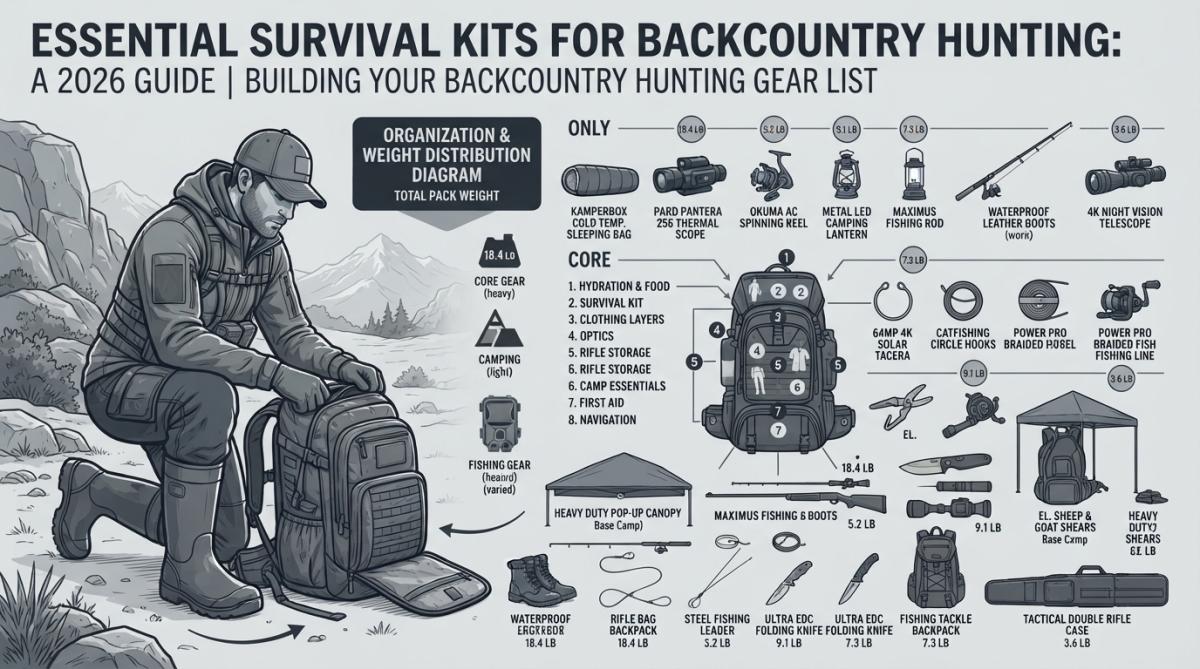
Weight matters. Most backcountry hunters carry packs between 30 and 50 pounds depending on hunt length and terrain. Adding a pound of survival gear is acceptable if it prevents a life-threatening situation.
Test your kit before the hunt. Know how to use every item. A tourniquet you've never applied is useless in an emergency. A water filter you've never operated might fail when you need it.
Weight-to-Utility Ratio Analysis
The best survival gear provides maximum benefit with minimum weight. An emergency blanket weighs less than two ounces and prevents hypothermia, exceptional utility for weight. A satellite communicator weighs eight ounces and provides communication and location, high utility, acceptable weight.
A lightweight tarp weighs six ounces and provides shelter. A full tent weighs two pounds. For backcountry hunting where you're mobile, the tarp is better weight-to-utility. A water filter weighs four ounces. Carrying water instead of filtering it adds five pounds per liter. The filter is better weight-to-utility.
Build your kit by eliminating items that don't solve real problems. Comfort items get left behind. Life-saving items get carried regardless of weight.
| Item | Weight | Primary Use | Utility Rating |
|---|---|---|---|
| Topo map | 0.5 oz | Navigation | Critical |
| Compass | 0.8 oz | Navigation backup | Critical |
| Emergency blanket | 1.5 oz | Hypothermia prevention | Critical |
| Ferro rod + char cloth | 1.2 oz | Fire starting | Critical |
| Lightweight water filter | 4 oz | Water purification | Critical |
| First aid basics | 8 oz | Injury management | Critical |
| Base layer jacket | 6 oz | Insulation | Critical |
| Rain jacket | 5 oz | Wind/water protection | Critical |
| Satellite communicator | 8 oz | Emergency communication | Critical |
| Multi-tool | 4 oz | Repair and utility | Important |
Scenario-Based Kit Customization
A one-size-fits-all kit doesn't exist. Customize based on your specific hunt.
Day hunt in familiar terrain: Minimal kit. Map, compass, fire starter, emergency blanket, first aid basics, insulation layer, communication device. Weight under five pounds.
Multi-day backpack hunt in alpine terrain: Full kit. Everything in the 10 Essentials plus extra insulation, more substantial shelter, larger first aid kit, water filtration, and high-calorie food. Weight five to ten pounds for the survival kit alone.
Backcountry hunt in grizzly country: Add bear spray, larger first aid kit for animal encounters, and more substantial shelter. Consider a satellite communicator if hunting alone.
Winter hunt: Extra insulation, larger emergency shelter, more fire-starting materials, high-calorie food, and avalanche safety equipment if in avalanche terrain.
For each hunt, write down the specific hazards: distance from help, expected weather, terrain difficulty, water availability, wildlife, and seasonal conditions. Build your kit to address those hazards.
Wilderness Survival Skills for Hunters Beyond Gear
Gear is useless without skills. A survival kit containing a water filter doesn't help if you don't know how to find water. A fire starter doesn't work if you can't build a fire.
Psychological Survival and Decision-Making
When things go wrong, panic kills faster than cold or hunger. Accept early that you might spend an unplanned night in the backcountry. This mental acceptance prevents panic when it happens.
Prioritize: shelter, fire, water, food, in that order. Build shelter first to prevent heat loss. Get fire going to provide warmth and water purification. Find water. Eat if food is available. This priority order has saved countless lives.
Make decisions slowly. Your first instinct when lost is often to push forward harder, which burns calories and increases panic. Stop, orient yourself with map and compass, and make a deliberate plan. Staying put and signaling for rescue is often the right choice.
Hypothermia Prevention and Recognition
Prevent hypothermia by managing heat loss: insulation, shelter, dry clothing, and adequate calories. Wet clothing loses insulation, change out of wet gear before you get cold.
Recognize early hypothermia: shivering, confusion, poor coordination, slurred speech, and irrational behavior. Get them to shelter, remove wet clothing, and provide warmth. Assume that anyone who's been wet and cold for hours might be developing hypothermia even if they deny it.
Maintenance and Expiration Checks for Survival Gear
A survival kit that hasn't been checked in years might fail when you need it. Check water purification tablets annually and replace if expired. Inspect first aid supplies and replace items as needed. Test fire starters before season. Check GPS and satellite communicator batteries annually.
Inspect insulation for damage. Review your map before each hunt and test navigation skills. Establish an annual maintenance schedule: early fall before season, mid-season, and after season. Thirty minutes of maintenance prevents gear failures when you're miles from help.
Field-Tested Kits Ready to Go
If assembling a kit from individual items feels overwhelming, several manufacturers offer pre-built survival kits. Quality matters, established outdoor brands have tested their kits in real conditions and refined them based on field experience.
For hunters, consider kits specifically designed for hunting rather than general hiking. A hunting-focused kit includes items for field dressing injuries, higher-calorie food, and shelter suitable for mobile hunting.
Rather than selling generic pre-built kits, we recommend building your kit based on your specific hunt. This approach costs more in time but results in a kit optimized for your hunting style and terrain.
Conclusion: Prepare Once, Hunt With Confidence
Building an essential survival kit for backcountry hunting requires thinking through scenarios you hope never happen. Most hunters will never need their survival kit. But the hunters who do need it, who get injured, lost, or stranded, are the ones who prepared.
The difference between an uncomfortable night and a life-threatening situation is preparation. A survival kit that stays in your pack, tested and maintained, is the foundation of backcountry hunting confidence. You can focus on hunting, on the landscape, on the challenge of the pursuit, because you know that if something goes wrong, you have the tools and knowledge to manage it.
Start with the 10 Essentials. Add hunting-specific items based on your terrain and season. Test everything before you hunt. Maintain your kit annually. Hunt with confidence knowing that you're prepared for what the backcountry might throw at you.
At Leash the Wilderness, we equip hunters who demand gear that works when conditions turn brutal. Our [Deer Scouting Kit](https://leashthewilderness.com/products/deer-scouting-kit-trail-camera-20x50-binoculars-1000m-rangefinder-bundle) combines navigation and reconnaissance tools built for serious backcountry work. We also carry the Hunters Optics Kit, which provides the precision optics and rangefinding that let you hunt effectively at distance. Every piece of gear we recommend is field-tested because we hunt the same terrain and understand what actually works when the road ends. Prepare your essential survival kit with quality components, and you'll hunt with the confidence that comes from being genuinely ready for what the backcountry demands.
Frequently Asked Questions
What should be in a backcountry hunting survival kit?
A complete kit includes navigation tools (map, compass, GPS), emergency shelter, fire starters, water filtration, first aid supplies, insulation layers, signaling devices, and a multi-tool. The 10 essentials framework ensures you cover all critical survival needs. Prioritize items based on season, terrain, and expected hunt duration. Field-tested gear from reputable outdoor suppliers ensures reliability when conditions turn harsh.
How do you customize a backcountry hunting gear list for different seasons?
Winter hunts require insulated sleeping bags, base layers, and extra fire-starting materials. Spring and fall need rain gear and moderate insulation. Summer kits can be lighter but still include sun protection and emergency shelter. Scenario-based customization means adjusting water filtration capacity, clothing weight, and emergency ration quantity based on expected temperature ranges, precipitation, and hunt duration in your specific backcountry region.
What wilderness survival skills for hunters matter most in emergencies?
Psychological survival, staying calm and thinking clearly, is often more critical than gear. Recognize early signs of hypothermia in yourself and hunting partners. Know how to signal for rescue using mirrors, whistles, or SOS devices. Understand basic shelter construction, water purification, and fire management. Practice these skills before you need them; muscle memory and confidence reduce panic and poor decisions when conditions deteriorate.
How often should I check and replace items in my first aid kit for hunting?
Inspect your first aid kit for hunting at least twice yearly, before hunting season and mid-season. Check expiration dates on medications, antiseptics, and bandages. Replace any items you've used. Ensure blister treatments, pain relievers, and antibiotic ointments are current. Store kits in cool, dry conditions to extend shelf life. A compromised first aid kit creates false confidence; replace it rather than guess about effectiveness.
What navigation tools for backcountry hunting are most reliable without batteries?
Topographic maps and a quality compass never fail, they don't require batteries or signal. Carry a waterproof map case and know how to orient a map using landmarks and compass bearing. GPS devices are excellent backups but always fail eventually. Combine map-and-compass navigation with GPS as a redundancy. Practice navigation skills at home; backcountry hunts are not the place to learn how to read a topo map or take a bearing.
Can I use a lightweight survival kit for casual day hunts, or is full gear necessary?
Day hunts still require core survival items, navigation, fire starter, first aid, emergency shelter, and water. A lightweight kit works if you stay within planned boundaries and have reliable communication. Carry a charged phone and tell someone your expected return time. Weather changes fast in backcountry terrain; even a short hunt can become an overnight emergency. Lightweight doesn't mean unprepared; it means prioritizing essentials and cutting unnecessary weight.
External Sources Referenced
[EXTERNAL_LINK: National Outdoor Leadership School wilderness survival principles | nols.org]
[EXTERNAL_LINK: American Red Cross wilderness first aid guidelines | redcross.org]
[EXTERNAL_LINK: U.S. Forest Service backcountry safety and preparedness | fs.usda.gov]
This article was written using GrandRanker