

Table of Contents
- How Thermal Optics Work in Daylight
- Thermal Imaging Limitations in Heat
- Thermal Scope Daytime Zeroing: Can You Do It?
- Thermal Monoculars vs. Riflescopes for Daytime Use
- Legal Considerations for Daytime Thermal Hunting
- Maintenance and Lens Care in Dusty Conditions
- Frequently Asked Questions
Last Updated: September 10, 2026
How Thermal Optics Work in Daylight
Yes, thermal optics work for daytime hunting, but not the way most people expect. Thermal imaging detects infrared radiation, the heat every animal and object gives off, not visible light. A thermal unit reads heat signatures through fog, brush, and shadows that hide game from glass.

Daylight doesn't switch a thermal sensor off. It changes the contrast. At dawn, a deer's body heat stands out hard against cool ground. By early afternoon, sun-baked rocks and soil run as warm as the animal you're trying to find. Pull a thermal out at noon, see gray soup, and assume it's broken? It isn't. The scene has gone flat.
Below: how thermal optics perform in daylight, where they fall short, and how to get a usable image when the sun is high.
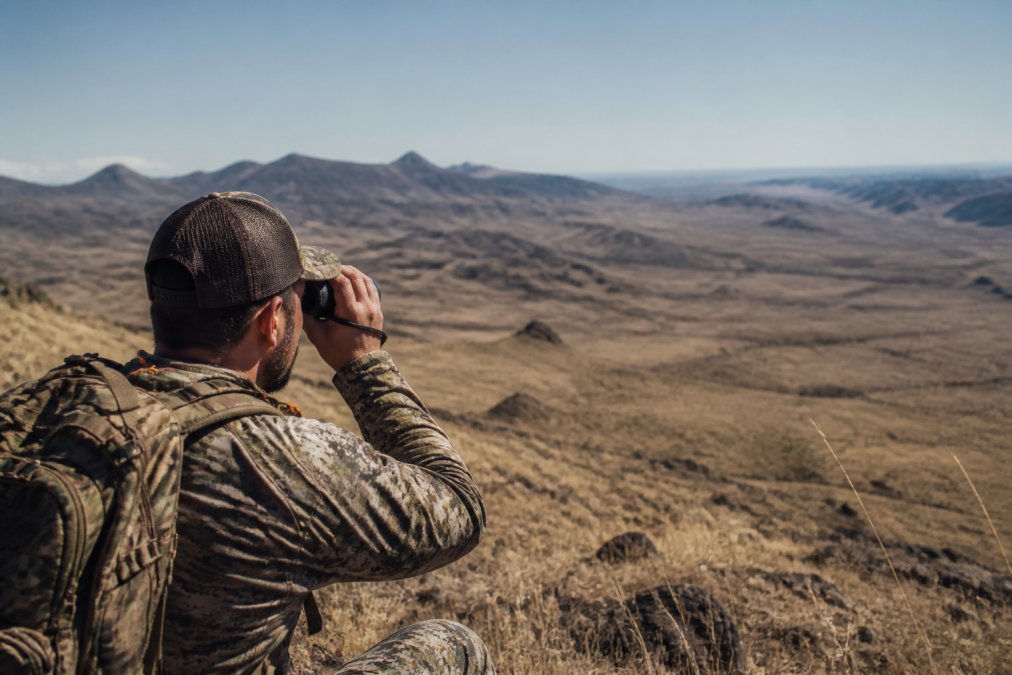
Infrared Radiation and Heat Signatures
Infrared radiation is the invisible energy every object emits in proportion to its temperature. A thermal sensor, usually a microbolometer, reads that energy and converts it into an image. Warmer objects show bright; cooler objects show dark. You're seeing heat, not light.
The practical difference: a deer behind brush still emits heat. A high-end glass scope can't see through that brush. A thermal unit often can, because the heat signature bleeds through gaps in the cover.
Thermal Contrast vs. Visible Light
Visible light and thermal contrast are two different currencies. Visible light depends on reflected photons reaching your lens. Thermal contrast depends on the temperature difference between target and background.
That distinction matters most at dawn and dusk, when ambient temperature drops fast and animal bodies stay warm. It matters least at midday, when solar loading heats everything in the frame. Daytime thermal performance is a timing game, not a yes-or-no question.
Thermal Imaging Limitations in Heat
The biggest limitation of thermal imaging in heat is thermal contrast collapse. When ground, rocks, and vegetation reach similar temperatures, the sensor has almost nothing to separate your target from the background. A deer at 101°F against 95°F ground barely registers (peer-reviewed research). The same deer against 60°F ground at dawn pops instantly.
This isn't a sensor failure. It's physics. A lower NETD (noise equivalent temperature difference) holds detail longer into the day, but no sensor beats a flat thermal scene.
Solar Loading and Thermal Crossover
Solar loading is the heat absorbed by rocks, soil, and vegetation from direct sunlight. By mid-afternoon, a south-facing rock slab can read warmer than a bedded animal. Thermal crossover is where target and background temperatures converge and the image washes out.
Two things help here:
- Hunt early morning or late evening when temperature spread is widest
- After a cold front, when ambient temps drop and animals stay warm
A common mistake is buying a bigger lens to fix midday washout. Bigger glass improves detection range, not thermal contrast. If the scene is flat, more magnification just gives you a bigger flat image.
Thermal vs. High-End Glass by Game and Scenario
This is where the 'does thermal work in daylight' question gets answered. It depends on what you're hunting and when.
Bedded deer in timber, midday. High-end glass wins. A bedded deer in shade is often cooler than the sunlit ground around it, inverting the thermal signature so the animal reads as a dark blob against a bright background. Good binoculars resolve the ear flick and horizontal back line that tell you it's a deer. Thermal at noon in timber is gray soup.
Bedded deer at first light. Thermal wins. The temperature spread is widest, and a deer's body heat stands out against cool ground even through brush. You'll find animals with thermal that you'd walk past with glass.
Predator hunting, any daylight hour. Thermal wins, and it's not close. Coyotes and foxes run hot against most terrain and often sit in cover where glass can't see them. A thermal monocular at 10 a.m. picks up a coyote in tall grass that binoculars miss entirely.
Feral hogs in thick cover. Thermal wins. Hogs run warm and move in groups, and the heat signature of a sounder is unmistakable even when the animals are invisible to the eye.
Open-country pronghorn or mule deer at distance. High-end glass wins during daylight. You're judging animals at 600+ yards, and thermal resolution at that range in daylight won't let you age a buck or count points.
Game recovery after the shot. Thermal wins. A downed animal in tall grass or brush is exactly the scenario thermal was built for, and it works in full daylight.
The pattern: thermal is a detection tool, glass is an identification tool. In daylight, use thermal to find heat and glass to confirm what you found. Hunters who make one do both jobs end up frustrated.
What NETD Actually Means in Daylight
NETD is measured in millikelvins (mK). Lower is better. A 25 mK sensor resolves smaller temperature differences than a 40 mK sensor, so it holds contrast longer as the day heats up (flir.com).
In practice, a sub-30 mK unit gives you usable image an hour or two later into the morning than a 40+ mK unit. That's the difference between finding a bedded buck at 9 a.m. and giving up at 8.
Don't buy on NETD alone. Sensor resolution (384x288 or 640x480), lens size, and display all matter. A 640-resolution sensor with 40 mK often out-resolves a 384 sensor with 25 mK in daylight because you have more pixels on target.
If the spec sheet doesn't list NETD, ask the manufacturer directly.
Thermal Scope Daytime Zeroing: Can You Do It?
Yes, you can zero a thermal scope in daylight, and it's often easier than at night. Paper targets hold ambient temperature differently than the surrounding berm, so a target shows as a distinct heat signature against cooler dirt. The catch: a hot barrel, sun-warmed paper, or a heat-soaked shooting mat can throw your point of aim.
For daytime zeroing, use a target you can also see with the naked eye or through backup glass. Confirm your thermal reticle aligns with actual point of impact, not just the heat blob.
PARD TD32 Thermal Imaging Scope, Waterproof LRF Digital Camera for Hunting | LTW
🛒 Shop the PARD TD32 Thermal Imaging Scope →
The PARD TD32 pairs a thermal sensor with a built-in laser rangefinder, so you're not juggling a separate rangefinder when a shot window opens. Waterproof construction handles rain and dust without a cover. It costs $3,299.00, so it's not for a casual weekend shooter.
Calibration Techniques for High-Sun Environments
Non-uniformity correction (NUC) is how a thermal unit cleans up sensor noise, and it matters more in high sun than at night. Most units run an automatic NUC on a timer or when the scene changes. In bright, hot conditions, force a manual NUC before you glass.
A few field-tested habits:
- Let the unit acclimate 10-15 minutes before you trust the image
- Force a manual NUC against a uniform surface (open sky, a shaded wall)
- Lower brightness and gain if the image is washing out
- Avoid pointing the lens at direct sun, which can damage the sensor
If you're running a thermal monocular for scouting, the same rules apply. Calibration isn't a one-time setup. It's a habit you repeat through the day.
Thermal Monoculars vs. Riflescopes for Daytime Use
Thermal monoculars win for daytime scouting. Thermal riflescopes win for daytime shooting. That's the short version.
A monocular is a spotting tool. You scan, find heat signatures, then switch to your day scope for the shot. It's lighter, cheaper, and better for covering ground. A thermal riflescope stays mounted and lets you shoot through the same optic you use to find game, a real advantage in thick cover where animals appear and vanish fast.
| Feature | Thermal Monocular | Thermal Riflescope |
|---|---|---|
| Primary use | Scouting, spotting | Aiming and shooting |
| Weight | Lighter, pocketable | Heavier, mounted |
| Best for | Daytime glassing, game recovery | Close-cover hunting, night work |
| Typical cost | Lower | Higher |
| Recoil rated | No | Yes |
For most hunters, a monocular plus a solid day scope covers more ground than a thermal riflescope alone. If you hunt tight timber where shots come fast, the riflescope earns its cost.
Legal Considerations for Daytime Thermal Hunting
Most articles tell you to 'check your local laws' and stop there. That's useless when you're planning a season. Here's the framework that matters, plus where to verify it.
The first thing to understand: thermal and night vision rules are usually written into a state's hunting regulations under 'artificial light' or 'electronic devices,' not a standalone 'thermal' heading. That's why hunters miss them. Read the equipment restrictions section, not just the season dates.
Three regulatory patterns show up across most states:
- Scouting-only allowance. Thermal is legal for locating game but not for taking it during a daylight big-game season. You can glass, then switch to a day scope.
- Species-specific carve-outs. Many states allow thermal for feral hogs, coyotes, and other predators year-round or during specified depredation windows, while restricting it for deer, elk, and pronghorn.
- Season-specific restrictions. Some states permit thermal during a general firearms season but prohibit it during archery or muzzleloader seasons, on the theory that it gives an unfair advantage at close range.
A few rules of thumb that hold in most jurisdictions:
- Owning a thermal unit is legal everywhere. Possession isn't the issue. Use is.
- Using thermal to locate game then shooting with a conventional scope is treated differently than shooting through a thermal riflescope. Know which one your state regulates.
- Public land rules can be stricter than state rules. A national forest or BLM unit may prohibit thermal use even when the state allows it.
- Tribal land and military installations have their own rules entirely. Don't assume state law applies.
Where to verify, in order of reliability:
- Your state wildlife agency's current online regulation digest. Search the PDF for 'thermal,' 'infrared,' and 'night vision.'
- The agency's law enforcement division phone line. Ask specifically about daytime use for the species and season you plan to hunt.
- The state fish and wildlife agency directory to find the right contact if you're hunting out of state.
Get the answer in writing. An email from a game warden or a screenshot of the regulation page is worth more than a forum post when you're standing at a check station.
Hunting big game with thermal during a legal daylight season in a state that restricts thermal use can get your license pulled and your gear seized. Verify your state's rules in writing before opening day, not the morning of.
If you hunt across state lines, build a spreadsheet: state, species, season, thermal allowed yes/no, source URL, date checked. Rules change. A two-year-old answer is not an answer.
If you're new to thermal and want to stay clearly on the right side of the rules, start with a monocular for scouting rather than a riflescope. Scouting-only use is permitted in more jurisdictions than shooting-through-thermal, and it's the lower-risk entry point.
If you're adding a thermal unit to a scouting kit, the Hunters Optics Kit pairs a rangefinder, rifle scope, and binoculars for the daylight half of the hunt. It's not thermal and not meant to be. It's the glass you use after the thermal tells you where to look.
Maintenance and Lens Care in Dusty Conditions
Dust is the quiet killer of thermal performance. A microbolometer sits behind a lens that collects fine grit, and even a thin film of dust scatters infrared energy before it reaches the sensor. That shows up as soft, washed-out images you'll blame on the unit.
Field habits that protect your optic:
- Keep the lens cap on between scans
- Blow off dust with a bulb blower before wiping
- Use a microfiber cloth and lens solution, never a shirttail
- Store the unit in a padded case, not loose in a pack
- Check the lens after every truck ride on dirt roads
In dusty daytime conditions, clean the lens once a day, not once a season. That alone keeps your image sharper than any firmware update.
A cheap bulb blower and a lens pen cost less than a replacement lens. Keep both in your pack. The grit you can't see is what scratches the coating you paid for.
Thermal optics work for daytime hunting when you understand what they can and can't do. They read heat, not light, and heat contrast collapses as the day heats up. Hunt the edges of the day, calibrate hard in high sun, and keep your lens clean.
If you're ready to add a thermal unit to your kit, start with the PARD TD32 Thermal Imaging Scope, or browse our Cold Weather Hunting collection for gear built to run in real conditions. Every item we carry is something we'd trust miles from the truck.
Frequently Asked Questions
Can you hunt with a thermal scope in the daytime?
Yes, but with real limits. Thermal optics detect heat signatures, so animals stand out against cooler backgrounds even in daylight. However, solar loading and thermal crossover can wash out contrast, especially midday. Early morning and late afternoon give the best results. For legal hunting, check your state regulations, as some restrict thermal use to certain hours or species. Practice with your thermal scope daytime zeroing to build confidence before the season.
What are the disadvantages of thermal optics?
Thermal optics have limitations in heat. Solar loading warms the ground and vegetation, reducing thermal contrast. Thermal crossover can make game blend in when their temperature matches the background. Battery life is shorter than optical scopes, and image resolution may not match high-end glass for identifying antler points. Cost is higher, and you cannot see color or fine detail. Maintenance in dusty conditions requires careful lens care to avoid scratches.
Can you zero a thermal scope in daylight?
Yes, you can zero a thermal scope in daylight. Use a heat source like a hand warmer or a target with a thermal signature. Place it at a known distance, then adjust your scope. In high-sun environments, calibrate often to counter solar loading. Many thermal scopes have a non-uniformity correction (NUC) feature to refresh the image. Always confirm zero at the distances you plan to hunt.
Does a thermal monocular work during the day?
A thermal monocular works during the day, but performance varies. It excels at detecting heat signatures through brush and fog. However, in full sunlight, the image may lack contrast. Use it for scouting and game recovery rather than long-range identification. A thermal monocular is lighter and more versatile than a riflescope for daytime scouting, but it won't replace high-end glass for detailed observation.