

Table of Contents
- Why Water Filtration Matters in Backcountry Hunting
- Types of Portable Water Filters for Hunters
- Gravity-Fed Water Filter for Hunting
- Pump Water Filter for Hunting
- UV Purification and Chemical Treatment Options
- Squeeze-Style and Survival Water Filters
- Comparison Table: Best Portable Water Filters for Hunters
- Key Selection Criteria for Hunter Water Filters
Best Portable Water Filters for Hunters
Last Updated: July 29, 2026
Why Water Filtration Matters in Backcountry Hunting
Finding clean water in remote hunting terrain is one of those challenges that separates a successful trip from a miserable one. According to the EPA guidance on waterborne pathogens, untreated water from streams, lakes, and springs can harbor giardia, cryptosporidium, and other microorganisms that cause serious illness. This guide from Leash the Wilderness covers the best portable water filters for hunters, gear designed to keep you hydrated and healthy when you're miles from the nearest town.
The best portable water filters for hunters aren't luxury items. They're survival tools. A lightweight filter or purification system means you can hunt longer, camp lighter, and stay mobile. You're not tethered to base camp water sources or forced to carry gallons of pre-filtered water in your pack.
Most hunters underestimate how much clean water matters until they're sick in their tent on day three of a five-day hunt. The right filter prevents that scenario entirely.
Types of Portable Water Filters for Hunters
Portable water filters fall into distinct categories, each with different trade-offs. Understanding the mechanics helps you choose the right tool for your hunting style, whether you're base camping for a week or doing mobile day hunts from a central location.
Understanding Micron Ratings and Waterborne Pathogens
Micron rating is the measurement of how small a particle a filter can remove. Lower micron ratings catch smaller threats. The EPA recognizes three main waterborne hazards: bacteria (0.2-10 microns), protozoa like giardia (1-15 microns), and viruses (0.004-0.1 microns).
Most hunters' water filters target bacteria and protozoa effectively. Viruses are less common in North American backcountry water unless you're near human settlements, but they matter if you're hunting internationally.
A 0.2-micron hollow fiber membrane removes 99.99% of bacteria and protozoa. That's the standard for serious backcountry hunters. Some filters advertise "3-micron" or "5-micron" ratings, these work for sediment and larger particles but won't reliably stop giardia. Check the fine print on any filter you're considering.
Filtration vs. Purification: What Hunters Need to Know
This distinction matters more than most hunters realize. Filtration removes particles and microorganisms through a physical barrier. Purification goes further, using chemicals, UV light, or heat to eliminate viruses and sometimes even some chemical contaminants.
For most North American hunting scenarios, filtration alone is sufficient. Hollow fiber membranes with 0.2-micron ratings handle bacteria and protozoa reliably. Purification becomes necessary if you're hunting near agricultural runoff, mining areas, or international locations where viral contamination is a real risk.
The trade-off: purification adds weight, cost, and complexity. UV systems require batteries. Chemical tablets add taste. If filtration covers your threat profile, skip the extra steps and save pack weight.
Gravity-Fed Water Filter for Hunting
Gravity-fed systems are the base camp workhorse. You fill a hanging reservoir, water drips through a filter cartridge into a collection container below, and you get clean water without any manual effort. Perfect for hunters who establish a camp and stay put for several days.
The appeal is obvious: zero effort once the system is hanging. While you're glassing for deer or preparing gear, water filters itself. Flow rates typically run 0.5 to 2 liters per hour depending on the filter type and water turbidity.
The downside is weight and setup complexity. You need hanging space, two containers, and tubing. Gravity systems aren't mobile, they're anchored to wherever you set them up. They also perform poorly in cold weather because water flow slows dramatically as temperature drops.
How Hollow Fiber Membranes Work
Hollow fiber membranes are the filtration technology found in most gravity-fed systems. These are tiny plastic tubes with walls perforated at the micron scale. Water passes through the walls; particles get trapped on the exterior surface.
The membrane handles the heavy lifting. As sediment accumulates on the exterior, flow rate drops. Most gravity-fed systems include a backflushing mechanism, you reverse water flow through the membrane to dislodge trapped particles and restore flow rate. This extends cartridge life significantly.
Hollow fiber membranes are durable and reliable, but they're vulnerable to freezing. If water inside the membrane freezes, the ice expands and ruptures the fibers. The filter fails permanently. This is why gravity systems are problematic for late-season hunts in cold climates.
Base Camp Setup and Flow Rate Performance
Setting up a gravity system takes 10-15 minutes. Hang the upper reservoir from a tree branch, connect the filter cartridge to the outlet tube, and position your collection container below. Most systems come with stakes to stabilize the lower container.
Flow rate depends on three factors: the filter type, water turbidity, and temperature. Clear alpine water flows faster than silty stream water. A 0.2-micron hollow fiber membrane in clear water might deliver 1.5 liters per hour. The same filter in turbid water might slow to 0.3 liters per hour as particles clog the surface.
Plan accordingly. If you need 3 liters of water for the evening and the next morning, start filtering early. Gravity systems reward patience, you can't rush them.
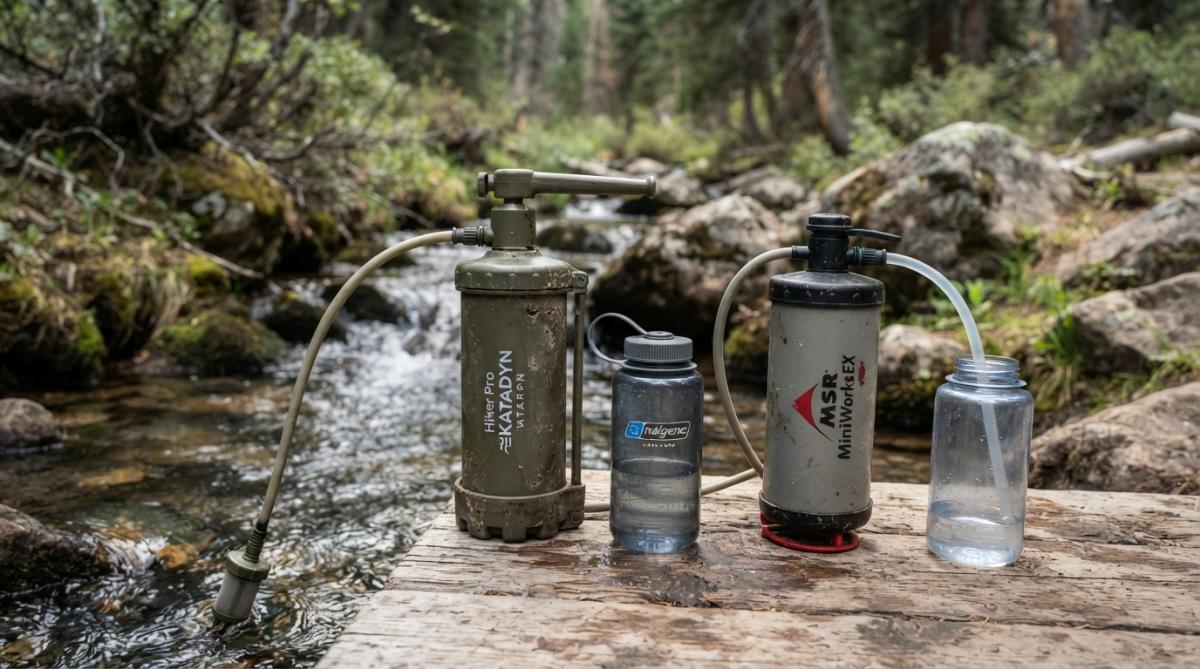
Pump filters are the mobile hunter's choice. Lightweight, fast, and portable, you fill a water bottle or hydration bladder by manually pumping water through the filter cartridge. No hanging required. No waiting for gravity to do the work.
Pump filters deliver clean water in 2-5 minutes depending on the model and water clarity. You can filter directly into a bottle or into a hydration bladder integrated into your pack. This flexibility makes pump systems ideal for day hunts or mobile base camps where you're not staying in one location.
The trade-off is effort. Pumping 3 liters of water takes real work, your hand and forearm get a workout. Some hunters find this tedious; others see it as a minor price for the mobility and speed.
Field Maintenance and Backflushing in Cold Weather
Pump filters require more field maintenance than gravity systems. After each use, backflush the cartridge by reversing water flow through the filter. This removes trapped particles and maintains flow rate for the next use.
In cold weather, backflushing becomes critical. If you don't purge water from the filter at the end of the day, residual moisture will freeze inside the cartridge overnight. A frozen pump filter is unusable until it thaws. The solution is simple: backflush thoroughly, shake out excess water, and store the filter in an insulated pack or sleeping bag.
Some pump filters include a protective case or insulation sleeve. If you're hunting in temperatures below freezing, these accessories are worth the extra weight. They keep your filter functional when conditions turn harsh.
Weight and Packability for Mobile Hunts
A typical pump filter weighs 4-8 ounces, negligible compared to gravity systems. The entire assembly fits in a cargo pocket or attaches to a hydration bladder with minimal footprint. This makes pump filters perfect for hunters who cover ground during the day and need reliable water filtration without pack bloat.
The intake line is the vulnerable component. It's thin, flexible tubing that draws water from a source. Protect it from damage during transport. A bent or kinked intake line reduces flow rate dramatically. Keep it coiled loosely in your pack and inspect it before each use.
Most pump filters accept standard water bottles (wide-mouth openings work best) and integrate with common hydration bladders. Verify compatibility before purchasing. Some older pump designs require proprietary bottles, which limits flexibility in the field.
UV Purification and Chemical Treatment Options
UV purifiers and chemical tablets are lightweight alternatives to mechanical filters. They handle viruses that mechanical filters miss, but they come with trade-offs in speed, taste, and reliability.
UV purifiers use ultraviolet light to damage the DNA of bacteria, protozoa, and viruses, rendering them harmless. Popular models are pen-sized devices you dip into a water bottle and activate for 30-90 seconds. They weigh 2-3 ounces and require a rechargeable battery.
The limitation: UV doesn't remove particles. If your water is turbid or silty, you need to pre-filter before UV treatment. This adds a step and complexity. UV also doesn't provide residual protection, once the light is off, new contamination can occur if you wait hours before drinking.
Chemical tablets (iodine, chlorine dioxide) are the lightest option. A bottle of 50 tablets weighs less than an ounce. They kill most bacteria and protozoa and provide residual protection as long as the chemical remains in the water. Viruses are less reliably eliminated by chemical treatment alone.
The downside is taste. Iodine leaves a metallic flavor that many hunters find objectionable. Chlorine dioxide is milder but still noticeable. Both require a waiting period, typically 20-30 minutes, before the water is safe to drink.
Water Purification Tablets for Hunting
Chemical tablets are a legitimate backup system, not a primary solution for most hunters. They're ideal as an emergency option when your main filter fails or as a supplement when you're uncertain about water safety.
Chlorine dioxide tablets are generally preferred over iodine for taste and effectiveness. They kill a broader spectrum of pathogens and don't leave the metallic aftertaste. A single tablet treats 1 liter of water. Cost per liter is low, roughly 5-10 cents per treatment.
For a week-long hunt, carrying 10-15 tablets as backup adds negligible weight and cost. If your pump filter breaks, you have a contingency plan. If you encounter water so turbid that your filter clogs, tablets let you treat water while you clean the filter.
Squeeze-Style and Survival Water Filters
Squeeze filters are lightweight hybrids between pump systems and gravity filters. You fill a collapsible bag with water, screw on a filter cartridge, and squeeze the bag to force water through the filter into a bottle or hydration bladder.
They're faster than gravity systems and require less effort than pump filters. A squeeze system can deliver 1-2 liters in 3-5 minutes. Weight is minimal, most squeeze filters weigh 3-6 ounces. They integrate easily with hydration systems and fit in any pack.
The catch: squeeze bags are fragile. Puncture a bag or strip the threads on the filter connection, and you're stuck. They're also vulnerable to freezing, water trapped in the bag or filter cartridge will freeze overnight in cold weather.
Survival filters are ultra-lightweight straw-style devices you use to drink directly from a water source. Some weigh under an ounce and fit in a cargo pocket. They work for immediate hydration but aren't practical for filling containers or hydration bladders. Use them as emergency backup, not as your primary system.
Lightweight Options for Backcountry Hunts
If pack weight is your obsession, here's the hierarchy: survival straw (under 1 ounce) < squeeze filter (3-6 ounces) < pump filter (4-8 ounces) < gravity system (12-20 ounces).
For mobile hunts where you cover 5+ miles per day, the weight difference between a pump filter and a gravity system is real. Over a week, carrying a lighter filter system means you can pack heavier optics, warmer clothing, or more food.
The trade-off is convenience. Gravity systems require zero effort once set up. Pump and squeeze filters demand active participation. Choose based on your hunting style: base camp hunters benefit from gravity systems; mobile hunters should prioritize pump or squeeze filters.
Integration with Hydration Bladders and Noise Discipline
Modern pump filters integrate seamlessly with hydration bladders, the soft packs you wear in your backpack. You connect the filter to the bladder's intake tube, pump water into the bladder, and drink through the standard tube while you hunt.
This integration matters for scent control and noise discipline. A rigid water bottle rattles in your pack and creates noise when you move. A hydration bladder stays quiet and compact. For hunters pursuing elk or deer where silence is critical, a filtered hydration bladder is worth the extra weight.
Some pump filters are designed specifically for bladder integration. The filter cartridge screws directly onto the bladder's fill opening, eliminating separate tubing. This simplifies the system and reduces failure points.
Comparison Table: Best Portable Water Filters for Hunters
Filter Type |
Weight |
Flow Rate |
Setup Time |
Best For |
Cold Weather |
|---|---|---|---|---|---|
Gravity-Fed |
12-20 oz |
0.5-2 L/hr |
10-15 min |
Base camp, large groups |
Poor (freezes easily) |
Pump Filter |
4-8 oz |
1-2 L/min |
2-5 min |
Mobile hunts, solo hunters |
Good (with backflushing) |
Squeeze Filter |
3-6 oz |
1-2 L/min |
3-5 min |
Lightweight trips, day hunts |
Fair (bag vulnerable) |
UV Purifier |
2-3 oz |
Instant |
30-90 sec |
Backup system, clear water |
Good (battery powered) |
Chemical Tablets |
<1 oz |
20-30 min |
Minimal |
Emergency backup, last resort |
Excellent (no moving parts) |
Key Selection Criteria for Hunter Water Filters
Choosing the right water filter depends on five variables: your hunting style, trip duration, climate conditions, pack weight tolerance, and water source reliability.
Hunting style is the primary driver. Base camp hunters who stay in one location for 3+ days should prioritize gravity systems, the convenience and flow rate justify the weight. Mobile hunters covering ground daily need pump or squeeze filters. Day hunters can get by with lightweight squeeze filters or even chemical tablets as backup.
Trip duration matters for cartridge life. A pump filter cartridge typically lasts 100-300 liters depending on water clarity. For a week-long hunt consuming 20 liters of water daily, you need a fresh cartridge or a backup filter. Gravity systems use larger cartridges (500-1000 liters), so base camp hunters can go longer between cartridge changes.
Climate conditions determine whether cold-weather performance is critical. If you're hunting above 8,000 feet in November or December, freezing is a real threat. Pump filters with proper backflushing and storage survive cold weather. Gravity systems and squeeze bags are risky. Chemical tablets and UV systems work regardless of temperature.
Pack weight tolerance is personal. A 16-ounce gravity system versus a 6-ounce pump filter is a meaningful difference if you're carrying 40+ pounds of gear. Over a week, that adds up. If you're already at your weight limit, the pump filter makes sense. If you have capacity, the gravity system's convenience might be worth it.
Water source reliability affects which system you choose. If you're hunting in arid terrain where water sources are rare and far apart, a gravity system is impractical, you can't stop and set up camp every time you need water. A pump filter lets you filter water opportunistically and keep moving.
Cartridge Life and Replacement Costs
Filter cartridges don't last forever. They clog with sediment and particles until flow rate becomes too slow to be practical. Replacement is necessary.
A typical 0.2-micron hollow fiber cartridge handles 100-300 liters before clogging becomes problematic. In clear alpine water, you might get 300 liters. In silty stream water, you might get 100 liters. This is why water clarity matters, it directly impacts how long a cartridge lasts.
For a week-long hunt, most hunters use one cartridge. For extended trips (10+ days), carry a spare cartridge. Cartridge cost varies by filter type, pump filter cartridges typically run 15-40 dollars depending on the brand and quality.
Gravity system cartridges are larger and more expensive (30-60 dollars) but last longer (500-1000 liters). The per-liter cost is lower, but the upfront investment is higher. This favors gravity systems for hunters who use them repeatedly across multiple seasons.
Cold-Weather Performance for Late-Season Hunts
Late-season hunting means cold water and freezing temperatures. This is where filter choice becomes critical.
Pump filters with proper field maintenance survive cold weather. The key is backflushing thoroughly at the end of each day to remove water from the cartridge, then storing the filter in an insulated pack or sleeping bag. If you're diligent, a pump filter works reliably in sub-freezing conditions.
Gravity systems are problematic. Water sitting in the cartridge overnight will freeze, permanently damaging the hollow fiber membrane. You'd need to drain the entire system every evening and store it indoors, impractical for backcountry hunting.
Squeeze bags are vulnerable because water trapped in the collapsible bag will freeze solid, making the bag unusable. UV systems work fine (battery powered, no water sitting in the device), but you still need a way to filter water without it freezing before you drink it.
Chemical tablets are the most cold-weather reliable option because they require no mechanical components. The tablets themselves won't freeze, and the chemical reaction works in cold water.
If you're hunting in late November or December in high elevation terrain, a pump filter is your best choice for primary water filtration. Keep chemical tablets as backup.
Durability and NSF Certification Standards
NSF International certification indicates that a filter has been independently tested and meets specific performance standards. NSF/ANSI Standard 42 covers sediment and chlorine removal. NSF/ANSI Standard 53 covers health-related contaminants including bacteria and protozoa.
Look for filters certified to NSF/ANSI 53 if you want third-party verification of performance. This certification means the filter has been tested and proven to remove 99.99% of bacteria and protozoa. It's not mandatory for backcountry filters, but it's a credibility signal.
Durability is about materials and construction. Pump filters with stainless steel or aluminum bodies outperform plastic models in rough conditions. Check the intake line material, silicone is more durable than vinyl. Verify that the filter cartridge is replaceable and that the manufacturer supplies spare parts.
For hunters who use their gear hard, durability matters more than modern features. A simple pump filter that works reliably in dust, mud, and cold is worth more than a complex system that fails in the field.
Water reliability is the foundation of a successful backcountry hunt. Dehydration clouds judgment, slows movement, and ends trips early. The right filter keeps you hydrated and healthy when you're miles from help. At Leash the Wilderness, we outfit hunters with gear that survives real conditions, not just lab tests. A quality portable water filter is one of those investments that pays for itself on your first serious hunt. Choose based on your terrain, season, and how far you travel from camp, and you'll have clean water every day you're in the backcountry.
Frequently Asked Questions
What kind of portable water filter is best for hunting?
The best portable water filter depends on your hunt style. Gravity-fed filters excel at base camp setups with reliable flow rates and minimal noise. Pump filters offer mobility for mobile hunts but require maintenance in cold weather. Squeeze-style filters provide lightweight packability for backcountry hunts. Consider micron rating (0.1–0.3 microns removes protozoa, giardia, and cryptosporidium), weight, and whether you need purification tablets as backup for viral protection.
Can I use a gravity water filter for hunting in cold weather?
Gravity-fed filters work in cold weather, but flow rates slow significantly below freezing. Hollow fiber membranes can freeze and crack if water remains in the filter. Keep your gravity filter insulated in a pack, use it during the warmest part of the day, and empty it completely before temperatures drop. For late-season hunts, pump filters or squeeze-style options with backflushing capability offer better cold-weather performance and field reliability.
What is the difference between filtration and purification for hunting water?
Filtration removes bacteria and protozoa through mechanical barriers (hollow fiber membranes at 0.1–0.3 microns). Purification eliminates viruses as well, requiring UV light, chemical treatment (iodine tablets), or boiling. For most U.S. backcountry hunting, filtration alone suffices because viruses are rare in remote freshwater. However, if you hunt near populated areas or agricultural runoff, combine filtration with water purification tablets for complete protection against all waterborne pathogens.
How long does a portable water filter cartridge last for hunters?
Most portable water filter cartridges last 1,000–10,000 gallons depending on water turbidity and micron rating. Sediment-heavy water clogs filters faster, reducing cartridge life. Backflushing extends lifespan by clearing debris without replacement. Track usage during hunts; a typical 3-day backcountry hunt uses 6–9 gallons. Check manufacturer specs and carry a pre-filter to extend cartridge life in turbid water. NSF-certified filters provide transparent replacement schedules and cost estimates.
Can I integrate a portable water filter with a hydration bladder for hunting?
Yes. Squeeze-style filters connect directly to hydration bladders, allowing on-the-move drinking without stopping. Pump filters can fill bladders at base camp or water sources. Gravity-fed systems work best for batch-filling bladders before a hunt. Choose a filter with low-noise operation to maintain scent discipline and avoid alerting game. Ensure the filter's outlet tubing fits your bladder's input valve, and test the setup before your hunt to avoid field surprises.
This article was written using GrandRanker