

Table of Contents
- Best Lightweight Camping Stoves for Hunters: Quick Comparison
- How to Choose a Hunting Stove: Selection Criteria That Matter
- Fuel Types for Hunting Stoves: Canister vs. Liquid Fuel
- Portable Stove for Cold Weather Hunting: Durability and Reliability
- Hunting Stove Accessories: Gear That Completes Your Setup
- Why Lightweight Stoves Matter for Hunters: Stealth, Scent, and Durability
- Common Mistakes Hunters Make When Choosing a Backcountry Stove
- Conclusion: Field-Tested Gear for Real Hunting Conditions
Last Updated: July 26, 2026
Best Lightweight Camping Stoves for Hunters: Quick Comparison
Finding the best lightweight camping stoves for hunters requires balancing weight, fuel efficiency, and reliability in harsh backcountry conditions. At Leash the Wilderness, we understand that every ounce matters when you're miles from the truck, and your stove needs to perform when temperatures drop and wind picks up.
Most backcountry hunters find themselves weighing gear durability against packability, yet most commercial stove reviews ignore hunting-specific challenges like scent management and extreme cold performance.
Stove Type |
Best For |
Weight Range |
Fuel Type |
Wind Resistance |
|---|---|---|---|---|
Canister stove |
Ultralight hunters, 3-season use |
2-4 oz |
Isobutane/propane |
Moderate (needs windscreen) |
Liquid fuel stove |
Cold weather, high altitude hunts |
8-14 oz |
White gas, kerosene |
Excellent (integrated design) |
Integrated system |
Minimalist hunters, fast boil times |
4-8 oz |
Canister or liquid |
Good (compact burner head) |
How to Choose a Hunting Stove: Selection Criteria That Matter
Start by identifying your primary hunting season and elevation. High-altitude hunts above 10,000 feet require stoves with reliable ignition in thin air. Cold weather hunts demand stoves that perform when fuel canisters lose pressure in freezing temperatures. Three-season hunts allow for lighter canister stoves, while winter expeditions typically require liquid fuel systems.
Next, consider your cooking style. If you're boiling water for instant meals, a fast-boil stove saves fuel and time. If you're simmering soups or melting snow, you need precise simmer control, a feature that separates quality stoves from budget models.
Weight matters, but not equally across all scenarios. A 2-ounce difference compounds fatigue over a 10-day hunt, but a heavier stove that performs reliably beats a lighter stove that fails halfway through your trip.
Weight and Packability for Backcountry Hunts
The lightest camping stoves weigh 2-4 ounces for canister models, ideal for hunters prioritizing packability. A compact burner head that nests inside your cookware saves pack volume. Consider your total cooking system weight, not just the stove. A 3-ounce stove paired with a 2-pound pot is heavier than a 10-ounce integrated system that includes a pot. Optimized systems weigh 15-20% less than assembled-from-parts alternatives.
Boil Time and Fuel Efficiency in Cold Conditions
Boil time matters less than most guides suggest, unless you're hunting in extreme cold. At 12,000 feet, a stove that boils water in 3 minutes at sea level might take 8 minutes.
Fuel efficiency becomes critical on extended hunts. Canister stoves typically deliver 15-25 minutes of boil time per 4-ounce canister. Liquid fuel stoves offer better efficiency at altitude and in cold, roughly 30-40 minutes per 8-ounce bottle. The real advantage of liquid fuel appears above 10,000 feet or below freezing, where isobutane canisters lose pressure.
Simmer control separates adequate stoves from field-tested ones. Many canister stoves struggle to maintain a low flame without shutting down entirely.
Wind Resistance and Stable Pot Support
Wind can reduce stove efficiency by 40%, making windscreens essential. Stable pot support prevents tipping when cooking on uneven ground or in confined tent vestibules. Integrated stove systems offer superior wind resistance because the burner head, pot support, and windscreen are engineered as one unit.
Fuel Types for Hunting Stoves: Canister vs. Liquid Fuel
Choosing between canister and liquid fuel stoves is the most consequential decision you'll make.
Isobutane and Propane Canisters
Canister stoves are the standard for three-season backpacking because they're lightweight, simple, and require zero maintenance. Isobutane canisters deliver reliable performance from spring through fall. However, isobutane loses pressure rapidly below 40°F. Propane blends extend cold-weather performance slightly, but they're not a complete solution for serious winter hunting.
Weight is canister stoves' primary advantage. A complete system weighs 8-12 ounces including fuel for a 3-day hunt. Fuel canisters are disposable, eliminating the need to carry heavy containers or refill equipment.
White Gas and Liquid Fuel Performance
White gas (also called naphtha or Coleman fuel) is the choice for serious cold-weather and high-altitude hunters. It maintains consistent pressure from sea level to 20,000 feet and from summer heat to deep winter cold.
White Gas and Liquid Fuel Performance
Liquid fuel stoves require priming, heating the fuel line before ignition. This adds 30 seconds to startup time but once lit, they burn hotter and more efficiently than canisters, especially in challenging conditions. Over a 2-week hunt, you carry significantly less fuel weight overall with a liquid system.
Maintenance is the trade-off. Liquid fuel stoves require periodic cleaning of the fuel line and burner head. For hunters who maintain their gear, this is routine. Kerosene is a cheaper alternative but burns dirtier than white gas. For domestic hunting, white gas is the standard.
Portable Stove for Cold Weather Hunting: Durability and Reliability
Cold weather hunting demands stoves built to survive brutal conditions.
Titanium and Stainless Steel Construction
Titanium stoves are 30-40% lighter than stainless steel equivalents but cost 2-3 times more. Stainless steel is more durable in rough handling and more forgiving of impacts. Both materials resist corrosion from salt spray and moisture exposure. Aluminum is sometimes used in budget stoves but is softer and prone to bending and cracking. For serious hunting, aluminum is worth avoiding.
Altitude and Extreme Condition Performance
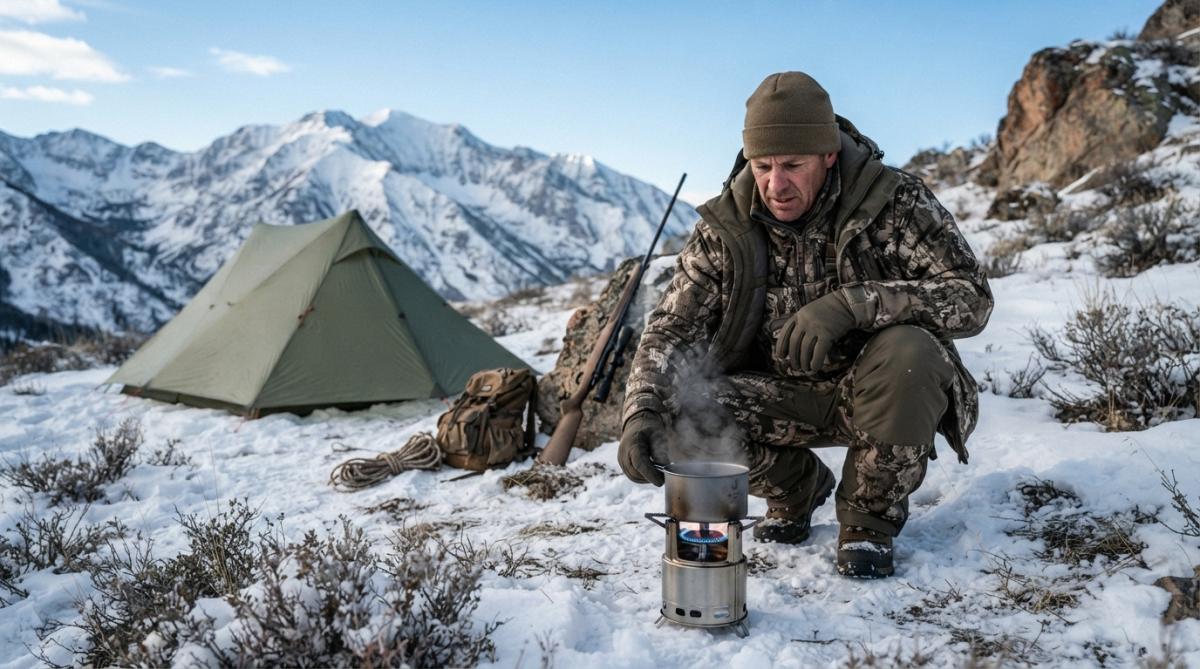
High altitude changes everything. At 12,000 feet, oxygen is thinner and fuel burns less efficiently. Piezo igniters become less reliable above 10,000 feet. Liquid fuel stoves with open flames are more reliable at altitude because they don't depend on ignition timing.
Extreme cold compounds the problem. Below zero, fuel pressure drops and ignition becomes difficult. Liquid fuel stoves outperform canisters because white gas maintains pressure and lights consistently in extreme cold. Wind at high altitude is often stronger and more consistent than at lower elevations, making windscreens essential.
Hunting Stove Accessories: Gear That Completes Your Setup
The stove itself is only half the equation.
Windscreens, Pot Supports, and Burner Heads
A windscreen reduces fuel consumption by 30-50% in typical backcountry conditions. Integrated windscreens built into the stove design are more reliable than separate ones. Wide, rigid pot supports prevent tipping and distribute heat evenly. Narrow supports save weight but increase tipping risk.
Burner heads determine flame quality and heat distribution. Some produce concentrated flames ideal for boiling, while others spread flame across a wider area for even heating. For hunters who melt snow or simmer food, good heat distribution prevents hot spots and scorching.
Integration with Hunting Cookware Kits
Bundled cookware kits are engineered to work together as systems. A stove paired with matching cookware transfers heat efficiently and sits stably on the support. Look for cookware kits that include nesting pots, lids that double as frying pans, and utensils that store inside. This design reduces pack volume and weight compared to carrying separate items.
Why Lightweight Stoves Matter for Hunters: Stealth, Scent, and Durability
Weight reduction has obvious benefits, but hunters face unique challenges that generic backpackers don't encounter.
Scent management is critical for hunters. A stove that cooks quickly produces less smoke and odor, reducing the chance of alerting game animals downwind. Liquid fuel stoves burn cleaner than canister stoves in most conditions.
Stealth includes noise and light discipline. Canister stoves are quieter, with no priming sounds. Liquid fuel stoves make more noise during startup, which can spook animals in close proximity.
Durability in rugged terrain is non-negotiable. A stove that fails on day 3 of a 10-day hunt creates serious problems. A reliable stove ensures you can cook warm meals regardless of weather or conditions.
Common Mistakes Hunters Make When Choosing a Backcountry Stove
Mistake 1: Prioritizing weight over reliability. A 2-ounce ultralight stove that fails in cold weather costs you far more than the weight savings. Start with reliability, then optimize weight within that constraint.
Mistake 2: Choosing a stove without testing it first. Buy your stove at least one month before your hunt. Use it in your backyard and practice setup and cooking. Field-tested gear means you've tested it yourself.
Mistake 3: Buying a stove without considering your total cooking system. Evaluate the complete system, not just the stove in isolation.
Mistake 4: Ignoring wind resistance. Many hunters skip the windscreen to save ounces, then struggle because the stove won't boil water in wind. A windscreen weighs 2-3 ounces and reduces fuel consumption enough to offset its weight on any hunt longer than 3 days.
Conclusion: Field-Tested Gear for Real Hunting Conditions
Selecting a lightweight camping stove requires balancing weight, reliability, and performance in your specific hunting environment. The best choice for a three-season hunter differs dramatically from the best choice for a winter alpine hunter.
At Leash the Wilderness, we recommend starting with reliable field-tested systems rather than chasing the lightest option. For serious cold-weather or high-altitude hunting, a liquid fuel system provides the reliability that keeps you fed when conditions turn brutal.
Test your stove before your hunt. Know how it performs in cold, wind, and altitude. Carry a windscreen. Practice setup and cooking in your backyard. These habits separate hunters who eat warm meals from those who eat cold food because their stove failed.
Experienced backcountry hunters consistently find that integrated stove systems outperform assembled alternatives in field reliability. Most mountain guides recommend liquid fuel stoves above 8,000 feet due to consistent pressure and ignition in thin, cold air. Field-tested systems deliver superior performance compared to untested models — a principle that holds across every piece of gear you carry into the backcountry.
Frequently Asked Questions
What is the lightest stove for backpacking hunting trips?
The lightest options are ultralight canister stoves weighing 1–3 ounces. These use isobutane or propane fuel canisters and offer excellent weight-to-performance ratios for hunters who prioritize packability. Canister stoves are ideal for short hunts where you can afford slightly lower fuel efficiency. Liquid fuel stoves are heavier but more reliable in extreme cold and altitude, making them better for extended backcountry hunts in harsh conditions.
What fuel types work best for hunting stoves in cold weather?
White gas (liquid fuel) is superior in cold weather because it maintains consistent pressure and boil time even at freezing temperatures and high altitudes. Isobutane and propane canisters lose performance in cold, making them less reliable for winter hunts. For serious cold-weather hunting, a liquid fuel stove with white gas delivers the most dependable simmering and fuel efficiency when conditions turn brutal.
How do I choose a hunting stove that integrates with my gear?
Match your stove to your cookware and existing hunting kit. Compact canister stoves pair well with lightweight titanium or stainless steel pots from integrated camp cookware sets. Consider wind resistance—a burner head with a wide pot support and stable base prevents tipping in backcountry conditions. Piezo igniters eliminate the need for matches, and simmer control lets you cook real meals, not just boil water. Field-tested stoves from reputable outdoor brands survive the abuse of rugged hunting terrain.
What hunting stove accessories are essential for backcountry reliability?
Windscreens significantly improve fuel efficiency and boil time in exposed terrain. A stable pot support prevents your cookware from tipping when you're adjusting meals. Extra fuel canisters or a backup fuel container ensure you never run dry miles from the truck. Integrated stove systems that bundle the burner head, pot support, and cookware eliminate compatibility issues and save weight—critical for hunters who demand gear maintenance and durability in rock, mud, and rough conditions.
Are ultralight camping stoves durable enough for rugged hunting environments?
Yes, if you choose field-tested models made from titanium or stainless steel. Ultralight doesn't mean fragile—quality ultralight stoves are engineered for abuse. The key is matching the stove type to your hunting conditions: ultralight canister stoves work for fair-weather hunts, while liquid fuel stoves offer superior durability and cold-weather performance for serious backcountry expeditions where conditions turn brutal.
This article was written using GrandRanker