

Table of Contents
- What Wilderness-Ready Equipment Actually Means
- Essential Gear for Remote Overlanding Trips
- Durable Fishing Tackle for Harsh Conditions
- How to Pack for Multi-Day Wilderness Trips
- Best Practices for Gear Maintenance in the Field
- Wilderness-Ready Equipment That Fits Your Region and Season
- Conclusion
- Frequently Asked Questions
Last Updated: September 16, 2026
What Wilderness-Ready Equipment Actually Means
Wilderness-ready equipment keeps working after the road ends, when weather, distance, and rough ground remove every option to improvise. It is gear you would trust miles from the truck.
Three things separate wilderness-ready equipment from ordinary sporting goods:
- Weather resistance over cosmetic finish. Sealed bearings, coated hardware, and fabrics that shed water instead of holding it.
- Field repair potential. Gear you can patch, re-tie, or re-rig with what you already carry.
- Honest weight. Ultralight gear that fails is heavier than durable gear that holds.
U.S. Forest Service guidance on backcountry travel and safety
Essential Gear for Remote Overlanding Trips
Remote overlanding is vehicle-based camping in true backcountry. You can carry more weight than a backpacker, so durability matters more than grams, and redundancy matters more than either.
Power, Optics, and Shelter Systems
Power, optics, and shelter form the spine of any remote setup. Lose power and navigation dies. Lose optics and you cannot read terrain or game at distance. Lose shelter and weather decides your trip.
🛒 Shop the Backcountry Power & Optics Kit →

What to Leave Behind
The hardest packing decision is subtraction. Leave the second stove, the spare camp chair, the "just in case" third knife. Every extra item is weight you carry and a thing that can break.
Durable Fishing Tackle for Harsh Conditions
Salt, grit, and cold water find every weak point in a rig. Durable tackle comes down to line, hardware, and corrosion resistance.
Line, Hardware, and Corrosion
Start with hardware. Brass barrel swivels resist corrosion far better than untreated steel, and a failed swivel costs you the fish and the lure. A 50-pack of Brass Barrel Swivel Interlock Snaps costs less than one lost crankbait.
🛒 Shop the Catfish Angler Starter Kit →

How to Pack for Multi-Day Wilderness Trips
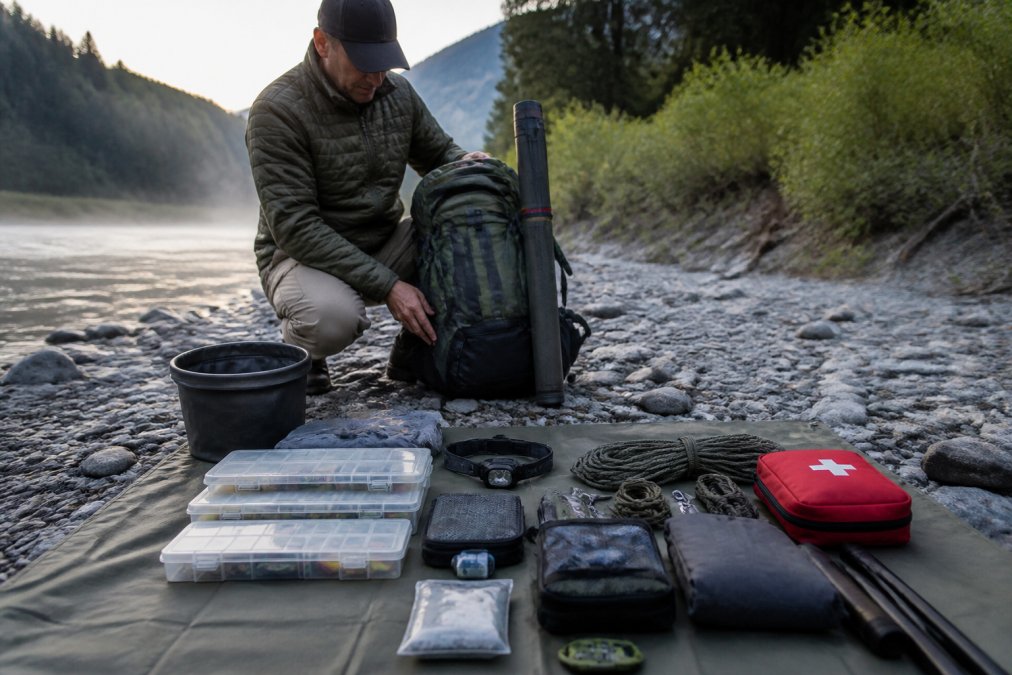
Packing for multi-day wilderness trips is a weight-budget exercise, not a gear-listing exercise. Decide your total carry weight first, then assign each item a slot against that number. Most pack failures are planning failures that show up on day two.
Start With a Base Weight Number
Base weight is everything you carry minus food, water, and fuel. Pick the number before the gear.
- Three-season backpacking, solo: 12-18 lb base weight is a realistic working range for gear that survives rough ground. Below 10 lb, you are usually trading durability for grams.
- Vehicle-based overlanding: base weight stops mattering. Carry the heavier shelter, the second stove, the full cook set. You have the payload.
- Cold-weather trips: add 3-5 lb for insulation and a warmer bag. Do not try to hold your summer number.
Weight-to-Durability Ratio, With Real Numbers
Weight-to-durability ratio is the number most gear guides ignore. A 400-gram shelter that tears on night two has an infinite ratio. A 900-gram shelter that survives ten seasons is lighter in real terms, because you bought it once.
| Gear Category | Typical Weight | Where to Spend Weight | Where to Save |
|---|---|---|---|
| Shelter system | 1.5-3 lb | Poles, guy points, floor fabric | Stakes, stuff sack |
| Sleeping system | 2-4 lb | Sleeping pad R-value, bag shell | Stuff sack, pillow |
| Water filtration | 6-16 oz | Filter housing, hose fittings | Bottles, pre-filter |
| Fire starters | 2-6 oz | Ferro rod, striker | Tinder (gather on site) |
| Fishing tackle | 2-8 lb | Line, swivels, rod guides | Lure duplicates, extra boxes |
| Repair kit | 8-16 oz | Multi-tool, cordage | Duct tape (wrap a pencil stub) |
Load Placement That Actually Works
Pack heaviest items against your spine, mid-pack, between your shoulder blades and your hips. That is the center of gravity your body already balances around. Weight above your shoulders makes you lean forward all day. Weight below your hips makes the pack sway on rough ground.
A working layout for a 40-50 liter pack:
Catfish Angler Starter Kit — Rod, Reel →
- Bottom: sleeping bag and shelter. Light, bulky, and you only touch them at camp.
- Middle, against your back: food, water, cook kit, and any dense tackle. This is your ballast.
- Top and lid: rain shell, headlamp, first-aid kit, and the day's snacks.
- Outside pockets: water filtration and fire starters in the same pouch, so a cold, wet, dark camp setup is one motion instead of five.
- Straps and belt: rod tube or trekking poles, lashed tight enough that nothing swings.
What to Leave Behind
The hardest packing decision is subtraction. Leave the second stove, the spare camp chair, the "just in case" third knife. Every extra item is weight you carry and a thing that can break.
Best Practices for Gear Maintenance in the Field
Field maintenance is the difference between gear that lasts a season and gear that lasts a decade. Most failures are preventable with ten minutes of attention. The bigger skill is knowing what to fix on the spot and what to abandon.
The Repair-or-Replace Decision
When something breaks miles from the truck, run three questions in order:
- Does the failure affect safety or shelter? Tent pole, pack strap, boot sole, water filter housing. Fix it now, even if the fix is ugly.
- Can the repair hold under load? A splinted tent pole with a sleeve and tape holds. A snapped rod tip taped back on will not cast, so stop trying and switch to a backup.
- Do you have the material to do it twice? Field repairs fail. If you only have one wrap of tape, save it for the failure that matters.
Field Repair Kits That Earn Their Space
A field repair kit should weigh under a pound. Build yours around these items:
- Two feet of duct tape wrapped around a pencil stub
- Ten feet of paracord (7-strand, so you can pull inner strands for thread)
- A multi-tool with pliers and wire cutters
- Spare rod tip and ferrules for your rod weight
- Needle and heavy thread for pack and tent repairs
- Two zip ties, heavy gauge
- A spare headlamp battery
- A 2-inch square of tenacious tape or a tire patch for shelter and pad holes
Field Repairs That Actually Hold
Tent pole splint. Slide a 6-inch section of aluminum tubing or a hollowed-out pen barrel over the break, tape both ends, and pitch the tent with the splint at a low-stress point, never at the apex where the pole carries the most load.
Routine Care Between Trips
If you are replacing gear that failed one too many times, the Tackle Storage collection has boxes and bags that keep hardware dry and organized, which cuts corrosion and lost pieces between trips.
Wilderness-Ready Equipment That Fits Your Region and Season
Regional conditions change what wilderness-ready equipment means. A setup that works in a humid lowland forest fails in high desert, and a cold-weather kit is dead weight in July.
- Cold weather hunting: insulation layers, hard shells, and gear that stays flexible below freezing. Sealed reel bearings matter more than line capacity.
- Hot weather hunting: breathable fabrics, hydration capacity, and lighter loads. Water filtration becomes the priority system.
- Coastal and saltwater: corrosion resistance across every metal component, from swivels to zipper pulls.
- High desert and alpine: UV resistance, wind-rated shelter, and navigation that does not depend on a phone battery.
Conclusion
The real test of wilderness-ready equipment is not the spec sheet. It is whether the gear still works on day four, in bad weather, with no backup. Most failures trace back to gear chosen for the wrong conditions or never maintained.
Frequently Asked Questions
What should be in a basic wilderness emergency kit?
Start with a first-aid kit, a fire starter, a headlamp plus spare batteries, a multi-tool, 50 feet of cordage, a water filtration method, and a topographic map with a compass. Add a repair kit for the gear you actually carry. Duct tape, spare rod tips, and a few zip ties cover most field failures. Keep it in one dry bag so you can grab it without digging.
How do you choose durable fishing tackle for harsh conditions?
Look at the hardware first. Brass barrel swivels and stainless hooks hold up in salt where cheap plated parts rust out in a season. Braided line resists abrasion better than monofilament around rock and shell. Match sinker weight to current rather than guessing, and rinse everything in fresh water the same day you fish salt or mud.
How do you maintain sporting equipment in mud and salt conditions?
Rinse with fresh water before anything dries. Mud and salt both pull moisture into seams and pivots, so clean those first. Dry everything fully in shade, never over a fire. Re-oil reel bearings, wipe down optics with a microfiber cloth, and check zippers for grit. A 20-minute rinse after each trip adds years to gear.
What are the essential survival tools for remote wilderness trips?
A fixed-blade knife, a multi-tool, a fire starter, a headlamp, cordage, a water filter, and a topographic map with compass. Those seven cover cutting, fire, light, shelter, water, and navigation. Everything else is comfort. If you carry a power station and rangefinder, you extend the trip, but the core seven keep you alive if the electronics quit.
Is wilderness-ready equipment overkill for a casual weekend angler?
Not if you pick the right pieces. A $19.99 tackle kit and a $7.99 pack of brass swivels handle most weekend trips fine. The overkill trap is buying expedition gear for a two-mile walk. Spend on the items that fail often, like line and hooks, and skip the rest until you actually need it.
How long does shipping take on outdoor gear orders?
Expect 10 to 20 business days. That matters if you have a trip on the calendar, so order early or buy locally for anything you need this weekend. It also means you should not count on a last-minute replacement arriving before you leave. Plan the kit a month out.