

Table of Contents
- What Separates Professional Grade Fishing Reels From Budget Options
- Fishing Reel Gear Ratio Explained: Matching Retrieve Speed to Your Technique
- Spinning Reel Drag Systems: How Smoothness Wins Fights
- Spinning vs Baitcasting: Which Professional Reel Type Fits Your Fishing
- When to Upgrade Your Fishing Reel (and When Budget Gear Is Fine)
- Fishing Reel Maintenance Tips for Anglers Who Fish Hard
- Why Professional Grade Fishing Reels Pay Off Over Time
- Frequently Asked Questions
Last Updated: September 14, 2026
What Separates Professional Grade Fishing Reels From Budget Options
The gap between a $30 reel and a $90 reel isn't marketing. It's what's inside the body: how the gears were cut, how the bearings are shielded, and what the drag washers are made of. Most reel reviews never open the side plate. This section does.
We've watched cheap reels die in salt spray and mud while metal-bodied reels kept working. That's the honest case for why professional grade fishing reels cost more. It comes down to four internal decisions that show up the first time a big fish pulls drag.
Machined Gears vs. Stamped Gears
Open a budget reel and you'll usually find stamped gears. A flat sheet of metal is punched into a gear shape, then stacked. The teeth are soft, the tolerances are loose, and under load the gear teeth flex and wear into each other. You feel it as a grind on the retrieve and a drag that surges instead of pulling smooth.
A machined gear is cut from a solid billet on a CNC mill (thomasnet.com). The teeth hold their shape under load, the mesh stays tight, and the retrieve stays smooth after hundreds of hours. That's the single biggest internal difference between a $30 reel and a $90 reel, and it's the one you can't see from the outside.
Bearing Count, Bearing Quality, and Shielded vs. Open
Bearing count is the spec every box brags about. Bearing quality is what actually matters. A reel with 10 cheap open bearings will feel rougher after a season than a reel with 4 shielded stainless bearings.
Shielded bearings keep grit and salt out of the race. Open bearings run smoother when new and rougher the moment sand gets in. For saltwater, shielded stainless is the only spec worth paying for. For freshwater only, open bearings are fine if you re-lube them.
Drag Washer Materials
Budget reels use felt or compressed fiber washers. They work when dry and new. They grab when wet, and they glaze when hot. A glazed washer is what causes the surge-and-slip you feel on a long run.
Professional reels use carbon fiber or greased carbon drag washers. Carbon fiber sheds heat, stays consistent wet or dry, and holds its friction curve across hundreds of drag pulls. That consistency is what lets you set drag at 25 to 30 percent of line strength and trust it on a surge.
Sealed Drag Systems and Corrosion Resistance
A sealed drag keeps water, sand, and salt out of the drag stack. On a budget reel, that stack is often open to the elements, so a single dunk in saltwater can leave you with a drag that grabs and slips instead of pulling smooth.
Corrosion resistance isn't just about the body. It's the bearings, the anti-reverse clutch, and the drag washers. Sealed drag systems cost more to build because they need more precise tolerances and better gaskets. That's a real part of why professional grade fishing reels carry a higher price.
The American Sportfishing Association on angler participation and gear trends tracks how much time the average angler spends on the water, and that number explains why frame durability matters: more hours means more exposure to salt, grit, and sun.
Fishing Reel Gear Ratio Explained: Matching Retrieve Speed to Your Technique
Gear ratio is the number of times the spool turns for each full turn of the handle. A 5.2:1 reel turns the spool 5.2 times per handle rotation; a 7.2:1 reel turns it 7.2 times.
That single number decides how you fish. Low ratios give you torque for cranking heavy lures or fighting fish that pull hard. High ratios give you retrieve speed for working topwater, burning a swimbait, or taking up slack fast before a fish shakes the hook.
Gear Ratio Alone Doesn't Tell You Retrieve Speed
Two reels can share a 6.3:1 ratio and pick up line at very different speeds. The number that actually matters is inches per turn (IPT), how much line the spool recovers with one full handle rotation. IPT depends on ratio and spool diameter, and spool diameter changes as line comes off the reel.
A full spool recovers more line per turn than a half-empty spool. That's why a reel that feels fast on the first cast feels slower after a long run. When you're comparing reels, look up the IPT spec, not just the ratio.
Here's the practical breakdown:
| Gear Ratio | Retrieve Character | Best For |
|---|---|---|
| 5.2:1 | High torque, slower line pickup | Cranking deep, big fish, heavy lures |
| 6.3:1 | Balanced | All-around bass, catfish, general use |
| 7.2:1 | Fast line pickup | Topwater, finesse, covering water |
Matching Ratio to Technique
A common mistake is buying the highest ratio you can find. If you're throwing deep crankbaits or fighting catfish in current, a 7.2:1 reel will wear you out. Match the ratio to the technique, not the spec sheet.
- Deep cranking (5.2:1 to 6.3:1): You need torque to pull a big-lipped plug through water. A high-ratio reel makes you work twice as hard for the same retrieve.
- Topwater and walking baits (7.2:1 and up): You need to pick up slack fast between twitches. Slow reels leave slack on the water and kill the action.
- Flipping and pitching (7.2:1 and up): Fast pickup gets your bait back to the boat and back into cover. Every second counts when you're working a bank.
- Inshore saltwater (6.3:1 to 7.2:1): You need speed to keep a fish out of structure and enough torque to turn a redfish or snook.
When a Slow Reel Beats a Fast One
If you fish big swimbaits, deep jigs, or heavy spoons, a slow reel does more of the work for you. You feel the lure thump instead of just cranking it. A 5.2:1 reel on a 2-ounce swimbait lets you crawl it along the bottom without burning energy.
Spinning Reel Drag Systems: How Smoothness Wins Fights
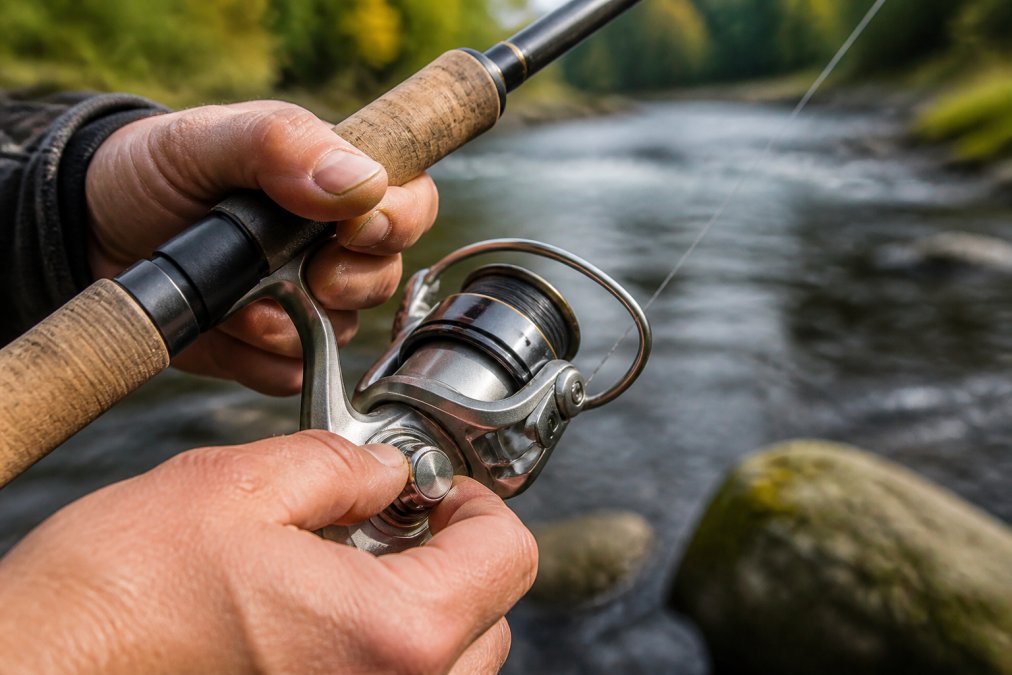
A spinning reel drag system works by letting line out under controlled tension when a fish pulls harder than your setting. Smoothness is what keeps the line from breaking on a surge.

Most drag failures happen in the first three seconds of a run. If the drag sticks, tension spikes, and the line snaps or the hook pulls. A smooth drag releases line in small, even increments, so the fish tires without you losing it.
How to Set Drag Before the First Cast
Set your drag by pulling line off the spool by hand, not by guessing. Here's the routine:
- Thread your line through the guides and tie on your lure or hook.
- Hold the rod at a 45-degree angle and pull line off the spool with steady pressure.
- Tighten or loosen the drag knob until the line comes off with firm resistance but no jerking.
- Aim for roughly 25 to 30 percent of your line's breaking strength as your drag setting.
- Test again after the first fish; drag can shift as washers seat.
If you're running 20-pound braid, your drag should slip somewhere around 5 to 6 pounds of pull. That gives a big fish room to run without popping the line.
Spinning vs Baitcasting: Which Professional Reel Type Fits Your Fishing
Spinning reels hang under the rod and cast light lures with almost no backlash. Baitcasting reels sit on top of the rod and give you thumb control for casting accuracy into tight cover.
The choice comes down to what you throw and where. Spinning wins for finesse fishing, light line, and windy days. Baitcasting wins for heavy lures, flipping jigs into structure, and long casts where you need to stop the lure on a dime.
- Spinning reel: Best for finesse, light lures, and anglers who want fewer casting errors.
- Baitcasting reel: Best for heavy lures, accuracy, and covering water fast.
- Line capacity: Spinning reels generally hold more line in smaller sizes.
- Braking system: Baitcasters use magnetic or centrifugal brakes to control spool speed; spinning reels don't need them.
- Backlash: Baitcasters can backlash if your brake and thumb control are off; spinning reels can't.
The SAMOLLA baitcasting reel features a 7.2:1 gear ratio for fast line retrieval when working lures or keeping up with fast-moving fish. Quality construction ensures smooth casts and reliable performance, while the baitcasting design offers the accuracy and control that experienced anglers prefer for targeting specific structure and. If you're working topwater or covering a lot of water, that retrieve speed helps.

🛒 Shop the SAMOLLA Baitcasting Reel → https://leashthewilderness.com/products/samolla-new-baitcasting-reel-casting-fishing-reel-saltwater-long-shot
For finesse and light line, the OKUMA AC Series spinning reel is built so that doesn't happen. Metal body, CNC-machined spool, 12kg of drag power, this reel is ready for whatever you throw at it, from bass in the shallows to bigger inshore saltwater species. Available in 6 sizes from 2000 to 7000. 12kg (26.4 lbs) max drag, enough stopping power for bass, pike, catfish, and inshore saltwat. That drag ceiling handles bass, pike, and inshore saltwater without slipping.
🛒 Shop the OKUMA AC Series Spinning Reel → https://leashthewilderness.com/products/newest-okuma-ac2000-7000-fishing-reel-metal-ball-grip-spinning-reel-5-2-1-metal-reel-cup-12kg-max-drag
When to Upgrade Your Fishing Reel (and When Budget Gear Is Fine)
Upgrade when your current reel fails you in a way you can name. If the drag grabs, if the handle wobbles, or if the anti-reverse slips under load, that's your signal. If it just feels old, that's not a reason.
Budget gear is fine for occasional trips, light species, and kids learning to cast. A $30 reel that lands panfish all summer is doing its job. The upgrade pays off when you fish hard, target bigger fish, or fish saltwater where corrosion kills cheap internals fast.
Fishing Reel Maintenance Tips for Anglers Who Fish Hard
Rinse your reel with fresh water after every saltwater trip, then dry it before storage. Salt left on the frame and bearings is the fastest way to kill a reel that would otherwise last years.
Here's a maintenance routine that works:
- Rinse the reel with low-pressure fresh water after saltwater use.
- Wipe the body dry with a cloth; don't let water sit in the handle joint.
- Back off the drag knob before storage so the washers don't compress.
- Re-lube the handle and line roller a few times a season.
- Check the line for nicks and re-spool if it's rough.
What most guides miss is the drag washers. Grease them lightly once a season. Dry washers grab; greased washers stay smooth, and smoothness is the whole point of a good drag system.
Why Professional Grade Fishing Reels Pay Off Over Time
A reel that lasts eight seasons costs less per season than a cheap reel you replace every two. That's the long-term ROI, and it's not complicated math.
The U.S. Fish and Wildlife Service on fishing participation and spending tracks how much anglers invest in gear annually, and the pattern is clear: people who fish often spend once on gear that holds up rather than repeatedly on gear that doesn't. Add in the cost of a lost fish or a snapped line on a trip you paid for, and the math tilts further toward better gear.
There's a second payoff that doesn't show up in a spreadsheet. A reel with smooth drag and consistent retrieve lets you fish the way you planned. You set the hook with confidence because you trust the drag. You cast into the spot you wanted because the reel lays line evenly. That's the real difference between professional grade fishing reels and budget options: not a spec sheet, but what you can do on the water.
Cheap reels fail at the worst moment, usually with a good fish on the line. If you're tired of losing fish to gear that can't take the pressure, Leash the Wilderness carries reels built to hold up: the OKUMA AC Series with 12kg of drag and a machined metal body, the Heavy Duty Spinning Reel with a 22 lb drag ceiling and dual handle, and bundles that save you 20% when you're setting up a full kit. Browse the Rods & Reels collection and gear up with tackle that works when the conditions don't.
Frequently Asked Questions
Are expensive fishing reels actually better?
They are better in ways you can measure. A reel like the OKUMA AC Series, at $62.99, uses a machined aluminum spool and metal body that hold up to salt, mud, and big fish pressure. Budget reels use graphite frames that flex under load, which costs you smoothness and drag consistency. The gap shows up after a season of hard use, not on the first cast.
What makes a fishing reel professional grade?
Four things: a machined aluminum body and spool instead of graphite, a sealed drag system that stays smooth when wet, quality ball bearings for consistent line lay, and a gear train cut to tight tolerances. Professional grade reels also hold their drag rating over time. A 12kg drag rating on a metal-body reel means something different than the same number on a plastic frame.
Do you need a high-end reel for casual fishing?
No. If you fish a few weekends a year for panfish and small bass, a $30.99 reel like the NX Spinning Reel with 10KG max drag handles that fine. Spend the money when you fish weekly, target big fish, or fish saltwater. That is when corrosion resistance and drag smoothness stop being nice-to-haves.
How does gear ratio affect reel performance?
Gear ratio sets how much line you recover per handle turn. A 7.2:1 baitcasting reel like the SAMOLLA pulls line fast, which suits working lures and keeping up with quick fish. A 5.2:1 ratio on the OKUMA AC Series trades some speed for cranking torque, which helps when you are pulling a big fish or a deep-diving crankbait. Match the ratio to your technique, not to a spec sheet.