

Table of Contents
- Why Proper Rod Storage Matters for Truck Transport
- Best Fishing Rod Racks for Trucks
- DIY Fishing Rod Holder for Truck Bed
- How to Protect Fishing Rods While Driving
- Short Bed vs. Long Bed Truck Storage Solutions
- Best Fishing Rod and Reel Combos for Transport
- Common Mistakes to Avoid When Storing Rods in Your Truck
- Frequently Asked Questions
Last Updated: September 3, 2026
Why Proper Rod Storage Matters for Truck Transport
Fishing rods are precision instruments. A rod that costs $200 or $2,000 will snap the same way if pinned sideways between the cab and tailgate (peer-reviewed research). The difference between a truck bed that protects your gear and one that destroys it comes down to intentional storage.
Most anglers throw rods loose in the truck bed and hope for the best. Vibration, sudden stops, sharp turns, and highway wind all work against loose gear. Rod tips snap. Guides get bent. Reels crack. The cost of replacing even one quality rod often exceeds the cost of setting up proper storage.
How to store fishing rods in a truck requires planning. Whether you're running a short bed or long bed, whether you choose a commercial rack or build your own, the principle stays the same: secure your rods so they can't move, protect the guides and tips from contact, and account for vibration over long distances.
Best Fishing Rod Racks for Trucks
The market offers two main categories of rod racks: vertical mounting systems and horizontal bed-mounted racks. Each solves different problems depending on your truck bed length, the number of rods you carry, and how often you need quick access.
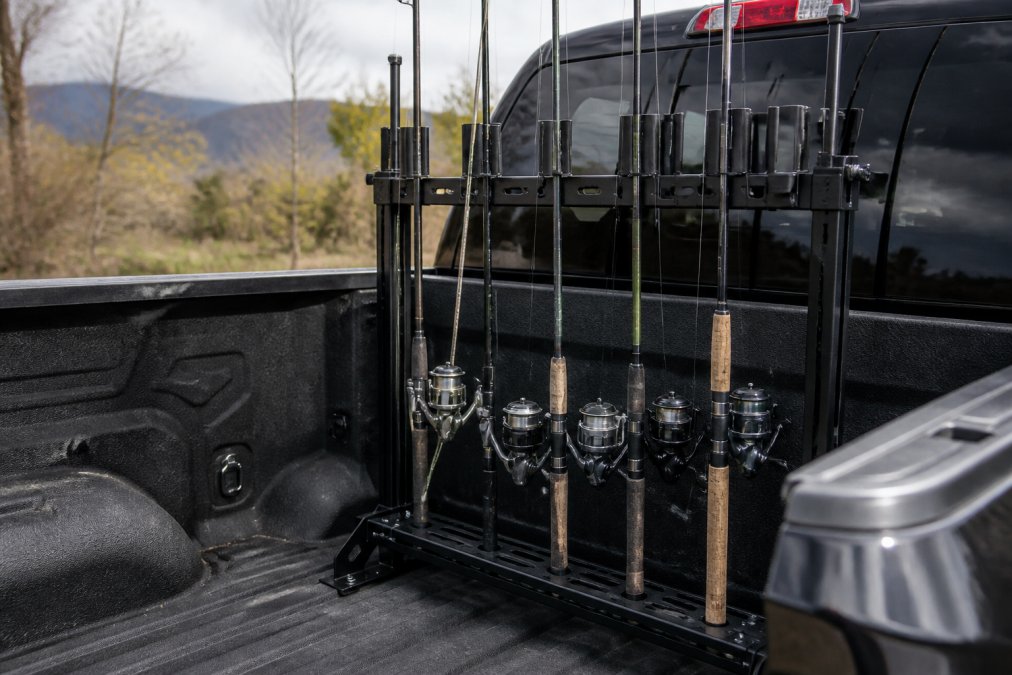
Vertical mounting systems
Vertical racks mount to the truck bed walls or cab and hold rods pointing upward. This approach takes minimal bed space and keeps rods out of the way during loading and unloading. The downside: vertical storage concentrates stress on the rod's butt end and can cause permanent bending if rods sit upright for extended periods without support along their length.
Vertical systems work best for short-distance transport with quick unloading. A rod spending 30 minutes vertical won't suffer damage. A rod sitting vertical for a week will develop a permanent curve (peer-reviewed research).
When choosing a vertical system, look for designs that secure the rod at multiple points, use padding to prevent reel damage, allow quick removal, and accommodate both conventional and spinning reels. Rod tips remain vulnerable unless you add individual sleeves.
Horizontal bed-mounted racks
Horizontal racks run the length of the truck bed and cradle rods along their entire length. This distributes the rod's weight evenly and prevents the stress concentration that happens with vertical storage. Horizontal mounting is the safer choice for long-term transport and expensive rods.
The trade-off: horizontal racks consume significant bed space. Long bed trucks accommodate horizontal storage more easily than short beds. Some horizontal racks fold down when not in use.
Quality horizontal racks include multiple cradles to prevent rod sag, padding to protect rod blanks and reels, adjustable width to fit different truck bed dimensions, and tie-down points to secure rods against movement.
DIY Fishing Rod Holder for Truck Bed
Building your own rod holder costs less than commercial systems and gives you complete control over fit and function. A DIY approach works especially well for short bed trucks or unusual configurations that commercial racks don't fit.
PVC tube construction
PVC pipe is the most common material for DIY rod holders because it's affordable, durable, and easy to work with. A basic system uses 4-inch or 6-inch diameter PVC cut into sections and mounted horizontally across the truck bed.
Here's how to build a functional PVC rod holder:
-
Measure your truck bed length from cab to tailgate to determine how long your PVC sections need to be.
-
Cut PVC to length using a saw. You'll typically need 2-3 sections running parallel to create cradles for multiple rods.
-
Cut lengthwise slots on the top side of each PVC section about 2 inches wide. The slot depth should be roughly half the pipe's diameter so the rod sits cradled.
-
Sand the slots smooth using sandpaper or a file to prevent damage to rod guides and reels.
-
Add padding by lining the inside of each slot with closed-cell foam or pool noodle material. Glue the padding in place with contact cement.
-
Create end supports that hold the PVC sections at the correct height and angle, running parallel to the truck bed.
The advantage of PVC construction: you can customize the number of cradles, spacing, and dimensions to fit your truck. The disadvantage: DIY systems require tools, time, and basic carpentry skills.
Mounting and securing your DIY holder
Once your PVC cradles are assembled, mounting them securely is critical. A poorly secured holder will shift during turns or hard stops.
-
Position the cradles so rods sit centered and level. Mark mounting locations with tape or chalk.
-
Install mounting brackets using U-bolts, angle iron, or heavy-duty clamps. Use existing truck bed tie-down points whenever possible.
-
Secure with multiple fasteners, at least two per mounting point to prevent rotation or shifting.
-
Add ratchet straps over the rods and through the bed to lock them in place. Tighten firmly but not so tight that you compress the rod blank or crush the reel.
-
Test for movement by rocking the truck gently. The entire assembly should stay rigid at highway speeds.
A solid DIY mounting system will outlast commercial racks and cost a fraction of the price.
How to Protect Fishing Rods While Driving
Even with a secure rack, rods need additional protection during transport. Highway vibration, wind, temperature changes, and road debris all threaten rod integrity.
Rod sleeves and stick jackets
Rod sleeves are fabric tubes that slide over individual rods. They protect guides, prevent reel damage, and dampen vibration. A quality sleeve is one of the simplest, most effective upgrades for how to store fishing rods in a truck.
Sleeves come in two styles: soft sleeves made from padded nylon or canvas are lightweight and affordable, working well for casual transport and short distances. Hard cases are rigid plastic or composite tubes that protect rods from crushing impacts and provide excellent vibration dampening. Hard cases cost more but are essential for expensive rods or long-distance transport.
When selecting sleeves, choose a length that covers the rod from reel to tip, look for internal padding at least one-quarter inch thick, verify the sleeve diameter fits your rod blank without forcing, and select sleeves with secure closures.
Securing rods for highway speeds
Ratchet straps and tie-downs prevent vibration by keeping rods from moving side to side or bouncing vertically.
The correct approach to securing rods:
-
Use ratchet straps rated for your load. Standard cargo straps with 1,500-pound working load limits are sufficient for fishing rods (fmcsa.dot.gov). Don't over-tighten.
-
Strap at three points minimum, near the butt end, at the middle, and near the tip area. This prevents the rod from flexing or bouncing between attachment points.
-
Secure the reel separately using a separate strap or bungee cord to immobilize it.
-
Keep straps perpendicular to the rod at a 90-degree angle, not parallel.
-
Check tension before driving. The rod should not move more than a quarter inch in any direction.
A properly secured rod won't vibrate against the rack, won't contact other rods, and won't shift during acceleration, braking, or turns.
Short Bed vs. Long Bed Truck Storage Solutions
Truck bed length dictates your storage options more than any other factor.
Short bed trucks (typically 5.5 feet) have limited space for horizontal storage. A long fishing rod won't fit diagonally. You'll need either vertical storage, a custom-built angled rack, or a roof-mounted carrier. Short bed owners often choose vertical systems or PVC racks that angle rods from the cab toward the tailgate.
Long bed trucks (typically 8 feet) accommodate horizontal storage easily. A standard fishing rod fits lengthwise with room to spare. Long beds give you flexibility to choose vertical, horizontal, or angled storage depending on your preference and the number of rods you carry.
Long bed owners can transport more rods with less complexity. A single horizontal rack holds four to six rods comfortably. Short bed owners typically manage two to three rods unless they stack them vertically.
Best Fishing Rod and Reel Combos for Transport
The rods and reels you choose affect how easily they transport.
Conventional reels sit on top of the rod and are less prone to damage from side-to-side movement. The reel foot is wide and stable, making them easier to secure in horizontal racks.
Spinning reels hang below the rod, requiring extra support in horizontal storage. A spinning reel that isn't fully supported can bend the rod blank downward over time.
Two-piece rods transport more easily than one-piece rods because they're shorter. Always secure two-piece rods so the ferrule joint doesn't flex.
For transport-specific considerations, prioritize rods with reinforced guides, reels with sealed drag systems, and rods with durable cork or foam grips. The Leash the Wilderness Rods & Reels collection includes combos selected specifically for durability in field conditions.
Common Mistakes to Avoid When Storing Rods in Your Truck
Most rod damage during transport comes from preventable mistakes.
Mistake 1: Storing rods loose in the bed. Loose rods roll, tangle, and contact the cab or tailgate during every stop and turn. Always use a rack or holder.
Mistake 2: Leaving rod tips exposed. Rod tips are the most fragile part. A small branch or road debris can crack a guide. Always use sleeves or cases for the tip area.
Mistake 3: Vertical storage for extended periods. A rod sitting vertical for days will develop a permanent bend. Unload vertical rods within hours.
Mistake 4: Over-tightening straps. Ratchet straps that compress the rod blank cause permanent damage. The strap should be snug but not cutting into the rod.
Mistake 5: Ignoring vibration. A rod that moves even slightly will develop micro-fractures. Use multiple straps and cradles to eliminate all movement.
Mistake 6: Stacking rods without separation. Multiple rods touching each other will tangle and damage guides. Use cradles or dividers to keep rods separated by at least 2 inches.
Mistake 7: Storing wet rods. Moisture trapped under a rod sleeve will promote mold and corrosion. Always dry rods completely before storage.
Mistake 8: Forgetting about reel protection. Reels take as much damage as rod blanks during transport. Secure the reel as carefully as you secure the rod.
Storing fishing rods in a truck properly takes planning but pays immediate dividends. A rod that arrives at the water in perfect condition performs better and lasts longer. Whether you choose a commercial rack, build a DIY holder, or invest in protective sleeves, the key is eliminating movement and protecting guides.
Start with the fundamentals: secure your rods so they can't move, protect the tips and guides, and account for vibration. From there, choose the specific system that fits your truck, your budget, and how often you transport gear. The Leash the Wilderness Tackle Storage collection includes field-tested solutions designed to survive real-world transport. Shop our complete selection and invest in protection that actually works.
Frequently Asked Questions
Is it better to store fishing rods vertically or horizontally in a truck?
Vertical storage works best for short-distance transport with quick unloading. Horizontal storage is generally the safer choice for long-term transport and expensive rods, as it distributes the rod's weight evenly. The key is preventing the rod from shifting during acceleration or braking, secure whichever orientation you choose with padding at contact points to absorb road vibration.
How can I prevent rod tip breakage during transport?
Rod tip breakage happens from vibration, impact, or pressure on the guides and top. Wrap rod tips in foam padding or use rod sleeves designed for transport. Never let rod tips rest directly against truck bed surfaces or other hard objects. Secure rods so they cannot bounce or shift, and avoid stacking heavy gear on top of them. A well-padded DIY PVC holder or commercial rod rack with foam inserts eliminates most breakage risk.
What's the best way to store fishing rods in a short bed truck?
Short bed trucks require angled or horizontal storage since vertical racks often extend beyond the tailgate. Use a tonneau cover with rod storage built in, or mount a horizontal rack that keeps rods parallel to the truck bed. Alternatively, position rods diagonally from the cab toward the tailgate and secure them with straps. This method protects rod tips and keeps them stable on turns and stops.
Are DIY PVC rod tubes effective for truck beds?
Yes. PVC tubes work well because they're affordable, durable, and easy to customize. Build tubes sized to fit your rod diameter (typically 2-4 inches), mount them horizontally or at an angle in the truck bed, and add foam padding inside to absorb vibration. Drill drainage holes to prevent water buildup, and seal the ends with foam caps. Many anglers trust DIY PVC setups because they're simple to repair and replace.
This article was written using GrandRanker