

Table of Contents
- What the Numbers on Hunting Binoculars Mean
- Understanding Magnification: 8x vs 10x vs 12x
- Objective Lens Diameter and Image Brightness
- Field of View and Why It Matters for Hunting
- Exit Pupil, Eye Relief, and Low-Light Performance
- Roof Prism vs. Porro Prism: Which Is Right for You
- Durability Features: Waterproofing, Fog-Proofing, and Coatings
- How to Clean Hunting Binoculars in the Field
Last Updated: August 27, 2026
What the Numbers on Hunting Binoculars Mean
When you pick up a pair of hunting binoculars, the first thing you'll see stamped on the barrel is something like "8x42" or "10x50." These numbers aren't marketing fluff, they're the foundation of everything the optic will do for you in the field. Understanding what they mean is the difference between picking gear that works and picking gear that fights you.
The first number is magnification. The second is the objective lens diameter in millimeters. That's it. But what those numbers actually mean for your hunt, how they change what you see, how bright your image is, how steady you can hold the binoculars, that's where the real story starts.
At Leash the Wilderness, we outfit serious hunters, anglers, and their trail dogs with rugged, field-tested gear that still works when conditions turn brutal. We know that most hunters grab whatever magnification sounds impressive without thinking about the trade-offs. Higher magnification sounds better until you're holding 12x binoculars at arm's length in a 10-knot wind and the image is dancing so much you can't see anything useful.
The objective lens diameter controls light gathering. A bigger objective means more light reaches your eye, which matters when you're hunting dawn and dusk, exactly when game is moving. But bigger objectives also mean heavier binoculars. You're making a choice every time you pick a number.
Understanding Magnification: 8x vs 10x vs 12x
Magnification tells you how many times closer the image appears compared to what your naked eye sees. An 8x magnification makes distant objects appear 8 times larger. A 10x makes them 10 times larger. Sounds straightforward until you're in the field and realize that higher magnification has a cost.
The Difference Between 8x42 and 10x42 Binoculars
The difference between 8x42 and 10x42 binoculars comes down to steadiness, field of view, and how hard your eyes work. With 8x magnification, you're looking at a wider view of the landscape and the image stays steadier when you're holding the binoculars by hand. A 10x42 pulls you closer to distant objects but requires more stability to keep the image from shaking.
Most hunters find 8x magnification more forgiving in real conditions. You can glass from a standing position, scan quickly, and still maintain a stable image. The trade-off is that distant details require more effort to resolve. With 10x, you get closer to those details, but hand-holding becomes harder, especially when you're tired or the wind is pushing you around.
For beginners, 8x42 is the smarter starting point. You'll spend less energy fighting image shake and more time actually looking for game. If you're hunting open country where you're glassing from a stable position, a tree stand, a blind, or prone on a ridge, then 10x becomes more practical because you're not hand-holding all day.
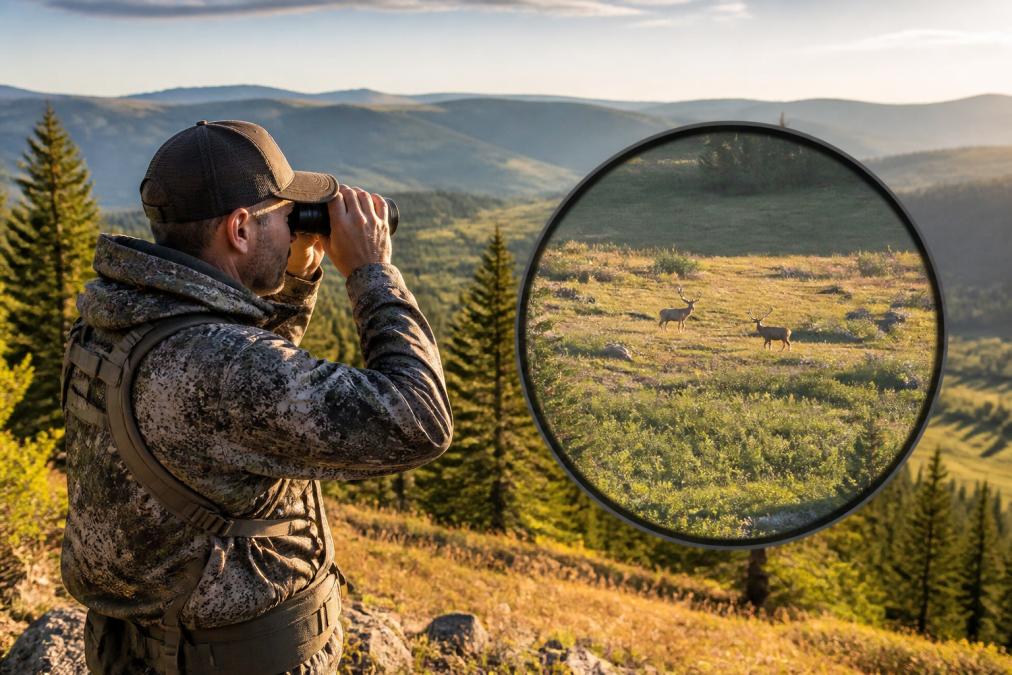
The 12x magnification exists, but it's a specialist tool. You need a tripod or a very stable shooting position. Most hunting situations don't demand it, and the added weight and complexity aren't worth the trade-off for general hunting.

Objective Lens Diameter and Image Brightness
The objective lens diameter, that second number in the binocular designation, directly controls how much light your binoculars gather. A 42mm objective gathers more light than a 32mm. A 50mm gathers even more. This matters most when you're hunting low-light conditions: dawn, dusk, and overcast days.
More light means a brighter, clearer image, especially in dim conditions. But there's a practical limit. A 50mm objective paired with 8x magnification creates a heavy, cumbersome package. A 42mm objective paired with 10x magnification is more balanced. The goal isn't the biggest objective, it's the right balance for how you hunt.
For most hunting situations, a 42mm objective is the sweet spot. It gathers enough light for early morning and late evening hunting without making the binoculars so heavy that you're fatigued by mid-day. If you're hunting in consistently bright conditions or open terrain where you can glass from a stable position, a smaller 32mm objective works fine and saves weight.
The relationship between magnification and objective diameter also determines something called the exit pupil, which we'll cover next. That's where the real performance differences show up.
Field of View and Why It Matters for Hunting
Field of view is how much landscape you can see through the binoculars at once. It's measured in degrees or in feet at 1,000 yards. A wider field of view means you see more terrain without moving the binoculars. A narrower field means you're looking at a smaller window of the world.
Higher magnification always means a narrower field of view. An 8x binocular has a wider field than a 10x. That wider view is an advantage when you're scanning for movement. Game often catches your eye as motion in your peripheral vision through the binoculars. A wider field gives you more chances to spot that movement before the animal moves out of frame.
But narrower fields aren't all bad. If you're looking at a specific hillside or water hole where you expect game to appear, the narrower field of a 10x or 12x lets you focus on that area without distraction. You're trading scanning speed for detail resolution.
For beginners, wider is generally better. You're still learning where to look and how to move binoculars across terrain efficiently. A wider field of view is more forgiving and lets you find game faster.
Exit Pupil, Eye Relief, and Low-Light Performance
The exit pupil is where optical performance gets real. It's the small circle of light that exits the binocular and enters your eye. The size of the exit pupil determines how much of the light the binocular gathers actually reaches your eye.
You calculate exit pupil by dividing the objective diameter by the magnification. An 8x42 binocular has a 5.25mm exit pupil. A 10x42 has a 4.2mm exit pupil. Your eye's pupil dilates in low light, in dim conditions, it can open to 7mm or larger (peer-reviewed research). If the binocular's exit pupil is smaller than your eye's pupil, you're not using all the light the binocular gathered. You're leaving light on the table.
This is why an 8x42 binocular performs better than a 10x42 in low-light hunting conditions. The larger exit pupil matches your dilated eye pupil more closely, so you're capturing more of that gathered light. For dawn and dusk hunting, this difference is noticeable.
Eye relief is how far your eye can be from the eyepiece and still see the full field of view. It matters if you wear glasses. Most hunting binoculars offer 15-17mm of eye relief, which works fine for eyeglass wearers. Some offer more. If you hunt in glasses, check the eye relief spec and test the binoculars with your glasses on before buying.
Roof Prism vs. Porro Prism: Which Is Right for You
Binoculars use one of two internal prism designs: roof prism or porro prism. The design affects the shape, weight, balance, and optical performance of the binocular.
Porro prism binoculars have the objective lenses wider apart than the eyepieces. They're bulkier and heavier, but they're optically simpler and less expensive to manufacture. Porro prisms also deliver excellent optical quality. Many hunters prefer them because they feel substantial and balanced in the hand.
Roof prism binoculars have the objective lenses aligned with the eyepieces. They're sleeker, more compact, and lighter. They look more modern. But they require more complex internal optics to achieve the same image quality, which makes them more expensive.
For hunting, the difference is mostly about preference and budget. A good porro prism binocular will often perform well for its price. A quality roof prism is lighter and easier to carry all day. If you're hiking into backcountry, the weight savings matter. If you're hunting from a stand or blind, the shape doesn't matter as much.
The real question: do you want optical performance or compact size? Most hunters choose optical performance. Porro prism binoculars can deliver that at lower cost.
Durability Features: Waterproofing, Fog-Proofing, and Coatings
Hunting binoculars need to survive rain, fog, temperature swings, and rough handling. Three features separate reliable optics from ones that fail in the field.
Waterproofing means the binocular won't leak when submerged or rained on. Look for a waterproof rating of at least IPX7, which means the binocular can handle submersion in 1 meter of water for 30 minutes (iec.ch). Most hunting binoculars exceed this. Waterproofing is standard on serious gear.
Fog-proofing prevents internal fogging when temperature changes rapidly, like when you bring cold binoculars into a warm vehicle. The binocular is sealed and filled with dry nitrogen gas instead of air (peer-reviewed research). The nitrogen prevents moisture from condensing inside. This is essential for hunting because you're moving between cold air and warm spaces constantly.
Lens coatings affect image brightness and clarity. Coated optics have a single layer of anti-reflection coating. Fully multi-coated optics have multiple layers on every air-to-glass surface. More coatings mean more light reaches your eye and less is lost to reflection. For hunting in low light, fully multi-coated optics are worth the cost.
Rubber armor protects the barrel from impacts and improves grip in wet conditions. It's standard on hunting binoculars and worth having.
| Feature | What It Does | Why It Matters |
|---|---|---|
| IPX7 Waterproofing | Survives submersion and rain | Hunting happens in wet conditions |
| Nitrogen Purged | Prevents internal fogging | Temperature swings cause fogging |
| Fully Multi-Coated | Maximizes light transmission | Low-light hunting needs brightness |
| Rubber Armor | Protects from impact and improves grip | Field use is rough |
How to Clean Hunting Binoculars in the Field
Your binoculars will collect dust, rain, and debris in the field. Cleaning them properly keeps the optics clear and protects the coatings.
Start with a soft brush or compressed air to remove loose dust and debris. Never wipe a dusty lens with a cloth, you'll grind particles into the coating and scratch it. Blow or brush first, always.
For wet binoculars, use a soft, lint-free cloth. Microfiber cloths are ideal. Wipe gently from the center of the lens outward in a circular motion. Don't press hard. The goal is to remove moisture without grinding anything into the glass.
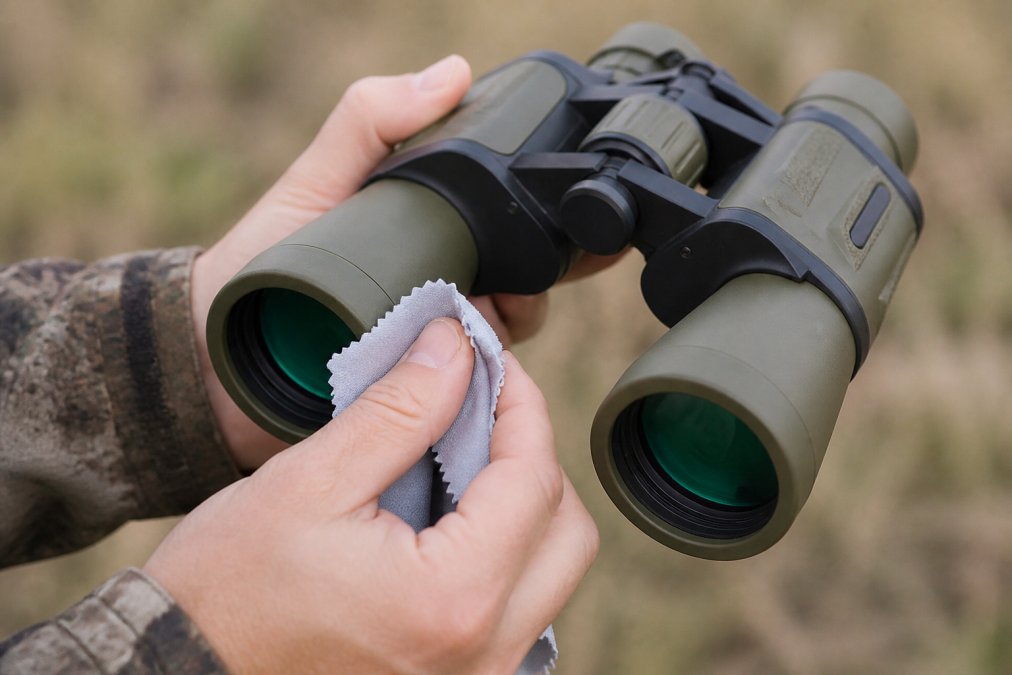
For stubborn smudges or fingerprints, use a lens cleaning solution made for optics. Apply the solution to the cloth, not directly to the lens. Wipe gently. Never use household cleaners or paper towels, they'll damage the coatings.
Keep your binoculars in a protective case when you're not using them. A case prevents dust accumulation and protects the optics from impacts. If you're hunting in wet conditions, store the binoculars in a dry place overnight so any internal moisture can evaporate.
Choosing the right hunting binoculars for beginners comes down to understanding what the specs actually mean and matching them to how you hunt. An 8x42 with a roof or porro prism design, fully multi-coated optics, and nitrogen purging will serve you well in most hunting situations. Test before you buy, prioritize optical performance over size, and invest in a quality pair that will last years in the field.
At Leash the Wilderness, we've curated gear that hunters trust because it works when conditions turn difficult. The Hunters Optics Kit brings together binoculars, a rangefinder, and a rifle scope in one complete package, everything you need to see clearly, measure distance accurately, and make the shot. Start there, learn the fundamentals, and you'll build a setup that performs.

Frequently Asked Questions
Q: What is the difference between 8x42 and 10x42 binoculars for hunting?
A: The first number is magnification, the second is objective lens diameter in millimeters. An 8x42 magnifies 8 times with a 42mm lens; a 10x42 magnifies 10 times with the same lens. The 10x42 brings distant subjects closer but has a narrower field of view and requires steadier hands. For beginners, 8x42 offers easier glassing and better low-light performance, while 10x42 suits hunters who want more magnification and can handle the shakier image.
Q: Which is better for deer hunting, 8x42 or 10x42?
A: For deer hunting, 8x42 binoculars are often better for beginners because they deliver a wider field of view, making it easier to scan brushy terrain and spot movement. They also perform better in dawn and dusk light, prime hunting times. A 10x42 works well if you're glassing open country from a distance and your hands are steady, but the narrower field of view can make tracking moving deer harder in thick cover.
Q: Do beginners need waterproof and fog-proof binoculars?
A: Yes. Waterproof and fog-proof binoculars are essential for hunting binoculars, not optional. Hunts happen in rain, snow, and temperature swings that fog regular optics. Waterproof construction keeps water out of the barrel, and nitrogen purging prevents internal fogging. Without these features, your optics will fail when conditions turn wet or cold, exactly when you need them most.
Q: What do the numbers on hunting binoculars mean?
A: Binocular numbers follow the format [magnification]x[objective lens diameter]. For example, 10x42 means 10x magnification and a 42mm objective lens. Magnification shows how many times closer the subject appears; objective lens diameter affects light gathering and image brightness. A larger objective lens (50mm vs. 42mm) gathers more light but makes binoculars heavier. Beginners should balance magnification, lens size, and weight based on hunting conditions and personal strength.
This article was written using GrandRanker