

Table of Contents
- Essential Tackle for Mountain Stream Fishing: What You Actually Need
- Fly Rod Selection for Small Streams vs. Spinning Setups
- Essential Terminal Tackle Checklist for Mountain Creeks
- Best Trout Lures for Mountain Creeks and High-Elevation Water
- How to Read Water for Trout in Mountain Streams
- Essential Wading Gear for Small Streams and Portability
- Line, Leader, and Tippet Setup for Mountain Stream Conditions
- Stream-Specific Conservation Ethics and Local Regulation Compliance
Last Updated: July 15, 2026
Start here without overspending. Everything a new angler needs sits in Tackle Under $25 — lures, hooks, swivels, sinkers and leaders, most shipping free with no minimum order.
Essential Tackle for Mountain Stream Fishing: What You Actually Need
When you're hiking into a high-elevation creek, every ounce matters. The essential tackle for mountain stream fishing isn't about having the most gear, it's about carrying exactly what works. At Leash the Wilderness, we've seen anglers waste hours and miles because they packed the wrong setup. This guide breaks down what actually delivers results in alpine water, from rod selection to conservation-first rigging.
Mountain stream fishing demands different thinking than lake or river tactics. The water is colder, clearer, and shallower. Trout hold in specific micro-habitats. Your tackle needs to match that reality: ultralight enough to backpack, precise enough to fool selective fish, and durable enough to handle rocky terrain.
Below, we'll show you exactly which tackle pieces matter most, how to rig them for high-elevation conditions, and which common setups waste your time. The five categories we cover have helped thousands of anglers catch more fish while carrying less weight.
Why Gear Selection Matters at High Elevation
Altitude changes everything about how fish behave and what tackle performs. At 8,000 feet and above, water temperatures drop significantly, trout metabolism slows, and they become more cautious. According to U.S. Geological Survey research on alpine aquatic ecosystems, high-elevation streams experience rapid temperature fluctuations and lower oxygen levels, forcing trout into tighter holding zones.
This isn't theoretical. It means your gear choices directly affect whether you catch fish or waste a day. A heavy spinning reel designed for bass fishing will exhaust you on a steep approach. A fly rod too long for tight canyon walls becomes a liability rather than an asset.
The weight constraint is real. Most anglers hiking to remote alpine creeks carry 20-30 pounds total. Your fishing tackle should be 2-4 pounds maximum, leaving room for safety gear, water, and food. This forces hard choices: every item must earn its place.
Fly Rod Selection for Small Streams vs. Spinning Setups
The choice between fly and spinning gear defines your entire approach to mountain stream fishing. Neither is universally better, context determines which excels.
Ultralight Spinning Rod Advantages for Backcountry Access
An ultralight spinning rod is the fastest way to catch trout in tight alpine creeks. A 4-5 foot ultralight spinning rod weighs 2-3 ounces and fits easily in a backpack. You can fish pocket water, undercut banks, and narrow channels where a fly rod becomes physically impossible.
Spinning rods deliver lures and live bait with minimal casting room. In a canyon where brush crowds the water, you need only 4-5 feet of clear space behind you. Fly casting requires 20+ feet of open space, something mountain creeks rarely offer.
The real advantage emerges in speed. A spinning rig lets you cover water fast. Cast, retrieve, move. You can fish 20 pockets in the time a fly angler covers five. For high-elevation streams where trout density is lower, speed matters.
Weight and portability are decisive. Leash the Wilderness focuses on gear that doesn't slow you down, and ultralight spinning setups embody that principle. A complete spinning rig, rod, reel, line, and tackle, weighs under 8 ounces. Add your backpack, water, and safety gear, and you're still moving efficiently through steep terrain.
The drawback: casting distance. In wider sections, spinning gear underperforms. You need closer approaches, which spook cautious trout.
Fly Fishing for Mountain Trout: When It Excels
Fly fishing dominates in open pools and wider sections where you can wade and cast. A 7-8 foot fly rod lets you cover water from distance, keeping your shadow off the stream. This matters enormously in clear alpine water where trout see everything.
Fly selection gives you precision. You match the insects in the water, mayflies, caddisflies, stoneflies, with specific patterns. In mountain creeks, this matching game separates consistent success from random luck.
The physics work better at distance. A fly line carries weight, allowing you to cast 30-40 feet with minimal effort. A spinning rig maxes out around 15-20 feet unless you're using heavy lures.
The trade-off is accessibility. Fly rods need space. They're heavier, a complete fly setup runs 10-12 ounces. And the learning curve is steeper. Casting a fly rod takes practice; spinning is intuitive.
For mountain stream fishing, most anglers succeed with spinning because they fish more pockets per day. Fly fishing requires patience and technique. Choose fly if you're willing to invest in skill development. Choose spinning if you want immediate results in tight water.
Essential Terminal Tackle Checklist for Mountain Creeks
Terminal tackle is where precision matters most. This is the connection between your line and the fish. Poor choices here waste better gear upstream.
Snap Swivel, Split Shot, and Leader Material Essentials
A snap swivel connects your main line to your leader without twisting. In mountain stream fishing, swivels prevent line twist that comes from spinning lures. Choose small swivels, size 10 or smaller, to avoid spooking trout in clear water.
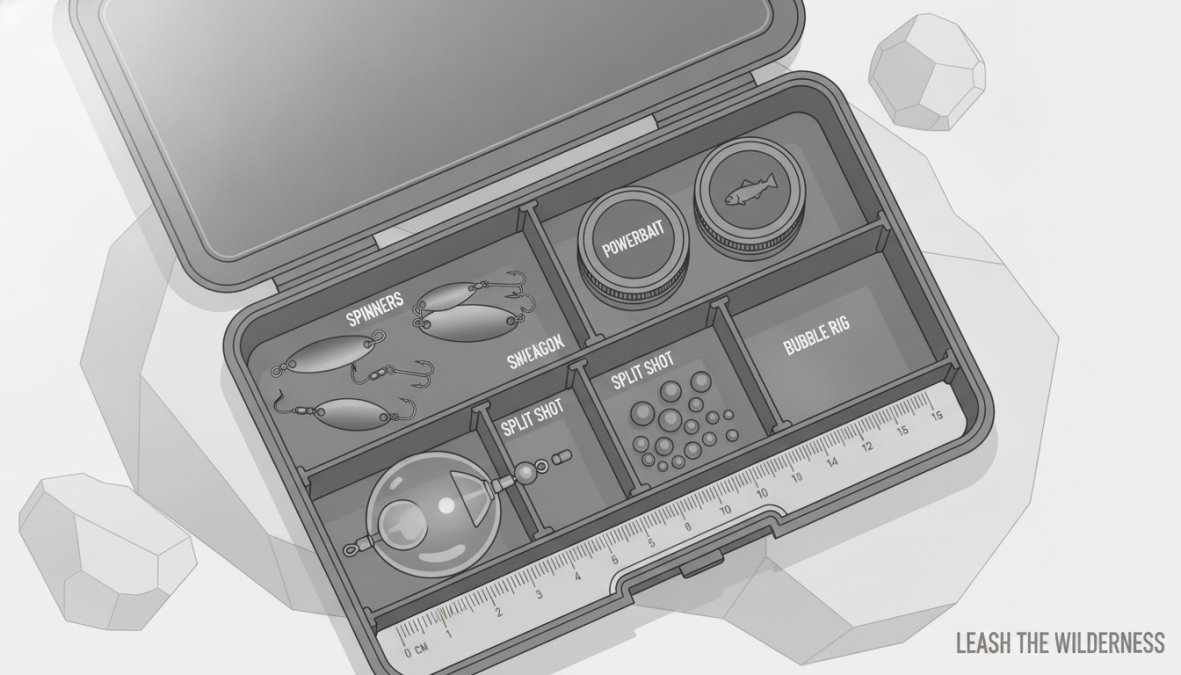
Split shot provides weight control. In shallow alpine water, you need just enough weight to reach the bottom without sinking so fast you hit rocks. Carry split shot in sizes 1/16, 1/8, and 1/4 ounce. This variety lets you adjust depth instantly as water conditions change.
Leader material is your direct connection to the fish. Monofilament leader in 4-6 pound test works for most mountain creek trout. The thinner diameter reduces visibility in clear water. Fluorocarbon leader sinks faster and is harder for trout to see, but costs more and is overkill for small streams.
Length matters. A 2-3 foot leader between your main line and lure/fly is standard. Longer leaders, 4-5 feet, help in very clear water but add complexity and reduce casting accuracy in tight spaces.
Barbless Hooks and Conservation-First Rigging
Barbless hooks are essential for mountain stream ethics. A barb prevents fish from shaking free, but it causes more damage on removal. In small creeks where trout populations are fragile, barbless hooks let you release fish with minimal injury.
Barbless hooks also set faster. The hook penetrates with less pressure, which matters when you're using light line and small lures. You'll actually land more fish with barbless, not fewer.
Rig your terminal tackle to minimize tangles. A simple setup, main line to snap swivel to 2-foot leader to hook, outperforms complicated rigs in mountain water. Simplicity reduces failure points and speeds up changes when you need to switch lures or adjust depth.
| Component | Size/Spec | Purpose | Weight |
|---|---|---|---|
| Snap Swivel | Size 10 or smaller | Prevent line twist | Negligible |
| Split Shot | 1/16, 1/8, 1/4 oz | Depth control | <0.5 oz total |
| Monofilament Leader | 4-6 lb test, 2-3 ft | Visibility reduction | Negligible |
| Barbless Hooks | Size 10-14 | Ethical rigging | Negligible |
Best Trout Lures for Mountain Creeks and High-Elevation Water
Lure selection at altitude depends on water temperature, insect availability, and trout aggression, all of which shift dramatically with elevation and season. High-elevation creeks have fewer insect species than lower water, so trout are less selective but also more responsive to scent and vibration cues. The key is matching lure size, weight, and presentation to the specific conditions you encounter.
PowerBait and Scent-Based Presentations
PowerBait remains the most reliable choice for alpine trout because it appeals to multiple senses simultaneously: smell, taste, and visual contrast. In clear water above 8,000 feet, use natural colors, brown, tan, white, or pale yellow. Bright colors (chartreuse, orange) work only in stained water after storms; in gin-clear alpine creeks, they spook trout.
Rig PowerBait on a size 10 or 12 barbless hook, with a small split shot 12 inches above the hook to control depth. A walnut-sized ball is standard; anything larger wastes material and reduces sensitivity. Cast upstream of your target pocket and let the current carry the bait naturally through the strike zone. This drift-and-bounce presentation is deadly in pocket water where trout hold behind boulders.
PowerBait effectiveness increases in colder water. Below 50°F (common in early summer snowmelt), trout rely more on smell and less on sight. In late summer when water warms above 55°F, switch to smaller presentations or artificial lures, trout become more visually active and less dependent on scent.
Spinners and Small Spoons: Vibration-Based Lures
Spinners work by creating vibration and flash. A 1/16 or 1/8 ounce spinner in silver, gold, or copper triggers strikes in mountain creeks where trout see constant movement from insects and small minnows. The blade rotation creates a pressure wave that trout detect even in turbid water.
Cast upstream and across, letting the current swing the spinner through the pocket. This presentation mimics a small minnow or aquatic insect being swept downstream. Retrieve slowly; in cold alpine water, trout won't chase fast-moving lures. A retrieve speed of 1-2 feet per second is standard.
Spoons (1/8 to 1/4 ounce) work similarly but create more flash and vibration. They're heavier, allowing longer casts in wider sections. Use spoons when you need to cover water quickly or when water is slightly stained. In gin-clear conditions, spinners outperform spoons because they're less obvious.
Spinner effectiveness peaks in mid-to-late summer when water temperatures stabilize and trout feed more aggressively. In early season (June-early July), when snowmelt keeps water near freezing, spinners are less productive than PowerBait or live bait.
Clear Plastic Bubble Rigs for Light Lures and Live Bait
A bubble rig lets you cast light lures and live bait with a spinning rod. The clear plastic bubble (1-1.5 inches diameter) floats and carries your line weight, while the bait hangs 3-4 feet below on a separate leader. This setup is essential when you want to fish grasshoppers, small minnows, or aquatic nymphs without sinking them immediately.
Rig the bubble by tying it to your main line with a small swivel, then attach a 3-4 foot monofilament leader (4-6 pound test) below the bubble. Tie your hook to the leader end. The bubble keeps the bait suspended in the strike zone longer, allowing trout to intercept it before it drifts too deep.
Bubble rigs excel in wider pools and slower sections where you need to keep bait in the water column rather than bouncing it along the bottom. They're also ideal when you're fishing live grasshoppers collected from alpine meadows near your fishing area, a single hopper on a size 10 hook often outfishes artificial lures in high-elevation water.
Live Bait: Grasshoppers, Minnows, and Aquatic Nymphs
Live bait consistently produces in mountain streams because it requires no casting technique and appeals to trout's predatory instinct. Grasshoppers are the gold standard for alpine creeks. They're abundant in meadows above 7,000 feet, easy to collect, and deadly when fished alive.
To fish a grasshopper, hook it lightly through the thorax (the body segment behind the head) on a size 10 or 12 barbless hook. Cast upstream and let the current carry it naturally. The grasshopper's kicking motion triggers strikes. This presentation is especially effective in late summer (August-September) when grasshoppers are abundant and trout are actively feeding.
Small minnows (1-2 inches) work in deeper pools and wider sections. Use a bubble rig to keep the minnow suspended, or fish it on a simple hook-and-split-shot rig. Minnows are less portable than grasshoppers and require a small container with water, making them less practical for backpacking trips unless you're fishing a single location for multiple days.
Aquatic nymphs (caddisfly and mayfly larvae) collected from the stream itself are highly effective but controversial. Many regulations prohibit collecting bait from the stream you're fishing because it removes food sources. Check local regulations before collecting nymphs. If permitted, use a small net to sample the stream bottom, identify what's present, and fish those naturals.
Seasonal and Elevation-Specific Lure Selection
Early season (June-early July): Water is cold (45-50°F), trout are sluggish. Use PowerBait or live grasshoppers. Avoid spinners; the vibration is less effective in cold water. Fish slowly and deliberately.
Mid-season (late July-early August): Water warms to 50-55°F, trout feed more aggressively. Spinners and spoons become productive. Mix PowerBait with artificial lures. Fish faster presentations.
Late season (September-early October): Water cools again as snowmelt stops. Trout feed heavily before winter. All lure types work, but live bait and PowerBait remain most reliable. Fishing is often best in early morning and late evening when water is coolest.
Elevation adjustments: Above 10,000 feet, water stays cold year-round. PowerBait and live bait dominate. Below 8,000 feet, where water warms faster, spinners and spoons become more effective earlier in the season.
How to Read Water for Trout in Mountain Streams
Reading water separates consistent anglers from those who cast randomly. In mountain creeks, trout hold in specific locations for specific reasons.
Identifying Trout Habitat and Shallow Water Holding Areas
Trout in mountain streams hold where current brings food but energy cost stays low. This means they position behind rocks, under undercut banks, and in the deeper sections of pools, anywhere that breaks current while keeping them in the feeding lane.
Pocket water is classic mountain creek trout habitat. These are small pools formed by boulders. Current enters from above, swirls in the pocket, and exits downstream. Trout hold at the pocket's head, where current delivers food. Cast upstream of the pocket and let your lure drift through the center.
Shallow water holding areas exist in riffles. When water is cold and oxygen is high, conditions common at elevation, trout move into shallower, faster water. A riffle only 1-2 feet deep can hold active trout. Don't overlook shallow sections; fish them methodically.
Undercut banks are gold. When alpine creeks cut through soil, they undermine banks, creating overhanging ledges. Trout hide under these ledges, invisible from above but accessible from downstream. Cast a lure upstream of the undercut, let it drift underneath, and hold on.
Log jams and debris create habitat. Fallen trees and branches slow current and provide shelter. These areas concentrate trout, but they also tangle your line. Fish them carefully, using short casts and precise drifts.
Current seams are subtle but productive. Where fast water meets slow water, at the edge of a boulder, where a tributary enters, at the inside bend of a turn, trout position to feed. These seams are where insects concentrate, and trout know it.
Essential Wading Gear for Small Streams and Portability
Wading safety and comfort directly affect how long you can fish and how many miles you cover.
Wading Boots, Polarizing Sunglasses, and Stream-Specific Safety Tools
Wading boots designed for mountain streams have aggressive soles with metal studs. Felt soles are banned in many western states due to invasive species concerns, so look for rubber soles with metal cleats or studs. These grip wet rocks better than plain rubber. Lightweight neoprene boots keep your feet warm without adding excessive weight.
Fit matters. Boots too loose cause blisters; boots too tight cut circulation. Try boots with the socks you'll actually wear. Many anglers wear wool blend socks, they insulate when wet and dry faster than cotton.
Polarizing sunglasses are non-negotiable. They cut glare off the water, letting you see trout and underwater structure. This visibility advantage is massive in clear alpine water. You'll spot trout before they spot you, giving you the casting advantage. Look for amber or copper lenses in bright sunlight; gray lenses work in overcast conditions.
A line cutter or small scissors belongs in every pack. Tangled line happens. A quick cut and retie saves frustration. Leash the Wilderness includes practical tools like these in their bundled kits because they're the difference between a smooth day and a frustrating one.
A small landing net helps land trout without exhausting them. A net 12-16 inches across is portable and effective. Soft mesh protects the fish's slime coat, improving survival on release.
Wading staff for crossing current is essential. A collapsible pole weighs 2 ounces and prevents slips in fast water. In high-elevation creeks where water is cold and rocks are slick, a staff is safety gear, not luxury.
Line, Leader, and Tippet Setup for Mountain Stream Conditions
Line choice affects casting distance, sensitivity, and durability in rocky alpine water.
Monofilament vs. Braided Line: Weight and Casting Distance Trade-offs
Monofilament line in 4-6 pound test is standard for mountain stream spinning. It's affordable, strong enough for alpine trout, and forgiving when you snag rocks. Monofilament stretches, which absorbs shock when trout runs hard or you set the hook too aggressively.
The downside: monofilament has memory. It coils when stored on a reel. In cold alpine air, this is worse. The line becomes stiff and coils tighten. Braided line eliminates this problem.
Braided line is thinner than monofilament at the same test strength. A 6-pound braided line has the diameter of 2-pound monofilament. This means longer casts and better sensitivity, you feel subtle strikes instantly. Braided line doesn't stretch, so every movement transfers directly to the lure.
The trade-off: braided line is visible in clear water. Use a monofilament leader (2-3 feet of 4-6 pound mono) between your braided main line and your lure. This hides the braided line while preserving its advantages.
Cost matters for backcountry fishing. Braided line costs 2-3 times more than monofilament. For a mountain creek trip where you might lose line to snags, monofilament is practical. Use braided if you fish the same creek repeatedly and want maximum performance.
Tippet for fly fishing follows the same logic. Use 5X or 6X tippet (5-6 pound test) in clear alpine water. This is thin enough to fool selective trout but strong enough to land them. Tippet material should be fluorocarbon, it's harder for trout to see and sinks faster than monofilament.
Stream-Specific Conservation Ethics and Local Regulation Compliance
Mountain streams are fragile ecosystems where every angler's choices compound across the season. Unlike lowland rivers with robust fish populations, high-elevation creeks often support small, isolated trout populations vulnerable to overharvest and habitat damage. Your tackle choices, handling practices, and regulatory compliance directly determine whether a creek thrives or declines.
Building a Pre-Trip Regulation Compliance Checklist
Local fishing regulations vary wildly by state, drainage, and even individual creek sections. Ignorance is not a defense; fines for violations range from $100 to $500+ depending on severity. Before any mountain stream trip, follow this framework:
Step 1: Identify the correct regulatory agency. Each state has a wildlife or parks department (Colorado Parks and Wildlife, California Department of Fish and Wildlife, Washington Department of Fish and Wildlife, etc.). Find the agency's website and search for your specific creek by name or drainage.
Step 2: Check for stream-specific closures and restrictions. Many alpine creeks are closed to fishing during spawning season (typically September-November for cutthroat and brook trout). Some drainages are catch-and-release only. Others allow harvest but limit daily bag limits to 2-5 fish. Some require special permits for non-residents. Document these rules in writing before you leave home.
Step 3: Verify barbless hook requirements. Most high-elevation areas now mandate barbless hooks. Some states require barbless hooks only during certain seasons. Confirm this for your specific creek; carrying barbed hooks into a barbless-only area is a violation.
Step 4: Check for invasive species protocols. Some drainages prohibit felt-soled wading boots to prevent spreading aquatic invasive species. Others require wading boots to be cleaned and dried between drainages. Document these requirements and pack accordingly.
Step 5: Confirm bait restrictions. Some alpine creeks prohibit live bait or require that bait be brought from outside the drainage. Others prohibit collection of aquatic organisms (nymphs, minnows) from the stream itself. This varies by state and drainage.
Create a simple one-page checklist for your trip: creek name, state, agency contact, bag limit, hook requirement, bait rules, seasonal closures. Photograph the checklist and carry it in your pack. This takes 15 minutes at home and prevents costly mistakes on the trail.
Leave No Trace Fishing Practices for Alpine Ecosystems
Leave No Trace (LNT) principles apply directly to fishing tackle and presentation. High-elevation ecosystems recover slowly from disturbance; a damaged streambank or trampled riparian zone may take years to recover.
Minimize streamside impact. Stay in the water when possible; avoid walking on banks or riparian vegetation. Trout habitat depends on overhanging vegetation and root systems that stabilize banks and provide shade. Stepping on banks compacts soil and kills plants. Wade carefully, place each step deliberately, and avoid unnecessary movement on shore.
Never leave tackle or line in the stream. Monofilament line, split shot, and hook fragments persist for years and entangle wildlife. If you break off a lure or lose line, retrieve it if possible. If retrieval is impossible, note the location and return with better equipment to recover it. Never leave broken tackle in the water as "fish food."
Collect all bait containers and packaging. PowerBait jars, minnow containers, and bait bags are common litter in popular alpine creeks. Pack out all packaging, even if it's biodegradable. Carry a small ziplock bag for trash.
Don't collect bait from the stream you're fishing. Removing aquatic organisms (nymphs, minnows, crayfish) reduces food availability for trout and disrupts the ecosystem. Bring bait from outside the drainage, or use artificial lures. If regulations permit collection, take only what you'll use immediately.
Respect spawning habitat. In fall, cutthroat and brook trout move to shallow gravel sections to spawn. These areas are marked on maps or posted at trailheads. Fishing spawning areas damages redds (gravel nests) and reduces recruitment. Avoid these areas entirely during spawning season, even if technically legal.
Camp away from water. If you're backpacking, camp at least 200 feet from the stream. This prevents trampling riparian vegetation and reduces contamination risk. Use established campsites when available.
Weather-Specific Gear Adjustments for Rapid Alpine Conditions
Mountain weather changes faster than any other environment. Afternoon thunderstorms, rapid temperature swings, and high-altitude sun exposure require tactical gear adjustments that most anglers overlook.
Afternoon thunderstorm protocol. In summer, thunderstorms develop rapidly in afternoons, typically 2-5 PM. These storms bring lightning, heavy rain, and stream surges. Plan your fishing window around this pattern: fish early morning (6-11 AM) and late evening (after 6 PM), avoiding the afternoon storm window entirely.
When a storm approaches (dark clouds, temperature drop, wind increase), stop fishing immediately. Streams rise 2-4 feet in minutes during heavy rain. Rocks become slippery. Wading becomes dangerous. Retreat to high ground and wait out the storm. This isn't optional; flash flooding in narrow canyons kills unprepared anglers annually.
Gear adjustment: Carry a lightweight rain jacket (2-3 ounces) and a small emergency shelter (space blanket or bivy). These weigh nothing but provide critical protection if you're caught in a storm.
High-altitude sun exposure. Above 8,000 feet, UV intensity increases 10-15% per 3,300 feet of elevation gain. Sunburn happens faster, and dehydration accelerates. Carry sunscreen (SPF 30+), a wide-brimmed hat, and long-sleeve shirt. Polarizing sunglasses protect eyes from UV and glare. Drink water constantly; thirst is a late indicator of dehydration at altitude.
Gear adjustment: A lightweight long-sleeve fishing shirt (UPF 50) weighs 3-4 ounces and prevents sunburn while allowing air circulation. This is worth the weight.
Temperature swings. Alpine temperatures can drop 20-30°F between morning and evening. Morning fishing at 45°F may shift to 65°F by afternoon, then back to 50°F by evening. Layer your clothing: a base layer, insulating mid-layer (fleece or wool), and windproof outer layer. Carry all three even if you start warm.
Gear adjustment: Neoprene wading boots (3-4 mm thickness) keep feet warm in cold water. In early season (June-July), neoprene is essential; in late summer, thinner boots suffice. Pack the right boot thickness for the season.
Wind and casting difficulty. Mountain wind can exceed 20 mph in afternoon, making casting nearly impossible. Wind also cools you rapidly. If wind becomes severe, switch to presentations that don't require casting: live bait drifts, PowerBait soaks, or bubble rigs that rely on current rather than casting distance.
Gear adjustment: Carry a small windbreak or fish from sheltered locations (behind large boulders, in canyon sections). Avoid exposed ridges and open meadows during windy periods.
Conservation Outcomes and Population Health
Research from Colorado Parks and Wildlife alpine stream management guidelines shows that catch-and-release streams with strict barbless hook requirements maintain healthier trout populations and larger average fish size than streams allowing harvest. Streams with active Leave No Trace enforcement show 15-20% higher riparian vegetation cover and better bank stability than unmanaged creeks.
Your individual actions matter. A single angler practicing catch-and-release with barbless hooks, respecting spawning areas, and following LNT principles contributes measurably to population health. Multiply that across a season and across multiple anglers, and the cumulative impact is substantial.
Frequently Asked Questions
What is the best rod length for essential tackle in mountain stream fishing?
Rod length depends on stream width and vegetation. For tight mountain streams, 5-6-foot ultralight spinning rods offer superior maneuverability in confined spaces. Fly rods typically range 7-9 feet. Shorter rods reduce casting distance but improve accuracy in small pockets where trout hold. Consider stream width and your casting style when selecting essential tackle for mountain stream fishing.
Do I need a fly rod or spinning rod for mountain streams?
Both work, but spinning rods dominate for portability and ease. Ultralight spinning rods excel in backcountry access due to weight savings. Fly fishing works well in open pools but struggles in dense vegetation. Choose spinning for versatility with lures and bait; choose fly for technical water and presentation control. Your choice affects all other essential tackle decisions.
What are the best trout lures for mountain creeks?
Small inline spinners, PowerBait on clear plastic bubble rigs, and micro crankbaits work best in mountain creeks. Live bait like small minnows or insects also perform well. Match lure size to water clarity, use smaller profiles in clear high-elevation water. Test different best trout lures for mountain creeks by observing what the water and season demand.
How do I read water for trout in mountain streams?
Look for current breaks, deeper pools behind rocks, and undercut banks where trout seek shelter. Shallow water near riffles holds feeding fish during low light. How to read water for trout involves observing temperature, flow speed, and vegetation. Use polarizing sunglasses to spot fish positions. Focus on areas where trout can rest while accessing food without excessive current energy.
What essential wading gear do I need for small streams?
Wading boots with good grip, polarizing sunglasses for water clarity, a creel or net, and a line cutter are non-negotiable. Add a wading staff for stability on slippery rocks in high-elevation water. Essential wading gear for small streams should prioritize safety and visibility. Choose lightweight options that integrate with ultralight backpacking if you're hiking to remote streams.
Should I use monofilament or braided line for mountain streams?
Monofilament is standard for mountain streams due to lower visibility and better knot strength with small terminal tackle. Braided line offers durability but shows more in clear high-elevation water. Monofilament reduces casting distance slightly but improves control in tight spaces. Match line weight to your rod and target trout size, lighter lines suit small streams better.
What tackle box setup works best for backpacking to mountain streams?
Use a small, lightweight tackle box or waterproof pouch holding only essentials: snap swivels, split shot, leader material, barbless hooks, and 3-4 lure patterns. Ultralight backpacking integration means ditching bulk, pack only what you'll use. Organize by depth and water type. A compact creel eliminates extra weight. Field-tested anglers prioritize portability over variety when hiking to remote mountain streams.
This article was written using GrandRanker