

Table of Contents
- What Separates Working Dog Gear From Pet Store Gear
- Rugged Dog Harnesses for Trail Hiking: Fit, Padding, and Load Distribution
- Matching Durable Gear for Working Dogs to the Job
- Tactical Dog Gear Maintenance: A Simple Inspection Routine
- Joint Health and Ergonomics for Dogs That Work
- Climate and Terrain: Picking Gear for Heat, Cold, and Wet
- Common Gear Mistakes and What They Cost You
- Conclusion
- Frequently Asked Questions
Last Updated: September 12, 2026
What Separates Working Dog Gear From Pet Store Gear
The problem starts with a buckle. A plastic side-release clasp that holds on a Saturday walk pops open when a dog loads it at a full sprint. Durable gear for working dogs is built around three components that fail first: stitching, hardware, and webbing. This guide covers how each fails, how to inspect it, and how to match a rig to the job your dog does.
Stitching, Hardware, and Webbing: The Three Failure Points
Bar-tack stitching is a dense, repeated stitch pattern at stress points where webbing meets a ring or buckle. It spreads load across many thread passes instead of one seam. Single-stitch box seams go first.
Hardware fails two ways: plastic snaps crack in cold, and cheap cast metal bends open under load. Look for welded D-rings, not split rings.
Webbing fails by abrasion, not breaking. A 1-inch nylon strap rated for 4,000 pounds still wears through where it rubs rock or a vehicle door (rei.com).
Quick-Release Hardware and Why It Matters
A quick-release buckle gets a dog out of a rig in seconds, if a strap snags on brush, if the dog goes into water, or if you switch from a tracking line to a leash.
The trade-off is real: quick-release hardware adds a failure point a sewn loop doesn't have. Buy metal buckles if the dog pulls hard, and check gate tension every time out.
Rugged Dog Harnesses for Trail Hiking: Fit, Padding, and Load Distribution
A trail harness has one job: move load off the throat and onto the chest and rib cage. A dog pulling into a neck-only collar restricts its airway on climbs. A fitted harness spreads that force across the sternum and shoulders, which is why rugged dog harnesses for trail hiking use a padded chest plate and a wide, load-bearing yoke.
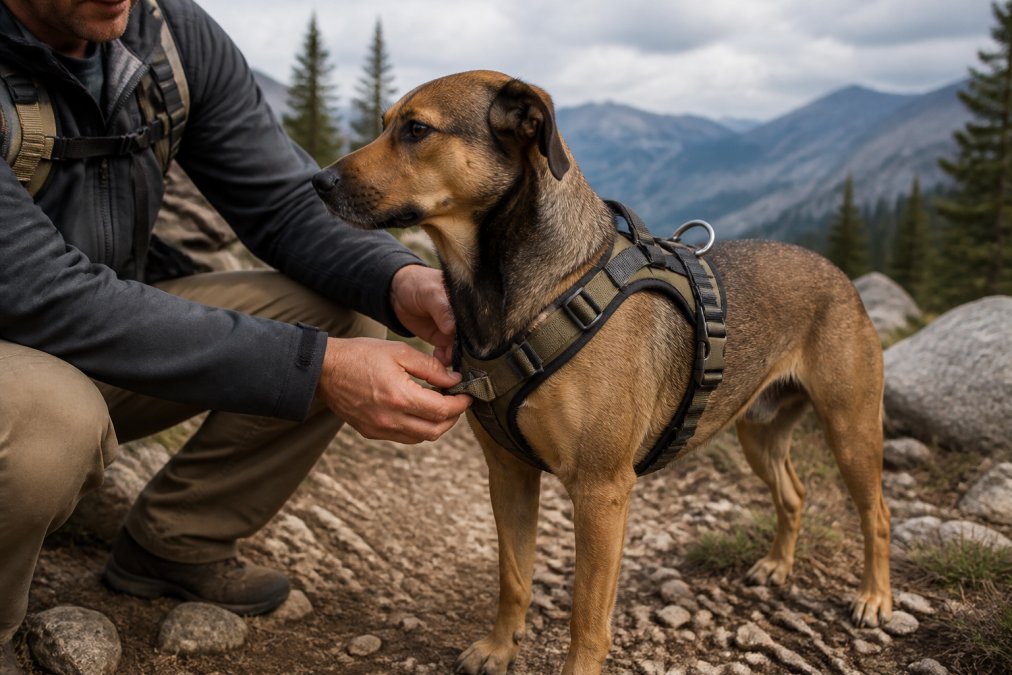
Padding placement matters more than thickness. A thick pad in the wrong spot creates a pressure point. A thin pad over the sternum beats an inch of foam across the shoulders.
How to Fit a Harness So It Doesn't Rub
- Measure the girth just behind the front legs, not at the neck.
- Fit two fingers under every strap, no more.
- Check the chest strap sits below the windpipe, not across it.
- Re-check fit after 15 minutes of movement, since hair compresses.
- Watch for hair loss or a hot spot after the first long day.
A harness that rubs will rub worse under load. Fix the fit before you add weight.
🛒 Shop the Track & Train Dog Collar →

Matching Durable Gear for Working Dogs to the Job
The rig follows the work. A detection dog on a 6-foot lead needs almost no load-bearing structure. A trail dog carrying its own water needs a harness rated for that weight. Matching durable gear for working dogs to the task is the step most owners skip, and it's why gear that works for one dog fails for another.
| Discipline | Primary Need | Key Hardware | What Fails First |
|---|---|---|---|
| Trail hiking | Load distribution | Padded yoke, welded D-ring | Chest strap stitching |
| Detection | Low profile, no snag | Flat webbing, no dangling tags | Buckle snagging on brush |
| Service work | Clear identification | Service dog vest panel | Panel attachment points |
| Search and rescue | High visibility, long line | Reflective webbing, swivel | Line wear at the swivel |
| Water work | Fast drainage, corrosion resistance | Metal hardware, biothane | Rusted quick-release gate |
Trail and Backpacking Work
A trail dog carrying its own water is the only common working setup where the dog bears real weight. The working ceiling most handlers use is 10 to 12 percent of body weight for a conditioned adult (akc.org). Ignore the 20 percent figure you see online, that's a pack-goat number. A 60-pound shepherd tops out around 6 to 7 pounds before stride length shortens on climbs.
That load sits on the rib cage, not the shoulders. A yoke crossing the shoulder blades restricts scapula rotation, and you'll see a shortened front stride within the first mile. Look for a chest plate at or below the sternum and a load-bearing strap running horizontally across the ribs.
Detection and Scent Work
Detection dogs work on a 6- to 15-foot lead, often through brush, vehicle interiors, and cargo. The gear requirement is the opposite of trail gear: nothing to snag, rattle, or change the dog's silhouette. Flat 1-inch webbing, no dangling ID tags, a buckle flush against the body.
Most handlers run a slip lead or martingale rather than a full harness, because a chest strap can interfere with the deep chest expansion a dog uses on a scent cone. If you run a harness for detection, test it on a known hide first.
Service Work
Service dog gear is the one category where the legal requirement drives design. Under the ADA, a service animal is a dog individually trained to do work or perform tasks for a person with a disability, and the handler isn't required to provide documentation or a vest (ada.gov). The vest is a communication tool, not a legal credential, but a high-contrast panel cuts down how often you get stopped in public.
The failure point is the panel attachment. Hook-and-loop patches lose grip after a few hundred cycles, and a peeling corner catches on doorframes. Stitched or snap-mounted panels outlast hook-and-loop by a wide margin.
Search and Rescue
SAR punishes gear hardest, because the dog is often on a 20- to 40-foot long line through terrain you can't see. The line is the wear item, not the harness. A line over rock edges, barbed wire, or tree trunks abrades at the contact point, and that's where it breaks.
Add a swivel between the long line and the harness. Without one, a dog circling a scent article twists the line into itself, and the knot can jam against hardware under tension. Reflective webbing matters at night, but the swivel prevents the failure you can't see coming.
Water and Wet Work
Biothane is a coated webbing that sheds water and mud instead of absorbing it. It costs more than nylon and doesn't stretch, which makes it a poor choice for a dog that needs give in the line. For water work, the no-stretch property is the point, a biothane long line doesn't load up with water weight or hold grit against the coat.
The trade-off: biothane is slick when wet. A dog that paws at its own line can slide a biothane strap through a buckle nylon would grip. If your dog does that, keep nylon on the body and biothane on the line.
If you are starting from scratch, the Dog Leashes & Leads collection is where most handlers should begin, the line is the piece that fails first in every discipline above.
Tactical Dog Gear Maintenance: A Simple Inspection Routine
Tactical dog gear maintenance is a five-minute check before every outing, not a deep clean once a season. Gear fails because wear goes unnoticed, not because it was cheap.
Why Gear Fails: The Three Mechanisms
Abrasion. Webbing wears where it rubs a hard edge, rock, a vehicle door, a metal D-ring. A 1-inch nylon strap rated for 4,000 pounds still wears through at a contact point because load concentrates on a few fibers. Run a thumb along each strap edge and feel for a fuzzy, raised texture. That's the outer weave gone and the load-bearing core exposed.
UV degradation. Nylon loses strength under sustained sunlight, and the loss isn't visible as a cut or fray, the strap just gets weaker while looking fine. A strap that's lived on a truck dash for two summers is a replacement candidate even if it looks new. Store gear out of direct sun.
Corrosion. Salt water and road salt attack moving parts first: buckle gates, swivel bearings, D-ring welds. A gate that sticks won't release under load. Rinse hardware after every wet or saltwater outing and dry it before storage.
The Pre-Outing Check
Run this before any multi-day trip, and monthly on working gear:
- Flex every buckle and listen for a click, not a grind
- Run a thumb along each strap looking for fraying or a cut core
- Check every bar-tack stitch point for pulled or broken thread
- Test each D-ring for deformation by hand
- Wipe metal hardware and check for rust at the welds
- Look for hair loss or hot spots on the dog after each long day
What Each Check Is Actually Looking For
Buckle click vs. grind. A clean click means the gate seats fully. A grind means grit or corrosion on the gate face, and a gate that doesn't seat fully can pop under load. Rinse it and work the gate a dozen times. If it still grinds, replace the buckle.
Strap fraying. Fraying at the edge is abrasion. Fraying mid-strap, away from any contact point, means the webbing itself is degrading, usually UV. That strap is done.
Bar-tack stitches. Bar-tack stitching is a dense, repeated pattern at stress points where webbing meets a ring or buckle, spreading load across many thread passes. One pulled thread is normal. Three or four broken threads in the same tack means the load is concentrating there and the tack is failing.
D-ring deformation. A welded D-ring that's started to open under load won't close back. Once it bends, the weld is compromised. Replace it. Don't bend it back.
Cleaning Biothane, Nylon, and Metal Hardware
Warm water and mild soap handle all three. Biothane wipes clean and needs no drying time. Nylon holds grit in the weave, so rinse it thoroughly and air dry out of direct sun. Metal hardware gets dried and, for saltwater work, a light coat of oil on the moving parts.
Never machine-dry nylon webbing. Heat sets wrinkles that become rub points.
When to Retire Gear
A working harness used daily has a service life of roughly 12 to 24 months before the webbing is the weak link, even with good care. A SAR long line may go faster from abrasion. The rule: if you can't remember when you bought it and it's seen two full working seasons, retire it. A new harness costs less than a failure in the field.
If you are replacing worn gear, the Dog Leashes & Leads collection has lines and leads built for the wear patterns above.
Joint Health and Ergonomics for Dogs That Work
Ergonomics is the angle most gear guides skip. A harness that shifts a dog's gait even slightly, worn for hours a day, adds up over years. Load-bearing gear on the shoulders pulls the dog forward and changes stride length. Gear that sits lower on the rib cage keeps the shoulder free to rotate.
For older working dogs, recovery matters as much as the work. An orthopedic foam bed gives joints a supported surface between outings, a different job than a working harness.
🛒 Shop the Orthopedic Dog Bed Mat →

Climate and Terrain: Picking Gear for Heat, Cold, and Wet
Cold changes hardware. Plastic buckles get brittle below freezing, and a snap that holds at 40 degrees can crack at 10. Run a dog in winter and metal hardware isn't optional.
Heat changes the dog more than the gear. A dark, padded harness absorbs sun and holds heat against the body, so a lighter, lower-coverage rig works better in summer. Check the chest and armpits for heat rash after warm-weather work.
Wet terrain is the abrasion test. Sand and grit work into webbing and act like sandpaper against the coat. Rinse gear after every sandy or muddy outing, and inspect strap edges where grit collects.
Common Gear Mistakes and What They Cost You
Buying for the dog's size instead of the dog's job is the most expensive mistake. A harness that fits perfectly still fails if the hardware isn't rated for the load.
- Sizing up to "grow into it." A loose harness rubs, and rubbing causes hot spots.
- Mixing hardware brands. A cheap snap on a quality strap fails first and takes the strap with it.
- Skipping the swivel. Twisted lines jam in hardware under load.
- Ignoring cold-weather brittleness. Plastic fails when you need it most.
- Never inspecting. Most failures are visible days before they happen.
Conclusion
The gear that survives matches the work, fits correctly, and gets inspected. Everything else is marketing. At Leash the Wilderness, we carry working-dog gear we'd trust miles from the truck, including field-tested collars and orthopedic beds built for dogs that actually work. Our bundles save 20%, returns run 30 days, and shipping takes 10-20 business days. Gear your dog for the conditions it actually works in.
Frequently Asked Questions
What materials make working dog gear actually durable in the field?
Look for two-ply nylon or biothane webbing, box-X reinforced stitching at every stress point, and metal hardware rated for load-bearing rather than stamped pot metal. Abrasion resistance matters more than thickness. A 1-inch webbing strap with bar-tacked joints will outlast a wider strap with single stitching. Check that buckles are metal, not plastic, on any point that takes pull.
How do you properly fit a tactical harness for a working dog?
Measure the girth just behind the front legs and the chest depth separately. You should fit two fingers flat under every strap, no more. The chest plate should sit on the sternum, not the throat. Walk the dog, then recheck. A harness that shifts side to side under load will rub raw spots within a few miles, so adjust before you commit to a long day.
What are the signs that a dog collar or harness is failing?
Frayed webbing at buckle contact points, stitching that has pulled loose, rust staining around metal, and buckles that no longer snap with a solid click. Run a fingernail along the webbing. If it catches on raised fibers, the abrasion resistance is gone. Replace anything showing two or more of these signs before the next trip out.
How often should you inspect your dog's working gear?
Before every trip for a quick visual pass, and a full inspection monthly. The monthly check means flexing every buckle, running your hands along the full length of each strap, and testing quick-release hardware under tension. Gear that sees saltwater, mud, or heavy brush gets checked after every use. A two-minute inspection beats a failed harness five miles from the truck.