

Table of Contents
- Quick Comparison: Top Rifle Scopes for Precision Hunting
- WestHunter HD GEN2: First Focal Plane for Long-Range Precision
- How to Sight in a Rifle Scope for Precision
- Versatile Mid-Range Options: 4-16x and 6-24x Scopes
- Maintaining Rifle Optics in Extreme Weather
- Key Features That Define Precision Hunting Scopes
- Which Scope Should You Choose?
- Conclusion
Last Updated: August 23, 2026
Choosing the right rifle scope separates a clean, confident shot from a miss that costs you the season. The best rifle scope brands for precision hunting deliver repeatable accuracy across magnification ranges, hold zero under recoil, and perform in conditions where most optics fail. At Leash the Wilderness, we've tested scopes in mud, dust, temperature swings, and backcountry abuse, and we know which designs actually deliver.
The problem most hunters face isn't finding a scope that works on the bench, it's finding one that still works when you're breathing hard, your hands are cold, and the animal is 400 yards away. That's where first focal plane design, turret tracking precision, and glass clarity separate the tools that earn trust from the ones that disappoint.
Quick Comparison: Top Rifle Scopes for Precision Hunting
| Scope Model | Magnification | Objective Lens | Reticle Type | Best For |
|---|---|---|---|---|
| WestHunter HD GEN2 6-24X50 FFP | 6-24x | 50mm | First Focal Plane, 1/10 MIL | Long-range precision beyond 300 yards |
| 6-24x50 AO Rifle Scope | 6-24x | 50mm | Glass-etched, red/green illuminated | Mid to long-range hunting with parallax control |
| 4-16X40 AOE Optics Hunting Riflescope | 4-16x | 40mm | Red/green dot illuminated | Versatile hunting from brush to open country |
| 4-16X40 AOEG Rifle Scope | 4-16x | 40mm | Red/green illuminated | Professional-grade hunting and tactical use |
| Riflescope 3-9x40 | 3-9x | 40mm | Red/green illuminated with mounts | Close to medium-range deer and varmint hunting |
| DIANA 4-16x44 Tactical Riflescope | 4-16x | 44mm | Green/red illuminated | Low-light tactical and challenging conditions |
WestHunter HD GEN2: First Focal Plane for Long-Range Precision
The WestHunter HD GEN2 6-24X50 FFP Riflescope is built for hunters who refuse to compromise on long-range accuracy. First focal plane design means your reticle subtensions stay true at every magnification level, 6x, 12x, or 24x. The 1/10 MIL click value delivers finer adjustments than standard turrets, translating to more precise corrections on long shots. Over 50 MOA of elevation and windage travel gives you the adjustment range serious long-range hunters need.

Fully multi-coated lenses deliver superior light transmission and clarity in dawn, dusk, and overcast conditions. The side focus parallax adjustment runs from 10 yards to infinity, eliminating parallax error from awkward shooting positions. The nitrogen-purged tube stays waterproof, shockproof, and fogproof from -40°C to +85°C (iso.org).
At 744-760 grams, this scope adds weight to your rifle. For hunters who glass from a truck, stand, or rest, that's irrelevant compared to the precision gained.
How to Sight in a Rifle Scope for Precision
Sighting in your scope correctly is the foundation of precision hunting. Start at a bench or rest where your rifle is completely stable. Fire three shots at a target 25 yards away without adjusting anything. This establishes your natural point of aim. If bullets scatter, add sandbags or a proper rest until groups tighten to 1 inch or less.
Move to 100 yards. Fire three shots and measure where they land relative to your aim point. Most rifle scopes use either 1/4 MOA or 1/10 MIL click adjustments. One click at 100 yards moves your impact about 1/4 inch (MOA) or slightly less (MIL) (nssf.org). Calculate how many clicks you need to center your group.
Adjust your elevation turret (vertical) first, then your windage turret (horizontal). Turn the turret the direction marked on the turret itself. After each adjustment, fire three more shots and remeasure. Repeat until your group centers on your aim point.
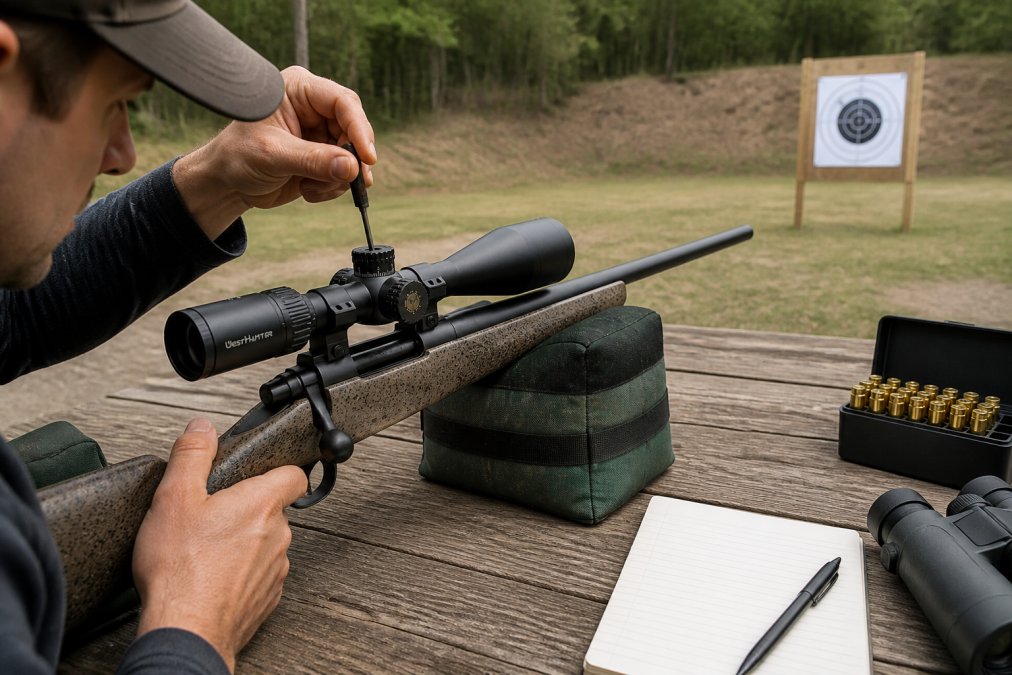
Once zeroed at 100 yards, move to 200 or 300 yards and verify your zero holds. If your group shifts, return to 100 yards and recheck your turret adjustments. After sighting in, fire a few more shots to confirm zero retention. Recoil can shift turrets on cheaper scopes.
Versatile Mid-Range Options: 4-16x and 6-24x Scopes
Most hunting happens between 100 and 300 yards. The 4-16x format balances field of view at lower magnification with enough zoom for accurate shots at distance. The 6-24x extends your range for open-country hunting where longer shots are common.
The 4-16X40 AOE Optics Hunting Riflescope delivers versatility without premium prices. The 40mm objective lens gathers enough light for dawn and dusk shooting, and the adjustable objective eliminates parallax error at extended ranges. Red and green illumination adapts to different backgrounds.

The 6-24x50 AO Rifle Scope pushes magnification higher for hunters who regularly shoot beyond 300 yards. The 50mm objective collects more light than a 40mm, which matters in low-light conditions. The glass-etched reticle won't shift under recoil.

What separates these mid-range options from budget alternatives is turret tracking. A quality scope returns to zero after you dial adjustments. Test this by dialing up 10 clicks, firing a shot, then dialing back 10 clicks and firing again. Your two shots should be in the same hole.
The 4-16X40 AOEG Rifle Scope sits in the middle of this range. It's professional-grade without the premium weight of first focal plane design.
Maintaining Rifle Optics in Extreme Weather
Rifle scopes fail in the field not from design flaws but from neglect. Dust, mud, salt spray, and temperature swings break scopes that weren't cleaned or protected. After every hunt, wipe down the exterior tubes and turrets with a dry cloth. If hunting in wet conditions, use a microfiber cloth to dry the objective and eyepiece lenses. Never touch the glass with bare fingers, skin oils etch coatings over time.
For stubborn dirt or salt residue, use lens cleaning solution designed for optics. Apply it to the cloth first, never directly to the glass. Wipe in circular motions from the center outward. Avoid paper towels, they're too abrasive.
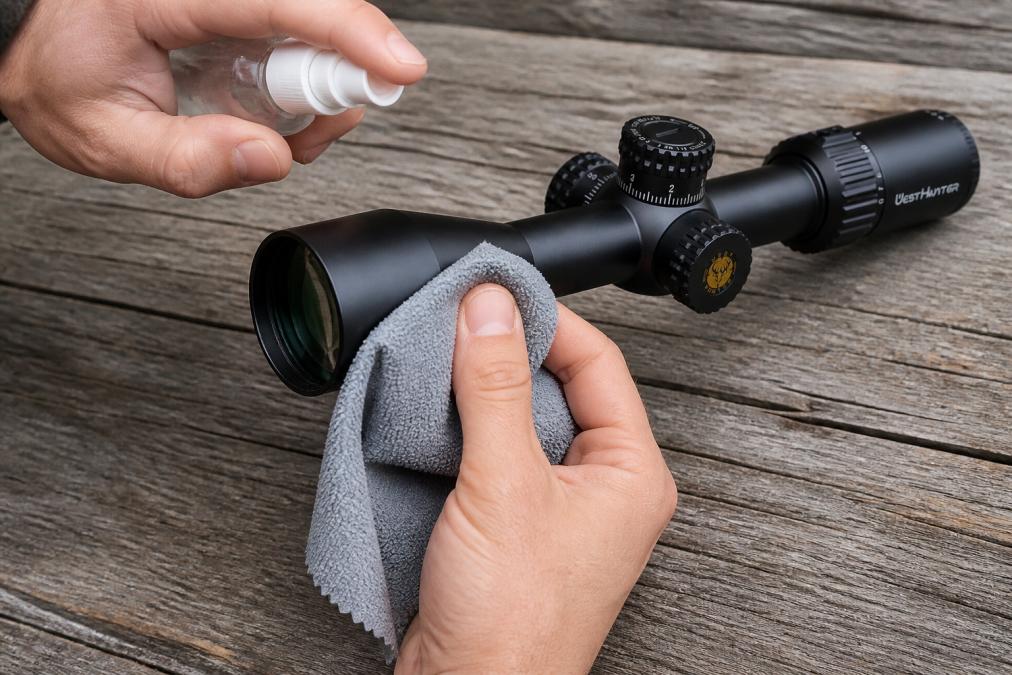
Check your turrets monthly. Grit inside the turret housing can jam the adjustment mechanism. If a turret feels rough or won't turn smoothly, don't force it, have the scope serviced.
Store your scoped rifle in a dry location. Humidity causes internal fogging when temperature swings occur. In extreme cold, avoid rapid temperature changes. Moving a scope from a warm truck into freezing air causes condensation inside the tube. Leave your rifle outside for 20 minutes before shooting to let the scope equalize to ambient temperature.
Key Features That Define Precision Hunting Scopes
First Focal Plane vs. Second Focal Plane: First focal plane scopes keep your reticle subtensions accurate at all magnification levels. Second focal plane scopes only show true subtensions at one specific magnification. For long-range hunting where you're using your reticle to range or calculate holdovers, first focal plane is worth the premium.
Turret Tracking and Repeatability: A scope with poor turret tracking won't return to the same point of impact when you dial adjustments. Test this by dialing 20 clicks up, firing, then dialing 20 clicks back down and firing again. Your two shots should be in the same hole.
Glass Clarity and Light Transmission: Multi-coated lenses deliver 95% light transmission compared to single-coated alternatives (peer-reviewed research). That difference is visible in low-light conditions when game is active.
Parallax Adjustment: Adjustable objective (AO) or side focus parallax eliminates parallax error. For precision hunting beyond 200 yards, parallax adjustment is essential.
Magnification Range: A 3-9x scope is lighter with a wider field of view than a 6-24x. If most hunting happens under 200 yards, 3-9x is plenty. A 4-16x or 6-24x makes sense if you regularly shoot beyond 300 yards.
Reticle Design: Glass-etched reticles won't shift under recoil. Illuminated reticles help in low-light conditions but require batteries. Mil-based reticles are standard for long-range hunting; MOA-based reticles are common in traditional hunting scopes.
Which Scope Should You Choose?
Start with your typical hunting distance. If most shots happen under 200 yards, the Riflescope 3-9x40 delivers accuracy without excess weight or complexity. Multi-layer coated lenses give you 95% light transmittance, and included mounts save money.
If you hunt varied terrain, the 4-16X40 AOE Optics or 4-16X40 AOEG offer versatility that handles 50 to 300 yards without compromise. The adjustable objective eliminates parallax error, and dual-color illumination adapts to any lighting.
If you regularly hunt beyond 300 yards or need to range game with your reticle, the 6-24x50 AO gives you magnification and light-gathering power. The 50mm objective is noticeably brighter than a 40mm at dawn and dusk.
For serious long-range precision hunters, the WestHunter HD GEN2 6-24X50 FFP is the clear choice. The 1/10 MIL adjustments deliver finer precision than standard turrets, and first focal plane design means your reticle holds true from 6x to 24x.
For hunters in low-light conditions or tactical applications, the DIANA 4-16x44 excels. The 44mm objective gathers more light than a 40mm, and the tactical reticle design handles challenging angles.
Consider bundled options. The Hunter's Optics Kit pairs a rifle scope with a 1600-yard rangefinder and 20x50 binoculars for complete optics coverage. Bundles save money and ensure complementary gear that works together.
What most hunters get wrong: they buy a premium scope and mount it on a cheap rifle or pair it with inadequate ammunition. A rifle scope is only as good as the rifle and ammunition that feed it. Invest in quality across all three, rifle, ammunition, and optics, and your accuracy will follow.
Conclusion
The best rifle scope brands for precision hunting deliver repeatable accuracy, hold zero under recoil, and perform in conditions where most optics fail. Whether you're shooting brush at 50 yards or open country at 400 yards, choosing the right scope magnification, reticle design, and glass quality determines whether you make the shot that matters.
At Leash the Wilderness, we've tested these scopes in real field conditions, mud, dust, temperature swings, and the kind of abuse that separates tools from toys. Every scope we carry has proven itself in the field. Start with your typical hunting distance, prioritize turret tracking and glass clarity, and invest in a scope that will earn your trust for years.
Frequently Asked Questions
Q: What features define a precision hunting rifle scope?
A: Precision hunting scopes combine several critical elements: first focal plane (FFP) or second focal plane (SFP) reticles with clear subtensions, magnification ranges suited to your hunting distance, objective lens diameters that maximize light transmission, and turret tracking that maintains zero after adjustment. Glass clarity, measured by light transmission and coatings, directly affects low-light performance. Durability features like nitrogen purging, waterproofing, and shockproof construction ensure your scope survives extreme weather and recoil without losing zero.
Q: How do I choose the right magnification for long-range hunting?
A: Magnification needs depend on typical shooting distance and game size. Close-range brush hunting (under 100 yards) works well with 3-9x scopes. Medium-range hunting (100-300 yards) benefits from 4-16x or 6-24x options. Extreme long-range precision (300+ yards) demands 6-24x or higher. Higher magnification helps with target acquisition and precision but narrows field of view and can be harder to use in moving-target situations. Consider your hunting terrain: open country supports higher magnification; thick cover favors lower magnification with wider field of view.
Q: Why is glass clarity critical for precision hunting in low light?
A: Light transmission determines how bright and sharp your image appears, especially during dawn and dusk when most game is active. Multi-coated lenses deliver 95% light transmittance compared to 85-90% for single-coated alternatives. This difference is dramatic in dim conditions, a clearer image means faster target identification and more confident shot placement. Glass coatings also reduce glare and internal reflections, improving contrast and edge sharpness. In extreme weather or fog, superior glass clarity becomes the difference between a clean shot and a missed opportunity.
Q: What makes a rifle scope rugged enough for extreme weather?
A: Weather-resistant scopes feature nitrogen purging to prevent internal fogging across temperature swings, waterproof sealing (IPX7 rating or better) to handle rain and moisture, and shockproof construction to survive recoil and field impacts. Aluminum alloy bodies withstand corrosion and physical abuse. Zero stop turrets prevent accidental adjustment shifts during transport. Durable glass coatings resist scratching and maintain optical clarity through sand, mud, and salt exposure.
Q: How do I properly mount a precision scope for accuracy?
A: Start with quality mounting rings matched to your scope tube diameter (typically 30mm or 1 inch). Position the scope so your eye naturally aligns with the exit pupil without head movement, this is proper eye relief. Use a torque wrench to tighten ring screws evenly (usually 20-25 inch-pounds) to prevent shifting. Ensure the reticle is level using a bubble level on the turret. After mounting, bore sight the scope roughly downrange, then verify zero at 25 yards before moving to your actual hunting distance. Always recheck zero after any impact or rough handling.
Ready to complete your hunting setup? The Hunter's Optics Kit combines a precision rifle scope with a 1600-yard rangefinder and quality binoculars, complete field coverage built for serious hunters. Order today and get field-tested optics shipped fast from the US with a 30-day return guarantee.
This article was written using GrandRanker