

Table of Contents
- Best Optics for Long Distance Hunting: Quick Comparison
- First Focal Plane vs. Second Focal Plane: What Matters for Long-Range Accuracy
- Long Range Hunting Scope Magnification: Finding Your Sweet Spot
- How to Use a Rangefinder for Hunting: Ballistic Calculator Integration
- Best Binoculars for Long Range Scouting: Complementing Your Scope Setup
- Critical Specs: Turret Adjustments, Reticle Design, and Glass Quality
- Weight, Durability, and Field Practicality
- Conclusion
Last Updated: August 9, 2026
Best Optics for Long Distance Hunting: Quick Comparison
Long-distance hunting demands optics that deliver precision at extreme ranges. Whether you're glassing terrain from a ridge or making a 500-yard shot, your scope and binoculars are as critical as your rifle. This guide breaks down what matters: magnification ranges, reticle systems, light transmission, and the specs that determine whether your shot connects or fails.
The comparison table below shows how the top optics stack up across critical performance metrics:
| Optic Type | Magnification | Objective Lens | Best Use Case | Key Advantage |
|---|---|---|---|---|
| First Focal Plane (FFP) Scope | 6-24x, 4.5-27x | 50mm, 56mm | Extreme long-range, PRS | Reticle scales with magnification |
| Second Focal Plane (SFP) Scope | 4-16x, 5-25x | 40mm, 50mm | General hunting, varied distances | Cleaner reticle, lighter weight |
| High-Magnification Scope | 7-35x, 4.8-35x | 56mm, 60mm | Open country, 800+ yards | Maximum light gathering, clarity |
| Hunting Binoculars | 10x, 12x | 42mm, 50mm | Scouting, glassing terrain | Portable, hands-free observation |
First Focal Plane vs. Second Focal Plane: What Matters for Long-Range Accuracy
First Focal Plane (FFP) reticles maintain consistent subtensions at every magnification level, meaning the reticle size relative to your target stays constant whether you're zoomed to 6x or 24x. Second Focal Plane (SFP) reticles only display accurate subtensions at one specific magnification, typically the maximum.
For long-distance hunting, this matters because it determines how you calculate holdovers. With an FFP scope, you can range a target and trust your reticle subtensions at any magnification. With an SFP scope, you must zoom to maximum magnification to use the reticle for ranging and holdover calculations. FFP scopes are faster for quick shots in variable terrain, while SFP scopes offer cleaner reticle designs and lighter weight.

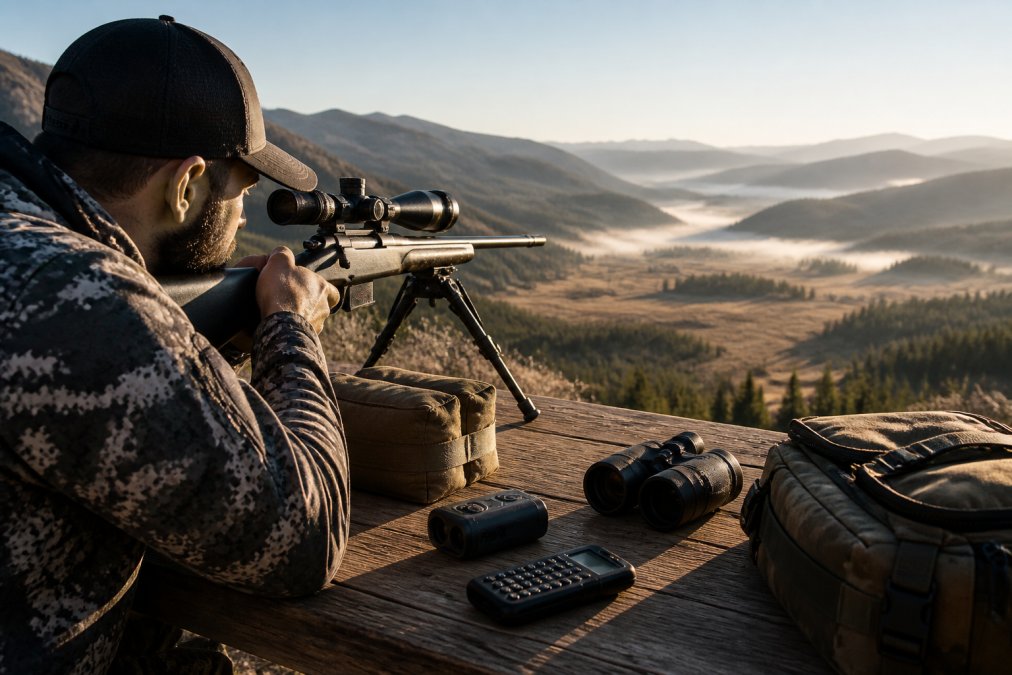
FFP scopes excel in open country where you're glassing at low magnification, then rapidly increasing magnification to make a shot. SFP scopes simplify the reticle design and often perform better in low-light conditions. For backcountry hunting under 400 yards, SFP is practical. For open-country hunting at 600+ yards, FFP removes a mental step during the critical moment.
Long Range Hunting Scope Magnification: Finding Your Sweet Spot
Magnification range determines what distances you can effectively hunt and how clearly you see your target. A 4-16x scope covers most hunting scenarios from 100 to 400 yards. A 6-24x scope extends that range to 600+ yards. A 7-35x or 4.8-35x scope reaches extreme distances but adds weight and narrows your field of view at low magnification.
For backcountry hunting where you're covering ground and making unpredictable shots, 4-16x provides the versatility you need. Low magnification (4x) gives you a wide field of view to locate animals. High magnification (16x) lets you verify vital zones before shooting. For open-country hunting where you glass extensively before shooting, 6-24x or higher magnification becomes valuable because you're already at the magnification needed for a precise shot when you find an animal.
The trade-off is real: each increase in maximum magnification adds weight and reduces the field of view at lower settings. A 7-35x scope with a 56mm objective lens weighs more than a 4-16x with a 40mm objective. In terrain where you're hiking miles between glassing points, that weight compounds.
How to Use a Rangefinder for Hunting: Ballistic Calculator Integration
A rangefinder alone doesn't guarantee accurate shots. The real power comes from pairing it with ballistic calculator integration, either built into your scope, loaded into a smartphone app, or written on a drop chart. The rangefinder measures distance. The ballistic calculator converts that distance into the exact holdover or turret adjustment needed for your specific rifle, ammunition, and environmental conditions.
Here's the workflow: You spot an animal at unknown distance. You range it. The rangefinder returns a number, say, 487 yards. You input that distance, your rifle's ballistic profile, and current conditions into a ballistic calculator. The calculator returns your holdover: "Hold 2.8 mils high" or "Dial 12 clicks up." You make that adjustment and shoot.
Without ballistic calculator integration, you're estimating holdover from memory or a printed chart, which introduces error. With integration, the math is outsourced to a tool that accounts for variables you might forget: air density at your elevation, temperature effects on powder burn, and the specific velocity of your ammunition lot.
The best binoculars for long range scouting often include rangefinding capability, which means you can glass terrain, identify a target, range it, and immediately know the distance without switching equipment.
Best Binoculars for Long Range Scouting: Complementing Your Scope Setup
Binoculars serve a different role than your rifle scope. While your scope is designed for precision aiming at a known target, binoculars are for glassing, scanning terrain, locating animals, and assessing distance and wind before you commit to a stalk. The best binoculars for long range scouting have high magnification (10x or 12x), large objective lenses (42mm or 50mm), and excellent light transmission for low-light conditions like dawn and dusk.
A 10x42 binocular has 10x magnification with a 42mm objective lens and an exit pupil of 4.2mm. A 12x50 binocular has a 4.2mm exit pupil as well, but the larger objective lens gathers more total light, making the image brighter in dim conditions. For backcountry hunting where weight matters, 10x42 is the practical standard. For open-country hunting from a glassing point, 12x50 or 15x56 provides superior magnification and light-gathering power.
Weight-to-magnification ratio matters. A 10x42 binocular weighs around 20-24 ounces. A 15x56 can exceed 35 ounces. If you're carrying binoculars for miles, the lighter option is tempting. If you're glassing from a ridge with a tripod, the heavier binocular's superior magnification pays dividends.
The Deer Scouting Kit includes binoculars paired with a rangefinder and trail camera for comprehensive terrain assessment. This bundled approach ensures all components are tested together and optimized for the same performance standard.
Critical Specs: Turret Adjustments, Reticle Design, and Glass Quality
Three technical specifications separate scopes that hold zero under recoil from scopes that drift: turret adjustments, reticle subtensions, and light transmission.
Turret Adjustments and Tracking Accuracy
Turret adjustments determine how precisely you dial elevation and windage corrections. A scope with 1/4 MOA (minute of angle) click adjustments means each click moves your point of impact 0.25 inches at 100 yards. A scope with 1/10 MIL (milliradian) adjustments means each click moves impact about 0.36 inches at 100 yards. MOA is more common in hunting scopes; MIL is preferred in precision rifle sports.
What matters more than the unit system is tracking accuracy, whether the turret actually moves the reticle the amount it claims. Quality scopes track reliably across their entire adjustment range. Budget scopes often have acceptable tracking at low adjustments but drift at extreme elevation or windage corrections.
Zero stop is a feature that lets you return to your rifle's zero by rotating the elevation turret until it stops, eliminating the need to count clicks. This is genuinely useful for hunting because if you dial for distance and miss, you can instantly return to zero without worrying about whether you've turned the turret the correct number of times.
Reticle Subtensions and MOA vs. MRAD Systems
Reticle subtensions are the fine lines and hash marks in your reticle that allow ranging and holdover calculations. A reticle with clear subtensions lets you measure the angle between your crosshair and a known-size target to estimate distance. It also lets you hold over the target to compensate for bullet drop without adjusting turrets.
MOA subtensions are based on the minute of angle system: 1 MOA equals 1.047 inches at 100 yards. MRAD subtensions use the metric radian system: 1 MIL equals 3.6 inches at 100 yards. For hunting, either system works if you understand it. The critical point: choose a reticle design that matches your ballistic calculator.
Light Transmission and Low-Light Performance
Light transmission is the percentage of light that passes through the scope's optical system. A scope with 92% light transmission loses 8% of available light. A scope with 85% transmission loses 15%. In bright daylight, this difference is imperceptible. At dawn and dusk, when hunting is most productive, the difference can mean the difference between seeing a vital zone clearly and seeing a dark blur.
Multi-coated lenses improve light transmission. Fully multi-coated lenses are better. Fully multi-coated with ED (extra-low dispersion) glass is better still because ED glass reduces chromatic aberration, color fringing that reduces clarity.
Nitrogen purging is a manufacturing process that fills the scope's internal tube with inert nitrogen gas, preventing internal fogging when temperature changes. This is standard on quality hunting scopes but absent on budget models.
Weight, Durability, and Field Practicality
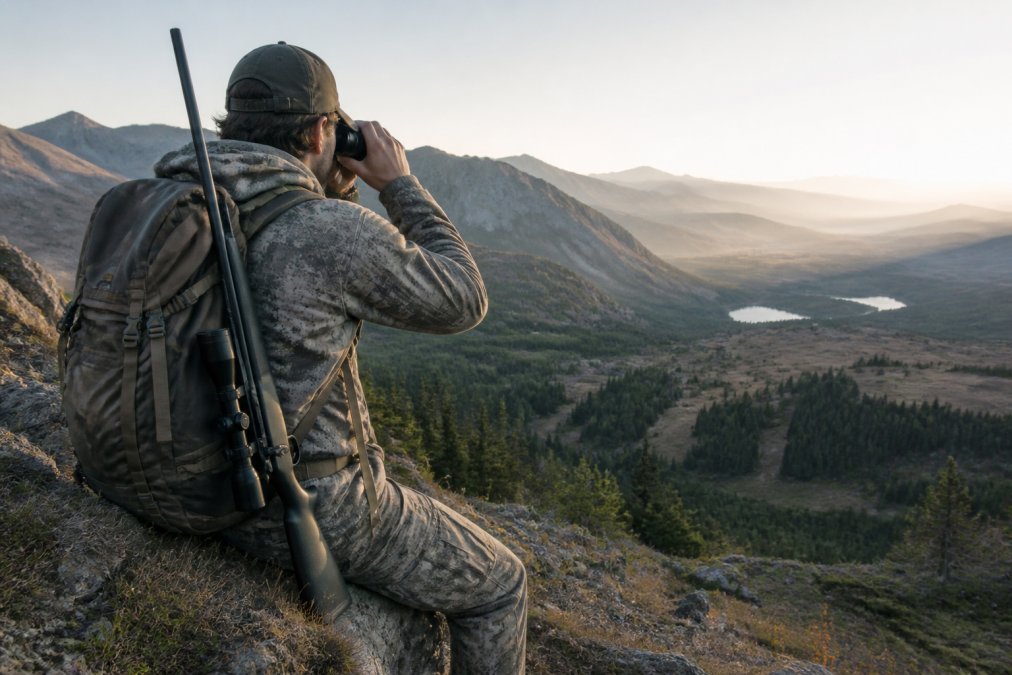
Scope weight compounds over a day of hunting. A light 4-16x40 scope weighs around 14 ounces. A heavy 7-35x56 scope can exceed 32 ounces. For backcountry hunting, weight-to-performance ratio is critical. A 4-16x40 scope with solid optics beats a heavier 6-24x50 if you're hiking miles between glassing points.

Durability in field conditions means the scope survives impacts, temperature extremes, and moisture without losing zero. Scopes with one-piece 34mm tubes are more rigid than scopes with 30mm tubes because the larger diameter resists flex under recoil. Shockproof construction means a quality scope can be dropped from waist height onto rock without losing zero.
Waterproof and fog-proof performance is standard on quality hunting scopes. A truly waterproof scope is sealed with O-rings and can be fully submerged without leaking.
The Backcountry Power Kit pairs optics with a rangefinder and night vision capability, designed specifically for hunters who need reliability in extreme conditions. This bundled approach ensures all components are tested together and optimized for the same performance standard.
Conclusion
The best optics for long distance hunting match your terrain, engagement distance, and hunting style. FFP scopes excel in open country where you're making precision shots at extreme range. SFP scopes are lighter and simpler for hunters who prioritize mobility. High-magnification scopes deliver the clarity and light-gathering power needed for 800+ yard shots. Binoculars with 10x-12x magnification and 42mm-50mm objectives let you glass terrain and locate animals before your scope comes into play. Turret adjustments, reticle subtensions, and light transmission are the technical specs that separate optics that perform from optics that disappoint in the field.
Leash the Wilderness stocks field-tested optics and bundled kits designed for serious hunters who demand reliability. Pair quality optics with rangefinder integration and quality binoculars to get the precision and light transmission needed for long-distance shots in real hunting conditions. Hunt with confidence at distances where precision matters most.
Frequently Asked Questions
What is the best magnification for long-range hunting?
For most long-distance hunting scenarios, 4x to 16x magnification covers 95% of shots. Lower magnification (4x-8x) works for open country under 300 yards; mid-range (8x-16x) handles 300-600 yards effectively. Beyond 600 yards, scopes with 20x-30x magnification give you the clarity needed for precise shot placement. The sweet spot for backcountry hunters is 4-16x or 6-24x, balancing weight and versatility.
Should I choose First Focal Plane or Second Focal Plane for long-range hunting?
First Focal Plane (FFP) reticles stay proportional at any magnification, making them superior for long-range work where you're constantly adjusting magnification. Second Focal Plane (SFP) reticles only work accurately at a specific magnification (usually marked on the scope). For dedicated long-distance hunting where precision matters, FFP is worth the cost. SFP is fine if you hunt at fixed distances or primarily use one magnification setting.
How do I know if a scope will hold zero after heavy recoil?
Look for scopes with a solid one-piece aluminum tube, sealed turrets, and a zero stop mechanism. Brands using nitrogen-purged, waterproof construction (like those in the Leash the Wilderness catalog) are engineered to maintain zero through repeated firing. Check for independent testing data, scopes rated for tactical or competitive use typically exceed hunting durability. If you're buying from Leash the Wilderness, every scope is field-tested for reliability in real conditions.
Do I need a separate rangefinder if my scope has ballistic adjustments?
Yes. Even scopes with built-in ballistic turrets require a rangefinder to know the exact distance to your target. Modern rangefinders paired with ballistic calculators remove guesswork, you get the range, input it, and the calculator tells you the exact hold or turret adjustment. This integration is faster and more accurate than relying solely on reticle holdovers, especially beyond 500 yards where wind and bullet drop compound errors.
This article was written using GrandRanker